
Visto un uccello? Identificalo all'istante con l'app Birdby
Apri l'appInformazioni
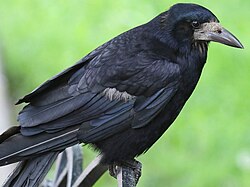
The Rook (Corvus frugilegus) is a highly social, intelligent passerine bird belonging to the crow family. It is characterized by its glossy black plumage, distinctive pale greyish-white bare skin around the base of the adult bill, and a shaggy 'trousers' of feathers on its legs. Rooks are well-known for their communal nesting colonies, called rookeries, and their foraging behavior in open agricultural landscapes.
Dimensioni e longevità
- Lunghezza
- 45-47 cm
- Apertura alare
- 81-99 cm
- Peso
- 325-570 g
- Longevità
- Up to 20 years in the wild, typically 6-10 years
- Dieta
- Omnivore, primarily invertebrates (especially earthworms, insect larvae), seeds, grains, fruits, carrion, and occasionally small vertebrates.
Caratteristiche fisiche
- Piumaggio
- Entirely glossy black, often with a purplish-blue sheen in good light. Feathers on the head, neck, and body are dense and sleek.
- Forma del becco
- Long, pointed, and slightly downcurved. In adults, the base of the bill is covered by distinctive pale greyish-white bare skin, which extends to the gape and chin. The bill itself is black.
- Colore degli occhi
- Dark brown
- Colore delle zampe
- Black
- Caratteristiche distintive
- The most distinctive feature of an adult Rook is the bare, pale greyish-white skin at the base of its bill, which is absent in other similar black corvids. They also have a characteristic shaggy appearance around their legs, often described as 'trousers'.
- Aspetto giovanile
- Juvenile Rooks lack the bare facial patch of adults; their bill base is feathered black, similar to a Carrion Crow. The bare patch develops during their first winter. Their plumage may appear duller and less glossy than adults.
- Cambiamenti stagionali
- No significant seasonal plumage changes. The bare facial patch develops in juveniles during their first winter.
- Dimorfismo sessuale
- Minimal to none; sexes are outwardly similar in plumage and size, though males may be slightly larger on average.
Come identificare
- 1
Bill Base
Look for the distinctive bare, pale greyish-white skin at the base of the bill in adult birds. This is the most crucial field mark.
- 2
Leg Feathers
Observe the 'shaggy trousers' appearance of feathers around the upper legs, which is more pronounced than in other corvids.
- 3
Head Shape
Note the relatively pointed head shape compared to the more rounded head of a Carrion Crow.
- 4
Social Behavior
Rooks are almost always seen in flocks, often large ones, especially when foraging or flying to roosts. Solitary black corvids are more likely to be Carrion Crows.
- 5
Vocalization
Listen for their characteristic harsh, often repeated 'kaaah' calls, which are distinct from the deeper 'caw' of a Carrion Crow or the 'cronk' of a Raven.
- 6
Habitat
Rooks strongly prefer open agricultural land and parkland, often near human habitation, especially where large trees are available for nesting.
Habitat e areale
- Biomi
- Temperate grasslands, agricultural lands, open woodlands, parks, and urban areas.
- Areale geografico
- Widespread across temperate Eurasia, from the British Isles and Western Europe eastward through Central Asia to eastern Siberia and northern China. Absent from the Iberian Peninsula, southern France, Italy (except for a few scattered populations), and Greece.
- Fascia altitudinale
- Typically found in lowlands and foothills, generally below 1,000 meters, but can occur higher in some parts of its range.
- Ambienti preferiti
- Prefers open country with scattered trees, particularly agricultural land, pastures, and parkland, where it can forage for food and find suitable trees for nesting in colonies.
Comportamento
- Periodo di attività
- Diurnal
- Abitudini alimentari
- Forages primarily on the ground, often in large flocks. Uses its strong bill to probe the soil for invertebrates, especially earthworms and grubs. Also consumes seeds, grains, fallen fruit, and carrion. Known to cache food.
- Comportamento sociale
- Highly gregarious, forming large flocks outside the breeding season and nesting in dense colonies (rookeries) during breeding. They exhibit complex social interactions and cooperative behaviors.
- Tipo di volo
- Strong, direct flight with steady wingbeats. Often glides on outstretched wings. Flies in large, often noisy, flocks to and from communal roosts and feeding grounds.
- Migrazione
- Partially migratory. Northern and eastern populations are migratory, moving south and west for the winter. Western and southern populations are largely resident, though some local movements occur.
- Territorialità
- Colonial nesters, with individual pairs defending a small territory immediately around their nest within the rookery. Feeding territories are generally not defended, as they forage communally.
Canto e richiami
- Canto
- Rooks do not have a complex song. Their vocalizations are primarily calls.
- Richiamo
- The most common call is a harsh, often repeated 'kaaah' or 'kraaah', which can vary in pitch and intensity depending on context. They also produce softer 'caw' notes, gurgles, and clicks, especially within the rookery or during social interactions. Calls are generally less resonant and more 'throaty' than those of a Carrion Crow.
- Quando vocalizza
- Vocalize year-round, but particularly noisy during the breeding season within rookeries and when gathering in large flocks at roosts or feeding sites.
Riproduzione
- Stagione riproduttiva
- Typically February to May, with peak egg-laying in March-April.
- Abitudini di nidificazione
- Nests colonially in large rookeries, often in the tops of tall trees (deciduous or coniferous). Nests are bulky structures made of sticks, lined with grass, moss, wool, and other soft materials. Rookeries can contain hundreds or even thousands of nests.
- Dimensione della covata
- 3-5 eggs
- Descrizione dell'uovo
- 3-5 (occasionally 2-7) eggs, pale blue-green to olive-green, heavily spotted and blotched with dark brown, olive, or grey. Average size is about 40 x 29 mm.
- Periodo di incubazione
- 16-18 days, primarily by the female.
- Periodo di involo
- 30-35 days after hatching. Young remain dependent on parents for some time after fledging.
- Cure parentali
- Both parents participate in feeding the young, though the female does most of the incubation. Young are fed regurgitated food.
Dove trovarlo
Agricultural Fields
Look for large flocks foraging in freshly ploughed fields, pastures, and stubble fields, especially in winter.
Parkland and Large Gardens
Areas with scattered mature trees provide ideal nesting and roosting sites.
Roadsides and Verges
Often seen foraging along roadsides for invertebrates disturbed by traffic.
Rookeries
During the breeding season (late winter to spring), locate large colonies of nests high in trees. These are often very noisy and conspicuous.
Consigli sul campo
- Scan Flocks. When observing a flock of black corvids, focus on individual birds to check for the bare bill base. This is easiest with a telescope or binoculars.
- Listen for Calls. Familiarize yourself with the distinct 'kaaah' call of the Rook, which can help differentiate it from other corvids even before visual confirmation.
- Observe Behavior. Rooks are highly social. If you see a large group of black birds foraging together or flying in formation, they are very likely Rooks.
- Timing. Rookeries are most active and noisy during the early spring when breeding is underway. Winter months see large feeding and roosting flocks.
Specie simili
Carrion Crow
Corvus corone
The most reliable distinction for an adult Rook is the bare, pale greyish-white skin at the base of its bill, which is feathered black in the Carrion Crow. Rooks also have a more pointed head shape and a shaggier 'trousers' of feathers on their legs. Their calls are generally harsher and less resonant than the Carrion Crow's 'caw-caw'.
Jackdaw
Corvus monedula
Jackdaws are significantly smaller than Rooks (33-34 cm vs 45-47 cm). They have distinctive pale grey eyes and a grey nape, contrasting with their black body plumage. Rooks are entirely black with dark eyes.
Raven
Corvus corax
Ravens are much larger (up to 67 cm) and have a much heavier, more powerful bill. They have a shaggy throat plumage (hackles) and a wedge-shaped tail in flight, whereas the Rook's tail is fan-shaped. Ravens typically occur singly or in pairs, not in large flocks like Rooks. Their call is a deep, resonant 'cronk'.
Fatti rapidi
- Sociality:
- Highly gregarious, forming large flocks and colonial rookeries.
- Dietary Flexibility:
- Opportunistic omnivore, adapting diet to seasonal availability.
- Tool Use:
- Known to use and modify tools in captivity, demonstrating high intelligence.
- Bare Facial Patch:
- Unique identifying feature in adults, distinguishing it from other black corvids.
- Ecological Role:
- Important in seed dispersal and pest control in agricultural areas.
Curiosità
- Rooks are one of the few bird species known to use tools in the wild, though less frequently observed than in captivity. They have been seen using sticks to extract grubs.
- The term 'rookery' specifically refers to a colony of Rooks, highlighting their unique communal nesting behavior.
- Despite their common name 'Gracchio comune' in Italian, which translates to 'Common Chough', the Rook is not a Chough (genus Pyrrhocorax) but a true crow (genus Corvus). This is a common misnomer in some regions.
- Rooks have been observed playing, such as dropping objects and catching them in mid-air, or sliding down snowy roofs.
- Their intelligence is comparable to that of chimpanzees in some cognitive tasks, such as problem-solving and understanding cause and effect.
Classificazione scientifica
- Regno
- Animalia
- Phylum
- Chordata
- Classe
- Aves
- Ordine
- Passeriformes
- Famiglia
- Corvidae
- Genere
- Corvus
- Specie
- Corvus frugilegus
Esplora Rook
Identifica uccelli ovunque
Gratis su iOS, Android e Web. Identificazione per foto e suono, database completo e la tua lista personale.