
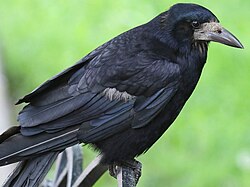
Come identificare Rook
Corvus frugilegus
Visto un uccello? Identificalo all'istante con l'app Birdby
Apri l'appPer identificare correttamente Rook (Corvus frugilegus), controlla ciascuna di queste caratteristiche. Gli uccelli possono essere complicati da riconoscere, perché comportamento, habitat e canto spesso confermano ciò che una sola foto non può.
Dimensioni a colpo d'occhio
- Lunghezza
- 45-47 cm
- Apertura alare
- 81-99 cm
- Peso
- 325-570 g
Caratteristiche fisiche da controllare
- 1
Piumaggio
Colorazione e disegno generale del piumaggio.
Entirely glossy black, often with a purplish-blue sheen in good light. Feathers on the head, neck, and body are dense and sleek.
- 2
Forma del becco
Forma e colore del becco, un segno di campo chiave.
Long, pointed, and slightly downcurved. In adults, the base of the bill is covered by distinctive pale greyish-white bare skin, which extends to the gape and chin. The bill itself is black.
- 3
Colore degli occhi
Colore dell'iride e segni distintivi sugli occhi.
Dark brown
- 4
Colore delle zampe
Colore di zampe e piedi.
Black
- 5
Caratteristiche distintive
Tratti distintivi che separano questa specie.
The most distinctive feature of an adult Rook is the bare, pale greyish-white skin at the base of its bill, which is absent in other similar black corvids. They also have a characteristic shaggy appearance around their legs, often described as 'trousers'.
- 6
Aspetto giovanile
Come i giovani si differenziano dagli adulti.
Juvenile Rooks lack the bare facial patch of adults; their bill base is feathered black, similar to a Carrion Crow. The bare patch develops during their first winter. Their plumage may appear duller and less glossy than adults.
- 7
Cambiamenti stagionali
Variazione del piumaggio tra stagione riproduttiva e non.
No significant seasonal plumage changes. The bare facial patch develops in juveniles during their first winter.
- 8
Dimorfismo sessuale
Differenze tra maschi e femmine.
Minimal to none; sexes are outwardly similar in plumage and size, though males may be slightly larger on average.
Segni di campo chiave
- Bill Base. Look for the distinctive bare, pale greyish-white skin at the base of the bill in adult birds. This is the most crucial field mark.
- Leg Feathers. Observe the 'shaggy trousers' appearance of feathers around the upper legs, which is more pronounced than in other corvids.
- Head Shape. Note the relatively pointed head shape compared to the more rounded head of a Carrion Crow.
- Social Behavior. Rooks are almost always seen in flocks, often large ones, especially when foraging or flying to roosts. Solitary black corvids are more likely to be Carrion Crows.
- Vocalization. Listen for their characteristic harsh, often repeated 'kaaah' calls, which are distinct from the deeper 'caw' of a Carrion Crow or the 'cronk' of a Raven.
- Habitat. Rooks strongly prefer open agricultural land and parkland, often near human habitation, especially where large trees are available for nesting.
Esplora Rook
Identifica uccelli ovunque
Gratis su iOS, Android e Web. Identificazione per foto e suono, database completo e la tua lista personale.