
Visto un uccello? Identificalo all'istante con l'app Birdby
Apri l'appInformazioni
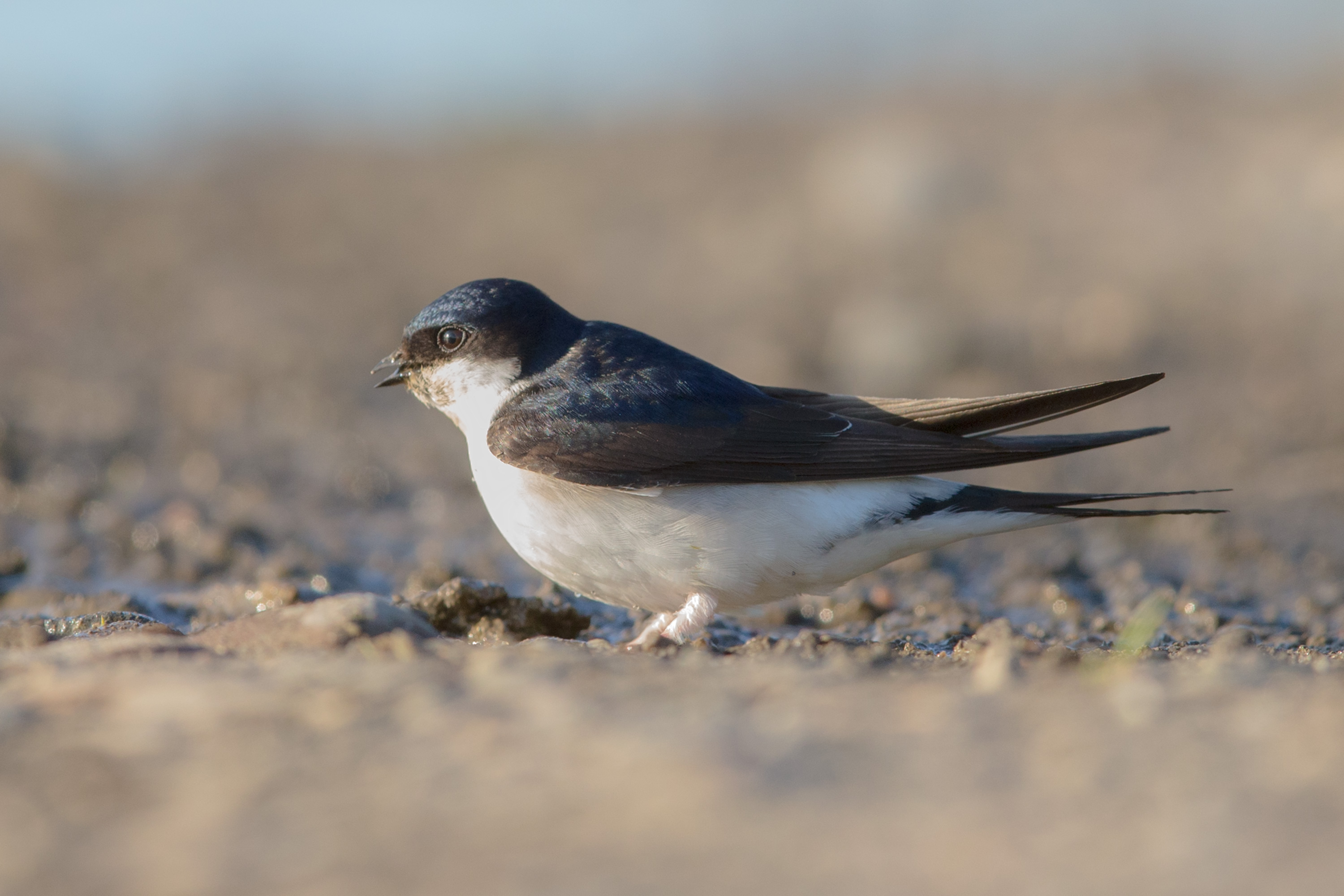
The Common House Martin, known in Italian as Balestruccio, is a small passerine bird in the swallow family. It is a highly aerial insectivore, recognized by its distinctive glossy blue-black upperparts, pure white underparts, and a prominent white rump. It is a migratory species, breeding across the Palearctic and wintering in sub-Saharan Africa and tropical Asia.
Dimensioni e longevità
- Lunghezza
- 13-15 cm
- Apertura alare
- 26-29 cm
- Peso
- 15-22 g
- Longevità
- Average 2-5 years, up to 10 years recorded
- Dieta
- Insectivore
Caratteristiche fisiche
- Piumaggio
- Adults have glossy blue-black upperparts, including the head, back, and wings. The underparts are pure white, extending to a very conspicuous white rump. The tail is forked but less deeply than that of the Barn Swallow, and lacks streamers. The legs are covered in small white feathers.
- Forma del becco
- Small, flattened, and broad at the base, adapted for catching insects in flight. Black in color.
- Colore degli occhi
- Dark brown.
- Colore delle zampe
- Pinkish-black, covered in small white feathers (tarsi and toes).
- Caratteristiche distintive
- Key features include the pure white rump, entirely white underparts, and feathered legs. Its flight is often described as more fluttering and less graceful than the Barn Swallow.
- Aspetto giovanile
- Juveniles are duller than adults, with sooty-brown upperparts instead of glossy blue-black. The white underparts may be tinged brownish, and the white rump is less bright. The feathers on the legs are less developed.
- Cambiamenti stagionali
- No significant seasonal plumage changes. The glossy blue-black upperparts may appear duller due to feather wear towards the end of the breeding season.
- Dimorfismo sessuale
- Males and females are virtually identical in plumage and size.
Come identificare
- 1
Rump Color
Look for the striking, pure white rump, which contrasts sharply with the dark back. This is the most reliable field mark.
- 2
Underparts Color
Observe the entirely pure white underparts, from chin to undertail coverts, without any streaking or rufous coloration.
- 3
Upperparts Gloss
Note the glossy blue-black upperparts, which can appear iridescent in good light.
- 4
Tail Shape
Check the tail, which is forked but relatively short and lacks the long streamers of the Barn Swallow.
- 5
Legs
If close enough, observe the small white feathers covering the legs, a unique feature among European swallows.
- 6
Flight Style
Its flight is often described as more 'fluttering' and less sweeping than the Barn Swallow, often flying higher and in tighter circles.
- 7
Nesting Sites
Look for mud nests attached to the outside walls of buildings, under eaves, or on bridges, often in colonies.
Habitat e areale
- Biomi
- Temperate grasslands, open woodlands, agricultural areas, urban and suburban environments.
- Areale geografico
- Breeds across most of Europe, temperate Asia, and North Africa. Winters in sub-Saharan Africa and tropical Asia.
- Fascia altitudinale
- From sea level up to 2,000 meters, occasionally higher in mountainous regions.
- Ambienti preferiti
- Prefers open country with access to water and suitable nesting sites, typically man-made structures like buildings, bridges, and cliffs. Often found in villages, towns, and cities.
Comportamento
- Periodo di attività
- Diurnal.
- Abitudini alimentari
- Feeds exclusively on flying insects, primarily small flies (Diptera), aphids (Aphididae), and small beetles (Coleoptera). It forages high in the air, often over water or open fields, catching prey on the wing with its wide gape.
- Comportamento sociale
- Highly social, especially during breeding and migration. Breeds in colonies, sometimes numbering hundreds of pairs. Roosts communally in large numbers, often in reedbeds or on buildings, outside the breeding season.
- Tipo di volo
- Characterized by rapid, agile, and often erratic flight, with frequent glides. It flies higher than the Barn Swallow and often in tighter circles. Its flight appears more 'fluttering' due to its shorter, broader wings.
- Migrazione
- A long-distance migratory species. European populations migrate south to sub-Saharan Africa, while Asian populations winter in tropical Asia. Migration occurs in broad fronts, often in large flocks, typically from late August to October and returning from March to May.
- Territorialità
- Colonial breeder, defending only the immediate vicinity of the nest. Foraging areas are shared.
Canto e richiami
- Canto
- A soft, warbling, chattering song, often delivered from the nest or a perch. It is less melodious and more disjointed than the Barn Swallow's song, consisting of a series of short, twittering notes and trills.
- Richiamo
- Common calls include a short, sharp 'chip' or 'chrip', often given in flight or as an alarm call. Also a softer 'prrrrt' contact call.
- Quando vocalizza
- Most vocal during the breeding season, especially around the colony and nest sites. Calls are frequent during foraging and migration.
Riproduzione
- Stagione riproduttiva
- Typically May to August in Europe, with two or sometimes three broods.
- Abitudini di nidificazione
- Builds a distinctive enclosed, cup-shaped nest of mud pellets, lined with grass and feathers. Nests are typically attached to vertical surfaces under eaves, ledges, bridges, or cliffs, often in colonies. Both sexes participate in nest building.
- Dimensione della covata
- 3-7 eggs, most commonly 4-5.
- Descrizione dell'uovo
- Usually 4-5 (range 3-7) pure white, unmarked, slightly glossy eggs.
- Periodo di incubazione
- 13-16 days, primarily by the female, but both parents may share duties.
- Periodo di involo
- 22-32 days after hatching. Young are fed by both parents.
- Cure parentali
- Both parents feed and care for the young. After fledging, young birds are still fed by parents for a short period and often return to the nest to roost.
Dove trovarlo
Urban and Suburban Areas
Commonly found in towns, villages, and cities where buildings provide suitable nesting sites under eaves and ledges.
Agricultural Land
Forages over farmland, meadows, and pastures, especially near water bodies, where insect prey is abundant.
Coastal Cliffs and Bridges
In natural settings, they will nest on cliffs, particularly coastal ones, and frequently under bridges over rivers or motorways.
Open Countryside
During migration, they can be seen almost anywhere over open country, often in large flocks.
Consigli sul campo
- Look Up. House Martins typically forage higher in the air than Barn Swallows. Scan the skies above buildings and open fields.
- Check Buildings. During the breeding season, look for their distinctive mud nests under the eaves of houses, barns, and other structures. The birds will be flying in and out.
- Observe Flight. Their flight is often more erratic and 'fluttery' compared to the more graceful, sweeping flight of the Barn Swallow. Look for rapid turns and glides.
- Listen for Calls. Their 'chip' or 'chrip' calls are distinctive and often given in flight, helping to locate them.
- Migration Hotspots. During spring and autumn migration, large flocks can be observed at coastal watchpoints or over large bodies of water.
Specie simili
Barn Swallow
Hirundo rustica
The Barn Swallow has a dark rufous throat and forehead, a deeply forked tail with long streamers, and lacks a white rump. Its underparts are buffy-white, not pure white. Its flight is more graceful and sweeping.
Sand Martin (Bank Swallow)
Riparia riparia
The Sand Martin is smaller and duller brown above, with a distinct brown breast band and white underparts. It lacks the glossy blue-black upperparts and white rump of the House Martin. It nests in burrows in sand banks.
Red-rumped Swallow
Cecropis daurica
The Red-rumped Swallow has a rufous rump (not white), a dark throat, and a longer, more deeply forked tail with streamers. Its underparts are buffy with dark streaking.
Fatti rapidi
- Distinguishing Mark:
- Pure white rump
- Nesting Material:
- Mud pellets
- Diet:
- Exclusively flying insects
- Sociality:
- Highly colonial breeder
- Migration:
- Long-distance migrant to Africa/Asia
Curiosità
- House Martins often reuse their mud nests year after year, repairing them as needed. They may also take over old Barn Swallow nests.
- The white feathers on their legs are thought to help keep the nest clean by preventing mud from sticking to their feet during nest construction.
- They are highly dependent on human structures for nesting, making them a common sight in populated areas across their range.
- A single House Martin can consume thousands of insects per day, playing a significant role in pest control.
- Despite their small size, they undertake epic migrations, covering thousands of kilometers between their breeding and wintering grounds.
Classificazione scientifica
- Regno
- Animalia
- Phylum
- Chordata
- Classe
- Aves
- Ordine
- Passeriformes
- Famiglia
- Hirundinidae
- Genere
- Delichon
- Specie
- Delichon urbicum
Esplora Common House Martin
Identifica uccelli ovunque
Gratis su iOS, Android e Web. Identificazione per foto e suono, database completo e la tua lista personale.