
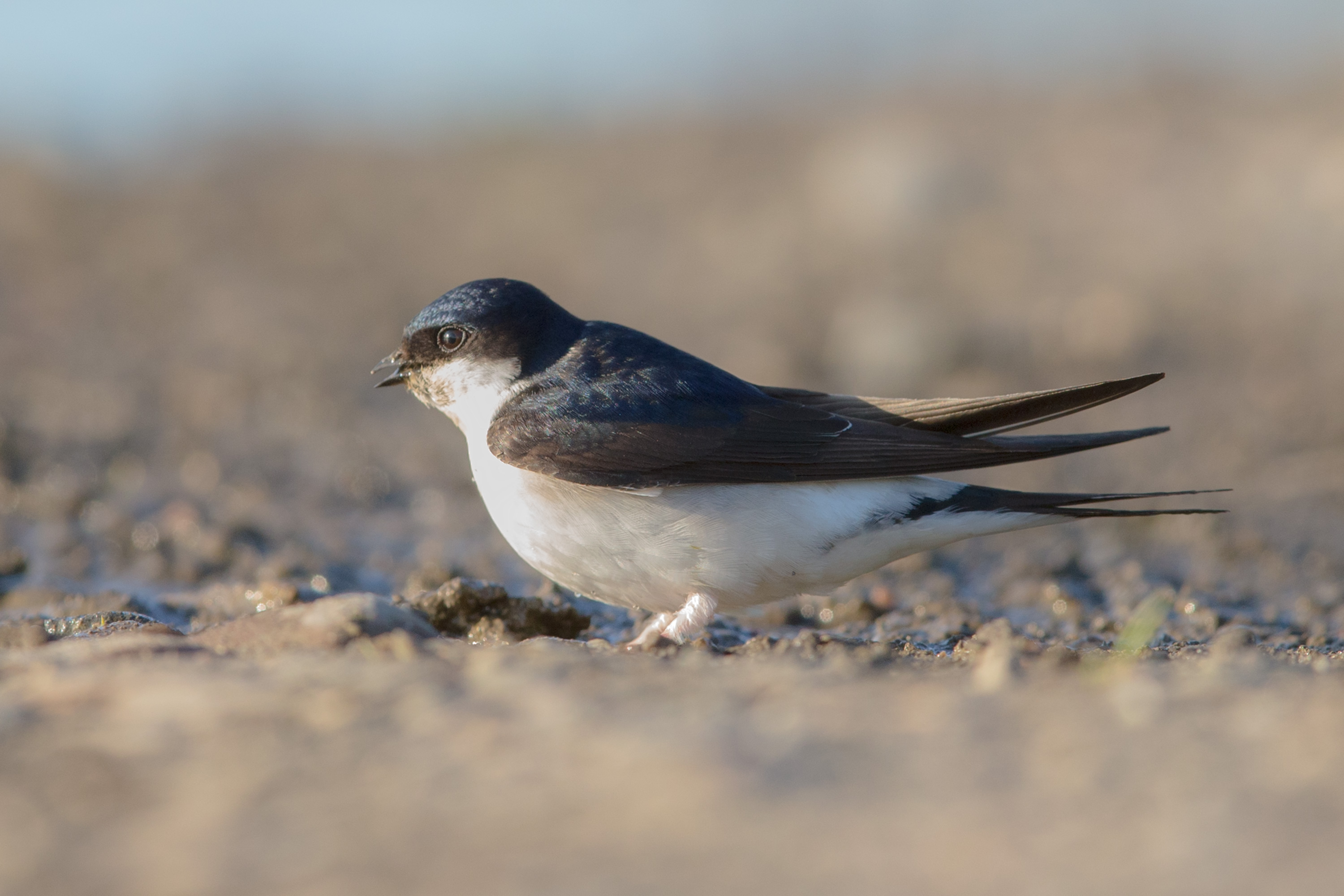
Come identificare Common House Martin
Delichon urbicum
Visto un uccello? Identificalo all'istante con l'app Birdby
Apri l'appPer identificare correttamente Common House Martin (Delichon urbicum), controlla ciascuna di queste caratteristiche. Gli uccelli possono essere complicati da riconoscere, perché comportamento, habitat e canto spesso confermano ciò che una sola foto non può.
Dimensioni a colpo d'occhio
- Lunghezza
- 13-15 cm
- Apertura alare
- 26-29 cm
- Peso
- 15-22 g
Caratteristiche fisiche da controllare
- 1
Piumaggio
Colorazione e disegno generale del piumaggio.
Adults have glossy blue-black upperparts, including the head, back, and wings. The underparts are pure white, extending to a very conspicuous white rump. The tail is forked but less deeply than that of the Barn Swallow, and lacks streamers. The legs are covered in small white feathers.
- 2
Forma del becco
Forma e colore del becco, un segno di campo chiave.
Small, flattened, and broad at the base, adapted for catching insects in flight. Black in color.
- 3
Colore degli occhi
Colore dell'iride e segni distintivi sugli occhi.
Dark brown.
- 4
Colore delle zampe
Colore di zampe e piedi.
Pinkish-black, covered in small white feathers (tarsi and toes).
- 5
Caratteristiche distintive
Tratti distintivi che separano questa specie.
Key features include the pure white rump, entirely white underparts, and feathered legs. Its flight is often described as more fluttering and less graceful than the Barn Swallow.
- 6
Aspetto giovanile
Come i giovani si differenziano dagli adulti.
Juveniles are duller than adults, with sooty-brown upperparts instead of glossy blue-black. The white underparts may be tinged brownish, and the white rump is less bright. The feathers on the legs are less developed.
- 7
Cambiamenti stagionali
Variazione del piumaggio tra stagione riproduttiva e non.
No significant seasonal plumage changes. The glossy blue-black upperparts may appear duller due to feather wear towards the end of the breeding season.
- 8
Dimorfismo sessuale
Differenze tra maschi e femmine.
Males and females are virtually identical in plumage and size.
Segni di campo chiave
- Rump Color. Look for the striking, pure white rump, which contrasts sharply with the dark back. This is the most reliable field mark.
- Underparts Color. Observe the entirely pure white underparts, from chin to undertail coverts, without any streaking or rufous coloration.
- Upperparts Gloss. Note the glossy blue-black upperparts, which can appear iridescent in good light.
- Tail Shape. Check the tail, which is forked but relatively short and lacks the long streamers of the Barn Swallow.
- Legs. If close enough, observe the small white feathers covering the legs, a unique feature among European swallows.
- Flight Style. Its flight is often described as more 'fluttering' and less sweeping than the Barn Swallow, often flying higher and in tighter circles.
- Nesting Sites. Look for mud nests attached to the outside walls of buildings, under eaves, or on bridges, often in colonies.
Esplora Common House Martin
Identifica uccelli ovunque
Gratis su iOS, Android e Web. Identificazione per foto e suono, database completo e la tua lista personale.