
Visto un uccello? Identificalo all'istante con l'app Birdby
Apri l'appInformazioni
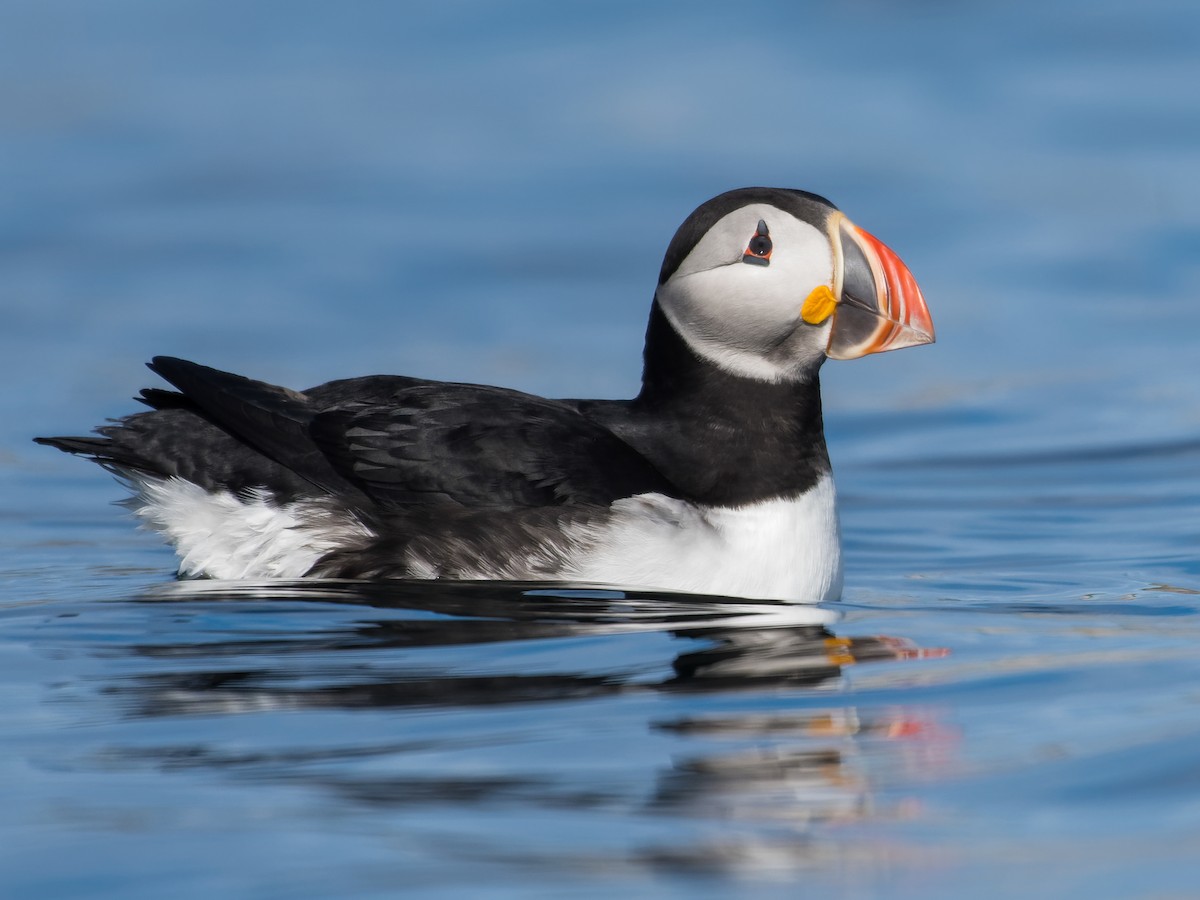
The Atlantic Puffin, known as 'Pulcinella di mare' in Italian, is a charismatic seabird belonging to the auk family. Renowned for its distinctive, brightly colored beak during the breeding season, it is an iconic species of the North Atlantic. These highly adapted marine birds spend most of their lives at sea, coming ashore only to breed in large colonies on coastal cliffs and islands.
Dimensioni e longevità
- Lunghezza
- 28-34 cm
- Apertura alare
- 50-60 cm
- Peso
- 320-480 g
- Longevità
- 18-20 years (up to 30+ years recorded)
- Dieta
- Carnivore (primarily piscivorous)
Caratteristiche fisiche
- Piumaggio
- Adult breeding plumage features a black back and crown, white underparts, and a distinctive greyish-white face patch. Non-breeding plumage is duller, with a darker grey face and a less vibrant bill. Juveniles resemble non-breeding adults but are generally smaller with a narrower, duller bill.
- Forma del becco
- Triangular and laterally compressed. During breeding season, it is brightly colored with blue-grey, yellow, and red bands. Outside of breeding, the colorful outer plates are shed, leaving a smaller, duller, greyish-orange bill.
- Colore degli occhi
- Dark brown, with a distinctive red ring and a small, fleshy, triangular blue-grey plate above and below the eye during breeding.
- Colore delle zampe
- Bright orange-red during breeding season, fading to duller orange or yellowish outside of breeding.
- Caratteristiche distintive
- The large, brightly colored, triangular bill in breeding adults is unmistakable. The upright posture on land and powerful, direct flight with rapid wingbeats are also characteristic.
- Aspetto giovanile
- Juveniles have a smaller, narrower, and duller bill that is mostly dark grey or blackish, lacking the vibrant colors and grooves of adults. Their face is darker grey, and they generally appear less robust than adults.
- Cambiamenti stagionali
- The most striking seasonal change is the bill. The colorful outer plates are shed after the breeding season, revealing a smaller, duller, greyish-orange bill. The face also darkens from greyish-white to a darker grey, and the eye ornaments are lost.
- Dimorfismo sessuale
- Males and females are outwardly similar in plumage and size, though males may be slightly larger on average. Bill coloration and size are identical between sexes during breeding.
Come identificare
- 1
Bill Coloration (Breeding Adult)
Look for the unmistakable large, triangular bill with vibrant blue-grey, yellow, and red bands. This is the most definitive field mark during the breeding season.
- 2
Face Pattern (Breeding Adult)
Observe the pale greyish-white face patch contrasting with the black crown and nape, and the distinctive red eye-ring with small blue-grey fleshy plates above and below the eye.
- 3
Plumage
Note the glossy black upperparts (back, wings, tail) and clean white underparts. This bicolored pattern is consistent across seasons, though the face darkens in winter.
- 4
Legs and Feet
Bright orange-red legs and webbed feet are visible when the bird is on land or taking off/landing.
- 5
Flight Style
In flight, observe the rapid, whirring wingbeats and direct, low-to-the-water flight path. They appear 'stocky' in the air.
- 6
Behavior on Land
On land, they stand upright and walk with a distinctive waddle, often appearing somewhat clumsy but endearing.
- 7
Vocalizations
Listen for the low, guttural 'growl' or 'purr' calls, especially when near or within breeding colonies.
Habitat e areale
- Biomi
- Marine, Coastal
- Areale geografico
- North Atlantic Ocean, including coasts of Iceland, Norway, Greenland, Faroe Islands, British Isles, eastern Canada, and northeastern USA.
- Fascia altitudinale
- Sea level to coastal cliff tops (up to several hundred meters for nesting sites)
- Ambienti preferiti
- Open ocean for foraging, and steep coastal cliffs, rocky islands, and grassy slopes for breeding colonies. They require soft soil or crevices for burrowing nests.
Comportamento
- Periodo di attività
- Diurnal, active during daylight hours for foraging and colony activities.
- Abitudini alimentari
- Primarily feeds on small fish (e.g., sand eels, herring, sprats, capelin) caught by pursuit-diving. They can dive to depths of 60 meters and hold multiple fish crosswise in their bill simultaneously, thanks to specialized spines on their tongue and palate.
- Comportamento sociale
- Highly colonial breeders, forming dense colonies of thousands to hundreds of thousands of pairs. Outside of the breeding season, they are pelagic and generally solitary or in small groups at sea.
- Tipo di volo
- Direct and powerful, with very rapid wingbeats (up to 400 beats per minute) to maintain flight. They are agile in the air but appear somewhat clumsy on land, walking with an upright waddle. Excellent swimmers and divers.
- Migrazione
- Migratory. After breeding, adults and juveniles disperse widely across the North Atlantic, spending the winter months far out at sea, often hundreds of kilometers from land. They return to breeding colonies in spring.
- Territorialità
- Highly territorial around their nest burrows during the breeding season, defending their immediate nesting site from conspecifics and predators.
Canto e richiami
- Canto
- Atlantic Puffins do not have a complex song. Their vocalizations are generally limited to guttural calls.
- Richiamo
- A low, growling 'arr-uh' or 'grrr-uh' sound, often described as a 'growl' or 'purr'. This call is typically heard within the breeding colony, especially from inside burrows or during interactions between birds. They also emit a soft 'a-a-a-ah' sound.
- Quando vocalizza
- Mainly vocalize during the breeding season when at the colony, particularly when interacting with mates, chicks, or other puffins, and when disturbed in their burrows. They are largely silent at sea.
Riproduzione
- Stagione riproduttiva
- Typically May to August, with peak egg-laying in late May to early June.
- Abitudini di nidificazione
- Monogamous. Nests in burrows dug into soft soil on grassy slopes or cliff tops, or in rock crevices. Burrows can be 1-2 meters deep. Both parents participate in burrow excavation and maintenance.
- Dimensione della covata
- 1 egg
- Descrizione dell'uovo
- A single, large, dull white egg, sometimes with faint brownish or purplish spots, often becoming stained during incubation.
- Periodo di incubazione
- 39-43 days
- Periodo di involo
- 38-50 days (average 40-41 days)
- Cure parentali
- Both parents share incubation duties and feed the chick (known as a 'puffling') with small fish carried crosswise in their bills. The chick is left alone in the burrow for much of the day as parents forage.
Dove trovarlo
Breeding Colonies
The best places to see Atlantic Puffins are at their large breeding colonies on remote islands and coastal cliffs in the North Atlantic. Key locations include Iceland (e.g., Látrabjarg, Vestmannaeyjar), Norway (e.g., Røst, Runde), the Faroe Islands, Scotland (e.g., Isle of May, Shetland, Orkney), Ireland (e.g., Skellig Michael), and parts of eastern Canada (e.g., Witless Bay Ecological Reserve in Newfoundland) and Maine, USA (e.g., Machias Seal Island).
Pelagic Waters
Outside of the breeding season, they are found far out at sea across the North Atlantic. Pelagic birding trips can offer opportunities to see them, though they are often distant and harder to identify without their breeding colors.
Consigli sul campo
- Visit during breeding season. The optimal time to observe Atlantic Puffins is from late April/May to mid-August when they are at their breeding colonies. This is when their bills are most colorful and they are most active on land.
- Use binoculars/spotting scope. Puffins often nest on steep cliffs or islands, so good optics are essential for detailed observation. Many colonies have designated viewing areas.
- Observe behavior. Watch for their comical waddling on land, their rapid flight, and their impressive ability to carry multiple fish in their bills. Observing their interactions within the colony can be very rewarding.
- Respect nesting sites. Always maintain a respectful distance from nesting birds to avoid disturbance. Follow local guidelines and stay on marked paths.
- Look for burrows. On grassy slopes, look for the entrances to their burrows, often indicated by worn paths or fresh soil. Puffins will often stand near their burrow entrances.
Specie simili
Horned Puffin
Fratercula corniculata
Found in the North Pacific. Distinguished by a fleshy, horn-like projection above the eye (lacking in Atlantic Puffin), a yellow bill base with a red tip (Atlantic Puffin has blue-grey, yellow, and red bands), and a larger, more triangular white face patch that extends further back on the head.
Tufted Puffin
Fratercula cirrhata
Found in the North Pacific. Easily distinguished by its prominent yellow ear tufts that extend from behind the eye, a much larger, entirely red bill (lacking the blue-grey and yellow of Atlantic Puffin), and a darker face.
Razorbill
Alca torda
Shares similar black and white plumage but has a much thinner, deeper, and more knife-like black bill with a white vertical stripe, lacking the bright colors and triangular shape of the Puffin's bill. Razorbills also have a more elongated body shape and a white line extending from the eye to the bill.
Common Murre (Guillemot)
Uria aalge
Also black and white, but has a much thinner, pointed, all-black bill. Lacks the Puffin's colorful bill and distinctive face pattern. Murres are more slender and have a longer neck.
Fatti rapidi
- Common Name:
- Atlantic Puffin
- Scientific Name:
- Fratercula arctica
- Family:
- Alcidae
- Conservation Status:
- Vulnerable
- Diet:
- Small fish (piscivorous)
- Clutch Size:
- 1 egg
- Habitat:
- North Atlantic coastal cliffs and open ocean
- Distinguishing Feature:
- Brightly colored, triangular bill in breeding season
Curiosità
- Atlantic Puffins are sometimes called 'sea parrots' or 'clowns of the sea' due to their colorful bills and somewhat comical appearance and gait.
- They can hold an average of 10-12 small fish in their bill at once, with a record of 62 fish in one go!
- Puffins are excellent swimmers and divers, using their wings to 'fly' underwater and their webbed feet as rudders.
- Their colorful bill plates are shed after the breeding season, revealing a smaller, duller bill, much like a deciduous tree shedding its leaves.
- Puffins form long-term pair bonds and often return to the same burrow year after year.
- The 'puffling' (puffin chick) is left alone in its burrow for much of its development, relying on parents to bring food.
Classificazione scientifica
- Regno
- Animalia
- Phylum
- Chordata
- Classe
- Aves
- Ordine
- Charadriiformes
- Famiglia
- Alcidae
- Genere
- Fratercula
- Specie
- arctica
Esplora Atlantic Puffin
Identifica uccelli ovunque
Gratis su iOS, Android e Web. Identificazione per foto e suono, database completo e la tua lista personale.