
Visto un uccello? Identificalo all'istante con l'app Birdby
Apri l'appInformazioni
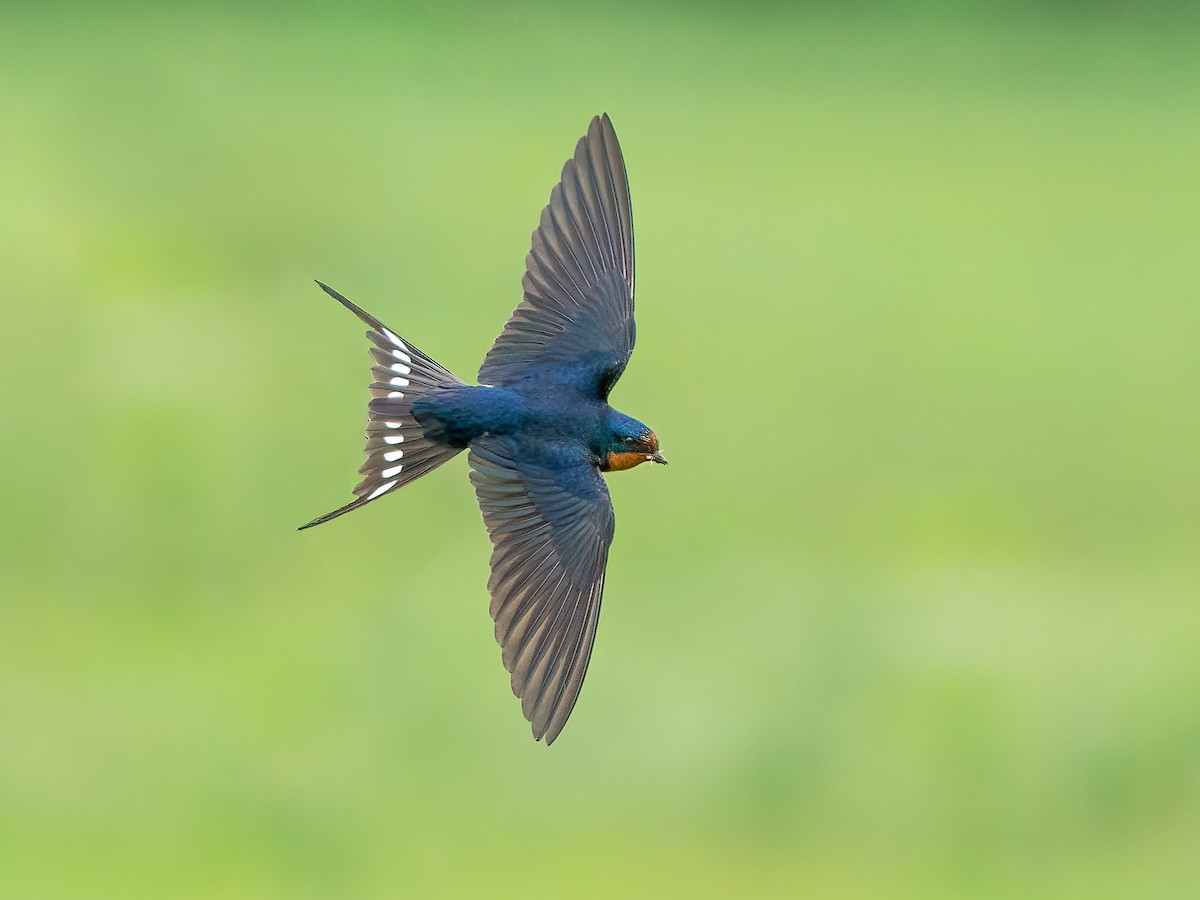
The Barn Swallow is a highly recognizable passerine bird known for its distinctive deeply forked tail, iridescent blue upperparts, and rufous underparts. It is a widespread migratory species, often associated with human habitation, where it builds its characteristic mud nests.
Dimensioni e longevità
- Lunghezza
- 17-19 cm (including tail streamers)
- Apertura alare
- 32-34.5 cm
- Peso
- 16-22 g
- Longevità
- Typically 2-4 years in the wild, with records up to 11 years.
- Dieta
- Insectivore
Caratteristiche fisiche
- Piumaggio
- Adults have glossy, iridescent steel-blue upperparts, a rufous-chestnut forehead and throat, separated from the pale creamy-white underparts by a broad, dark blue-black breast band. The tail is deeply forked with long streamers, especially in males, and has a row of white spots on the inner webs of the outer tail feathers, visible in flight.
- Forma del becco
- Small, flattened, and triangular with a wide gape, adapted for catching insects in flight. Black in color.
- Colore degli occhi
- Dark brown.
- Colore delle zampe
- Short, blackish-brown legs and feet, adapted for perching rather than walking.
- Caratteristiche distintive
- Deeply forked tail streamers (longer in males), iridescent blue back, rufous throat and forehead, and a dark breast band. White spots on the outer tail feathers are a key field mark.
- Aspetto giovanile
- Juveniles are duller than adults, with browner upperparts and paler, buffier underparts. The rufous on the face and throat is less intense, and the tail streamers are much shorter and less deeply forked, resembling those of a House Martin (Delichon urbicum) or Sand Martin (Riparia riparia).
- Cambiamenti stagionali
- No significant seasonal plumage changes. Breeding and non-breeding plumages are essentially the same, though plumage may appear slightly worn by the end of the breeding season.
- Dimorfismo sessuale
- Males typically have longer, more prominent tail streamers than females. The blue iridescence on the back may be slightly more intense in males, and the rufous on the throat and forehead can be richer. Females generally have shorter tail streamers and duller plumage.
Come identificare
- 1
Tail Shape
Look for the deeply forked tail with long streamers, especially noticeable in flight. Males have longer streamers.
- 2
Plumage Coloration
Note the iridescent steel-blue back and crown, contrasting with the rufous-chestnut throat and forehead, and the creamy-white belly with a dark breast band.
- 3
White Tail Spots
Observe the row of small white spots on the inner webs of the outer tail feathers, visible when the tail is fanned in flight.
- 4
Flight Pattern
Its agile, acrobatic flight, often low over open ground or water, is characteristic.
- 5
Nesting Sites
Presence of mud nests under eaves, inside barns, or on bridges is a strong indicator.
Habitat e areale
- Biomi
- Open country, farmland, meadows, pastures, wetlands, and coastal areas. Requires open spaces for foraging and structures for nesting.
- Areale geografico
- Breeds across the Northern Hemisphere, including North America, Europe, Asia, and parts of North Africa. Winters in the Southern Hemisphere, including South America, Africa, and parts of Asia and Australia.
- Fascia altitudinale
- From sea level up to approximately 3,000 meters, though typically found at lower elevations.
- Ambienti preferiti
- Prefers open agricultural landscapes with access to water and man-made structures (barns, sheds, bridges, houses) for nesting. Avoids dense forests and arid deserts.
Comportamento
- Periodo di attività
- Diurnal.
- Abitudini alimentari
- Exclusively insectivorous, catching insects (flies, mosquitoes, beetles, moths, aphids) in agile flight. Often forages low over water or fields, especially during insect hatches. Drinks by skimming over water surfaces.
- Comportamento sociale
- Highly social, especially outside the breeding season. Forms large communal roosts, sometimes numbering thousands of individuals, particularly during migration. During breeding, they are territorial around their nests but may nest in loose colonies.
- Tipo di volo
- Graceful, agile, and acrobatic flight, characterized by rapid wing beats, glides, and sharp turns. Often flies low to the ground or water. Can hover briefly.
- Migrazione
- Long-distance migratory species. European populations winter in Africa, North American populations in Central and South America, and Asian populations in South Asia and Australia. Migrates in large flocks, often following coastlines or river valleys.
- Territorialità
- Territorial around the nest site during the breeding season, defending a small area immediately surrounding the nest from conspecifics and predators. Males may defend a larger foraging territory during courtship.
Canto e richiami
- Canto
- A cheerful, warbling, and twittering song, often delivered from a perch or in flight. It consists of a series of rapid, melodious notes, often ending with a distinctive 'squeaky' or 'sneezy' flourish.
- Richiamo
- Common calls include a sharp 'wit-wit' or 'tswit' contact call, a 'sitt' alarm call, and a 'squeak' or 'churr' when agitated or around the nest.
- Quando vocalizza
- Most vocal during the breeding season, especially males singing to attract mates and defend territory. Calls are heard year-round, particularly during foraging and social interactions.
Riproduzione
- Stagione riproduttiva
- Typically April to August in the Northern Hemisphere, with variations depending on geographic location. Can raise 1-3 broods per season.
- Abitudini di nidificazione
- Nests are cup-shaped, made of mud pellets mixed with grass and straw, lined with feathers. They are typically built on vertical surfaces under eaves, inside barns, sheds, bridges, or other sheltered man-made structures. Both sexes participate in nest building.
- Dimensione della covata
- 3-7 eggs (most commonly 4-5).
- Descrizione dell'uovo
- 3-7 (usually 4-5) eggs per clutch. Eggs are white, speckled with reddish-brown or purplish-grey spots, particularly at the larger end. Approximately 20 x 14 mm.
- Periodo di incubazione
- 13-17 days, primarily by the female.
- Periodo di involo
- 18-23 days after hatching. Young are fed by both parents.
- Cure parentali
- Both male and female parents feed and care for the young. After fledging, juveniles remain dependent on parents for several days to weeks, learning to forage independently.
Dove trovarlo
Agricultural Areas
Barns, sheds, stables, and other farm buildings provide ideal nesting sites and open fields for foraging.
Wetlands and Water Bodies
Lakes, rivers, ponds, and marshes are excellent foraging grounds due to abundant insect populations.
Open Countryside
Meadows, pastures, and open fields are preferred for aerial insect hunting.
Coastal Areas
Can be found along coastlines, especially during migration, where insects are plentiful.
Consigli sul campo
- Look for nests. Check under the eaves of buildings, inside open barns, under bridges, and in culverts for their distinctive mud cup nests.
- Observe flight patterns. Watch for their characteristic swift, acrobatic flight as they chase insects, often flying low over fields or water.
- Listen for calls. Their cheerful, twittering song and sharp 'wit-wit' calls are often heard around nesting sites or foraging areas.
- Visit during breeding season. They are most easily observed during the breeding season (spring and summer in the Northern Hemisphere) when they are actively nesting and raising young.
- Check communal roosts. During migration, look for large flocks gathering at communal roosts, often in reed beds or dense vegetation, at dusk.
Specie simili
Red-rumped Swallow
Cecropis daurica
The Red-rumped Swallow has a distinctive rufous rump (Barn Swallow has a blue-black rump), a pale, unstreaked belly, and a rufous nuchal collar. Its tail streamers are also long but often appear less deeply forked than a Barn Swallow's in flight, and it lacks the white tail spots.
House Martin
Delichon urbicum
The House Martin has a pure white rump (Barn Swallow has a blue-black rump), entirely white underparts, and a much shorter, less deeply forked tail. It lacks the rufous throat and forehead of the Barn Swallow. Its flight is often described as more buoyant.
Sand Martin
Riparia riparia
The Sand Martin is smaller and duller, with brown upperparts and white underparts, separated by a distinct brown breast band. It lacks any blue iridescence or rufous coloration and has a very shallowly forked tail. It typically nests in burrows in sand banks.
Fatti rapidi
- Primary Diet:
- Flying insects
- Nest Type:
- Mud cup nest
- Migration Status:
- Long-distance migrant
- Habitat Preference:
- Open country with structures for nesting
- Distinguishing Feature:
- Deeply forked tail streamers
Curiosità
- Barn Swallows are one of the most widespread swallow species globally, found on every continent except Antarctica.
- The length of a male's tail streamers is an indicator of his fitness, with longer streamers often preferred by females during mate selection.
- They are highly beneficial to humans as they consume vast quantities of agricultural insect pests.
- Barn Swallows often reuse their mud nests year after year, sometimes repairing and adding to them.
- During migration, Barn Swallows can cover thousands of kilometers, navigating with remarkable precision.
Classificazione scientifica
- Regno
- Animalia
- Phylum
- Chordata
- Classe
- Aves
- Ordine
- Passeriformes
- Famiglia
- Hirundinidae
- Genere
- Hirundo
- Specie
- Hirundo rustica
Esplora Barn Swallow
Identifica uccelli ovunque
Gratis su iOS, Android e Web. Identificazione per foto e suono, database completo e la tua lista personale.