
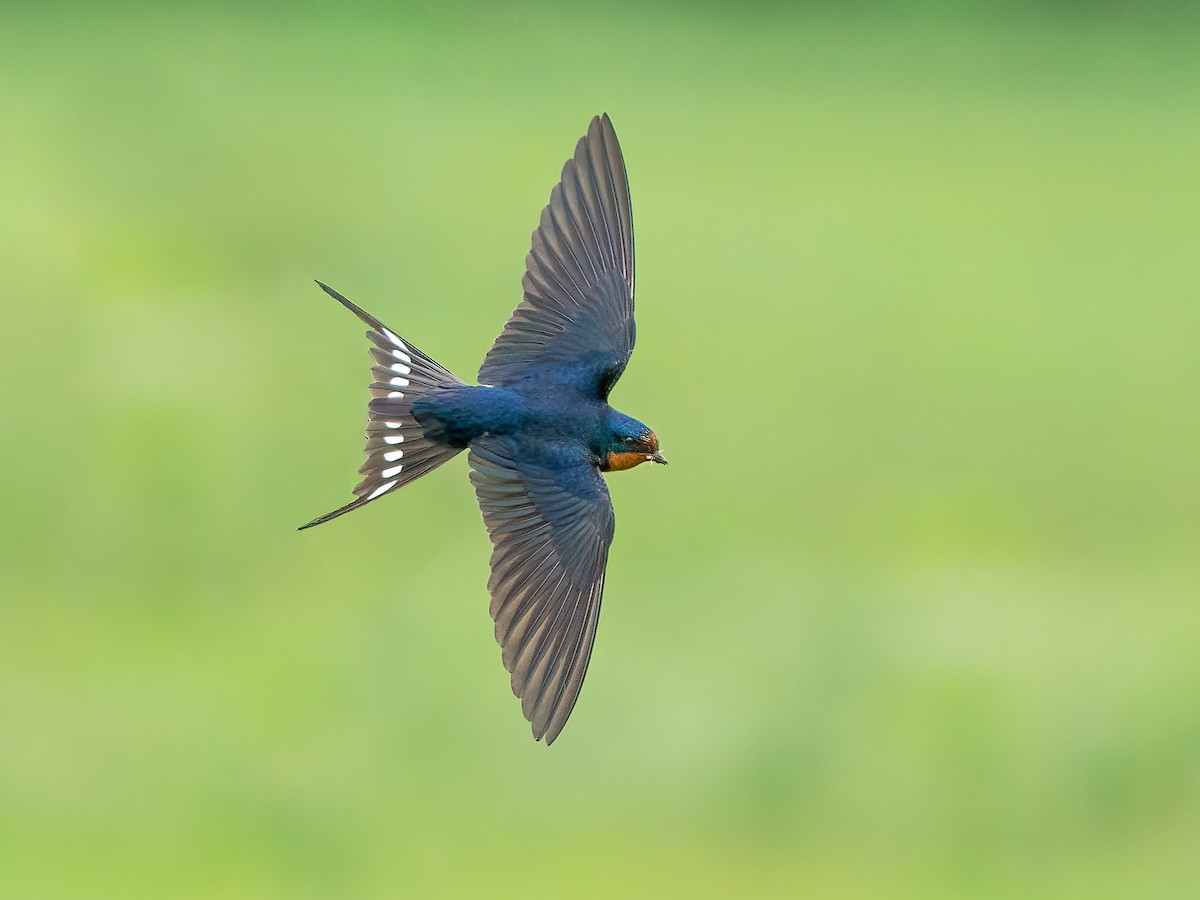
Come identificare Barn Swallow
Hirundo rustica
Visto un uccello? Identificalo all'istante con l'app Birdby
Apri l'appPer identificare correttamente Barn Swallow (Hirundo rustica), controlla ciascuna di queste caratteristiche. Gli uccelli possono essere complicati da riconoscere, perché comportamento, habitat e canto spesso confermano ciò che una sola foto non può.
Dimensioni a colpo d'occhio
- Lunghezza
- 17-19 cm (including tail streamers)
- Apertura alare
- 32-34.5 cm
- Peso
- 16-22 g
Caratteristiche fisiche da controllare
- 1
Piumaggio
Colorazione e disegno generale del piumaggio.
Adults have glossy, iridescent steel-blue upperparts, a rufous-chestnut forehead and throat, separated from the pale creamy-white underparts by a broad, dark blue-black breast band. The tail is deeply forked with long streamers, especially in males, and has a row of white spots on the inner webs of the outer tail feathers, visible in flight.
- 2
Forma del becco
Forma e colore del becco, un segno di campo chiave.
Small, flattened, and triangular with a wide gape, adapted for catching insects in flight. Black in color.
- 3
Colore degli occhi
Colore dell'iride e segni distintivi sugli occhi.
Dark brown.
- 4
Colore delle zampe
Colore di zampe e piedi.
Short, blackish-brown legs and feet, adapted for perching rather than walking.
- 5
Caratteristiche distintive
Tratti distintivi che separano questa specie.
Deeply forked tail streamers (longer in males), iridescent blue back, rufous throat and forehead, and a dark breast band. White spots on the outer tail feathers are a key field mark.
- 6
Aspetto giovanile
Come i giovani si differenziano dagli adulti.
Juveniles are duller than adults, with browner upperparts and paler, buffier underparts. The rufous on the face and throat is less intense, and the tail streamers are much shorter and less deeply forked, resembling those of a House Martin (Delichon urbicum) or Sand Martin (Riparia riparia).
- 7
Cambiamenti stagionali
Variazione del piumaggio tra stagione riproduttiva e non.
No significant seasonal plumage changes. Breeding and non-breeding plumages are essentially the same, though plumage may appear slightly worn by the end of the breeding season.
- 8
Dimorfismo sessuale
Differenze tra maschi e femmine.
Males typically have longer, more prominent tail streamers than females. The blue iridescence on the back may be slightly more intense in males, and the rufous on the throat and forehead can be richer. Females generally have shorter tail streamers and duller plumage.
Segni di campo chiave
- Tail Shape. Look for the deeply forked tail with long streamers, especially noticeable in flight. Males have longer streamers.
- Plumage Coloration. Note the iridescent steel-blue back and crown, contrasting with the rufous-chestnut throat and forehead, and the creamy-white belly with a dark breast band.
- White Tail Spots. Observe the row of small white spots on the inner webs of the outer tail feathers, visible when the tail is fanned in flight.
- Flight Pattern. Its agile, acrobatic flight, often low over open ground or water, is characteristic.
- Nesting Sites. Presence of mud nests under eaves, inside barns, or on bridges is a strong indicator.
Esplora Barn Swallow
Identifica uccelli ovunque
Gratis su iOS, Android e Web. Identificazione per foto e suono, database completo e la tua lista personale.