
Visto un uccello? Identificalo all'istante con l'app Birdby
Apri l'appInformazioni
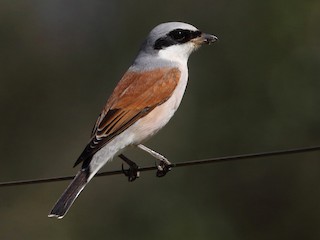
The Red-backed Shrike is a medium-sized passerine bird, known for its predatory habits, often impaling prey on thorns or barbed wire, earning it the nickname 'butcher bird'. It exhibits distinct sexual dimorphism, with males displaying a striking grey head and rufous back, while females are more cryptically colored. It is a long-distance migrant, breeding across much of Europe and western Asia and wintering in southern Africa.
Dimensioni e longevità
- Lunghezza
- 16-18 cm
- Apertura alare
- 24-27 cm
- Peso
- 25-35 g
- Longevità
- Up to 8 years in the wild
- Dieta
- Carnivore (primarily insectivore)
Caratteristiche fisiche
- Piumaggio
- Males have a grey crown and nape, a prominent black mask extending from the beak through the eye, a rufous-chestnut back, and pinkish-white underparts. The wings are dark brown with a small white patch at the primary bases (often concealed). The tail is black with white outer tail feathers. Females are duller, with a brownish-grey crown, a less distinct brownish mask, a rufous-brown back, and buffy-white underparts with fine crescent-shaped barring on the flanks and breast. Juveniles resemble females but are more heavily barred and mottled overall, with a scaly appearance on the back.
- Forma del becco
- Strong, hooked beak, dark grey to black, with a distinct tomial tooth on the upper mandible.
- Colore degli occhi
- Dark brown
- Colore delle zampe
- Dark grey to black
- Caratteristiche distintive
- Hooked beak, upright posture, long tail, and the male's distinctive grey head and rufous back. The black mask is a key feature for both sexes, though less prominent in females.
- Aspetto giovanile
- Juveniles are heavily barred and mottled brown on the upperparts and underparts, with a scaly pattern on the back. The mask is indistinct, and the overall coloration is much less vibrant than adults.
- Cambiamenti stagionali
- No significant seasonal plumage changes in adults; breeding and non-breeding plumages are essentially the same. Juveniles molt into first-winter plumage which resembles adult females.
- Dimorfismo sessuale
- Pronounced. Males are much more brightly colored with a grey head, black mask, and rufous back. Females are duller, browner overall, with a less distinct mask and barred underparts.
Come identificare
- 1
Male Plumage
Look for the distinctive combination of a grey head, black mask, and rufous-chestnut back. Pinkish-white underparts are also characteristic.
- 2
Female Plumage
Identify by the brownish-grey head, less distinct brownish mask, rufous-brown back, and buffy-white underparts with fine crescent-shaped barring.
- 3
Juvenile Plumage
Note the heavily barred and mottled brown appearance, especially the scaly pattern on the back and underparts.
- 4
Behavior
Observe its 'butcher bird' behavior: perching prominently, scanning for prey, and the characteristic impaling of prey on thorns or barbed wire.
- 5
Beak Shape
The strong, hooked beak with a distinct tomial tooth is a key shrike feature.
- 6
Habitat
Search in open, scrubby habitats with scattered bushes and trees, often near agricultural fields or meadows.
Habitat e areale
- Biomi
- Temperate grasslands, shrublands, open woodlands, agricultural land
- Areale geografico
- Breeds across most of Europe (excluding the British Isles, Iceland, and parts of Scandinavia) and western Asia. Winters in southern Africa, primarily in the savanna and bushveld regions.
- Fascia altitudinale
- Typically found from sea level up to 2000 meters, occasionally higher in mountainous regions.
- Ambienti preferiti
- Prefers open, mosaic landscapes with scattered thorny bushes, hedges, scrub, and small trees, often near meadows or pastures. Requires suitable perches for hunting and thorny vegetation for impaling prey.
Comportamento
- Periodo di attività
- Diurnal
- Abitudini alimentari
- A predatory passerine, it primarily feeds on large insects (beetles, grasshoppers, crickets, dragonflies, bees, wasps), but also takes small vertebrates such as voles, shrews, lizards, frogs, and small birds. It hunts from an exposed perch, swooping down to catch prey on the ground or in flight. Known for its habit of impaling prey on thorns, barbed wire, or wedging it into crevices for later consumption or to aid in dismemberment.
- Comportamento sociale
- Generally solitary or found in pairs during the breeding season. Migrates in loose flocks, but not typically seen in large aggregations.
- Tipo di volo
- Direct and undulating flight, often low over the ground. When hunting, it performs short, agile flights from perches.
- Migrazione
- Long-distance migratory. Arrives on breeding grounds in April-May and departs for wintering grounds in August-September. The migration route is broad-front, often crossing the Mediterranean Sea and the Sahara Desert.
- Territorialità
- Highly territorial during the breeding season, with males defending their breeding territories through song and displays.
Canto e richiami
- Canto
- A soft, warbling, and melodious song, often incorporating mimicry of other bird species. It can be quite varied and complex, with trills, whistles, and chattering notes. Often delivered from an exposed perch.
- Richiamo
- Common calls include a harsh, grating 'chek' or 'cherr', a scolding 'chack-chack', and a soft 'tew' or 'twee'. Alarm calls are sharper and more insistent.
- Quando vocalizza
- Most vocal during the breeding season, particularly at dawn and dusk, and throughout the day when establishing territory or attracting a mate.
Riproduzione
- Stagione riproduttiva
- May to July, with peak activity in June.
- Abitudini di nidificazione
- Nests are typically built in dense thorny bushes or small trees, 1-3 meters above the ground. The nest is a bulky, cup-shaped structure made of twigs, grass, moss, and roots, lined with finer materials like hair, wool, and feathers.
- Dimensione della covata
- 4-7 eggs, usually 5-6.
- Descrizione dell'uovo
- 4-7 eggs, typically pale greenish-white or buff, heavily spotted and blotched with brown, grey, or olive, often forming a ring at the broad end. Eggs measure approximately 22 x 16 mm.
- Periodo di incubazione
- 14-16 days, primarily by the female.
- Periodo di involo
- 14-16 days after hatching. Young remain dependent on parents for some time after fledging.
- Cure parentali
- Both parents participate in feeding the nestlings and fledglings, though the female does most of the incubation.
Dove trovarlo
Scrublands and Hedges
Look in areas with dense thorny bushes, hawthorn hedges, and scattered small trees, which provide both hunting perches and nesting sites.
Open Woodlands and Forest Edges
Often found at the edges of deciduous or mixed woodlands, particularly where they border open fields or clearings.
Agricultural Landscapes
Common in traditional agricultural areas with hedgerows, pastures, and fallow fields, especially those with minimal pesticide use.
Power Lines and Fences
These provide excellent elevated perches for hunting, so check wires and fence lines in suitable habitats.
Consigli sul campo
- Look for prominent perches. Red-backed Shrikes often perch conspicuously on the tops of bushes, small trees, fence posts, or power lines while scanning for prey.
- Listen for their song. Their melodious, warbling song, often with mimicry, can draw attention to their presence, especially during the breeding season.
- Observe hunting behavior. Watch for their characteristic swooping flights from a perch to catch insects on the ground, and look for 'larders' of impaled prey.
- Visit during migration. During spring (April-May) and autumn (August-September) migration, they can be seen in a wider range of habitats as they pass through.
- Use binoculars. Their relatively small size and often distant perches make binoculars essential for observing plumage details and behavior.
Specie simili
Woodchat Shrike
Lanius senator
The Woodchat Shrike male has a chestnut crown and nape (not grey), a white patch on the wing (more prominent than Red-backed), and entirely white underparts without pinkish wash. Females are also distinct, lacking the rufous back of the Red-backed Shrike.
Great Grey Shrike
Lanius excubitor
Larger and paler overall, with a grey back (not rufous), a longer tail, and a more prominent white wing patch. The black mask is narrower and does not extend as far back. Juveniles are also much paler and less barred than juvenile Red-backed Shrikes.
Lesser Grey Shrike
Lanius minor
Similar in size but has a grey back (not rufous), a broader black mask that extends onto the forehead, and a pinkish flush on the breast and flanks. The tail is shorter and less graduated than the Red-backed Shrike.
Fatti rapidi
- Diet:
- Large insects, small vertebrates
- Migration:
- Long-distance migrant to southern Africa
- Nesting:
- Cup-shaped nest in thorny bushes
- Distinguishing Feature:
- Male's grey head, black mask, rufous back
- Behavior:
- Impales prey on thorns ('butcher bird')
Curiosità
- The Red-backed Shrike is one of the few passerine birds that regularly preys on small vertebrates, showcasing its predatory nature.
- Its habit of impaling prey on thorns or barbed wire is not only for storage but also helps it tear apart larger prey items, as its feet are not strong enough to hold them.
- Despite its 'butcher bird' reputation, its song is surprisingly melodious and often includes imitations of other bird species.
- The species has experienced significant declines in some parts of its European range, particularly in Western Europe, due to habitat loss and changes in agricultural practices.
Classificazione scientifica
- Regno
- Animalia
- Phylum
- Chordata
- Classe
- Aves
- Ordine
- Passeriformes
- Famiglia
- Laniidae
- Genere
- Lanius
- Specie
- Lanius collurio
Esplora Red-backed Shrike
Identifica uccelli ovunque
Gratis su iOS, Android e Web. Identificazione per foto e suono, database completo e la tua lista personale.