
Come identificare Red-backed Shrike
Lanius collurio
Visto un uccello? Identificalo all'istante con l'app Birdby
Apri l'appPer identificare correttamente Red-backed Shrike (Lanius collurio), controlla ciascuna di queste caratteristiche. Gli uccelli possono essere complicati da riconoscere, perché comportamento, habitat e canto spesso confermano ciò che una sola foto non può.
Dimensioni a colpo d'occhio
- Lunghezza
- 16-18 cm
- Apertura alare
- 24-27 cm
- Peso
- 25-35 g
Caratteristiche fisiche da controllare
- 1
Piumaggio
Colorazione e disegno generale del piumaggio.
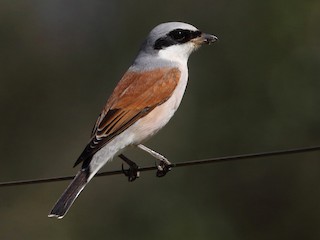
Males have a grey crown and nape, a prominent black mask extending from the beak through the eye, a rufous-chestnut back, and pinkish-white underparts. The wings are dark brown with a small white patch at the primary bases (often concealed). The tail is black with white outer tail feathers. Females are duller, with a brownish-grey crown, a less distinct brownish mask, a rufous-brown back, and buffy-white underparts with fine crescent-shaped barring on the flanks and breast. Juveniles resemble females but are more heavily barred and mottled overall, with a scaly appearance on the back.
- 2
Forma del becco
Forma e colore del becco, un segno di campo chiave.
Strong, hooked beak, dark grey to black, with a distinct tomial tooth on the upper mandible.
- 3
Colore degli occhi
Colore dell'iride e segni distintivi sugli occhi.
Dark brown
- 4
Colore delle zampe
Colore di zampe e piedi.
Dark grey to black
- 5
Caratteristiche distintive
Tratti distintivi che separano questa specie.
Hooked beak, upright posture, long tail, and the male's distinctive grey head and rufous back. The black mask is a key feature for both sexes, though less prominent in females.
- 6
Aspetto giovanile
Come i giovani si differenziano dagli adulti.
Juveniles are heavily barred and mottled brown on the upperparts and underparts, with a scaly pattern on the back. The mask is indistinct, and the overall coloration is much less vibrant than adults.
- 7
Cambiamenti stagionali
Variazione del piumaggio tra stagione riproduttiva e non.
No significant seasonal plumage changes in adults; breeding and non-breeding plumages are essentially the same. Juveniles molt into first-winter plumage which resembles adult females.
- 8
Dimorfismo sessuale
Differenze tra maschi e femmine.
Pronounced. Males are much more brightly colored with a grey head, black mask, and rufous back. Females are duller, browner overall, with a less distinct mask and barred underparts.
Segni di campo chiave
- Male Plumage. Look for the distinctive combination of a grey head, black mask, and rufous-chestnut back. Pinkish-white underparts are also characteristic.
- Female Plumage. Identify by the brownish-grey head, less distinct brownish mask, rufous-brown back, and buffy-white underparts with fine crescent-shaped barring.
- Juvenile Plumage. Note the heavily barred and mottled brown appearance, especially the scaly pattern on the back and underparts.
- Behavior. Observe its 'butcher bird' behavior: perching prominently, scanning for prey, and the characteristic impaling of prey on thorns or barbed wire.
- Beak Shape. The strong, hooked beak with a distinct tomial tooth is a key shrike feature.
- Habitat. Search in open, scrubby habitats with scattered bushes and trees, often near agricultural fields or meadows.
Esplora Red-backed Shrike
Identifica uccelli ovunque
Gratis su iOS, Android e Web. Identificazione per foto e suono, database completo e la tua lista personale.