
Visto un uccello? Identificalo all'istante con l'app Birdby
Apri l'appInformazioni
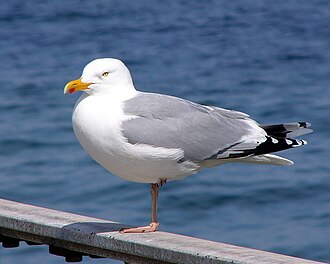
The European Herring Gull (Larus argentatus) is a large, widespread gull species found across the Northern Hemisphere. It is a highly adaptable and opportunistic feeder, often associated with coastal environments but increasingly found inland, particularly in urban areas. Known for its distinctive calls and robust build, it is a familiar sight in many parts of its range.
Dimensioni e longevità
- Lunghezza
- 55-67 cm
- Apertura alare
- 138-150 cm
- Peso
- 750-1600 g
- Longevità
- Up to 30 years in the wild, typically 10-15 years
- Dieta
- Omnivore, highly opportunistic. Diet includes fish, crustaceans, mollusks, insects, eggs and chicks of other birds, small mammals, carrion, offal, discarded human food, and berries.
Caratteristiche fisiche
- Piumaggio
- Adults have a pale grey back and upperwings, with black wingtips (primaries) featuring white 'mirrors' (spots). The head, neck, underparts, and tail are pure white. Juveniles are mottled brown with dark streaking, gradually acquiring adult plumage over 3-4 years.
- Forma del becco
- Strong, slightly hooked yellow bill with a prominent red spot on the lower mandible (gonys). Juveniles have a dark bill that gradually lightens.
- Colore degli occhi
- Pale yellow iris with a red orbital ring in adults. Juveniles have dark eyes.
- Colore delle zampe
- Pinkish-flesh in adults. Juveniles have pinkish-grey legs.
- Caratteristiche distintive
- Large size, pale grey mantle, black wingtips with white mirrors, yellow bill with red spot, pink legs. The red spot on the bill is a key feature for chick begging behavior.
- Aspetto giovanile
- First-year birds are entirely mottled brown with a dark bill and dark eyes. Second-year birds show a mix of brown and grey feathers, with some white on the head and underparts, and a paler bill base. Third-year birds are largely grey and white but retain some brown in the wings and tail, and the bill is still duller yellow with a less prominent red spot. Full adult plumage is achieved in the fourth year.
- Cambiamenti stagionali
- Adult plumage is largely consistent year-round. In non-breeding plumage (winter), adults may show some faint streaking on the head and nape, which is lost by the breeding season.
- Dimorfismo sessuale
- Males are generally slightly larger and heavier than females, but plumage is identical. This difference is often not discernible in the field.
Come identificare
- 1
Size and Shape
Look for a large, robust gull with a powerful build and a strong, slightly hooked bill.
- 2
Mantle Color
Note the pale grey color of the back and upperwings. This is a key distinction from darker-mantled gulls.
- 3
Wingtip Pattern
Observe the black wingtips (primaries) with prominent white 'mirrors' (spots) on the outer two primaries. This pattern is characteristic.
- 4
Leg Color
Check for pinkish-flesh colored legs in adults. This immediately rules out Yellow-legged and Lesser Black-backed Gulls.
- 5
Bill Color and Markings
Identify the yellow bill with a distinct red spot on the lower mandible. Juveniles have dark bills that gradually lighten.
- 6
Vocalizations
Listen for the loud, raucous 'long call' – a series of 'kyow' or 'gah' notes followed by a drawn-out 'kyaaaah'.
- 7
Juvenile Plumage
In young birds, look for heavily mottled brown plumage, dark bill, and dark eyes. Note the gradual transition to adult plumage over several years.
Habitat e areale
- Biomi
- Coastal areas, estuaries, large inland lakes, rivers, agricultural land, urban environments, landfills.
- Areale geografico
- Widespread across the North Atlantic, including Europe, Scandinavia, Iceland, and parts of North America (where it is often considered a subspecies or closely related species, Larus smithsonianus). Its range extends from the Arctic to temperate zones.
- Fascia altitudinale
- Primarily sea level to low elevations, though can be found at higher altitudes when foraging inland.
- Ambienti preferiti
- Rocky coasts, sandy beaches, cliffs, islands, harbors, fishing ports, estuaries, agricultural fields, urban rooftops, and landfills.
Comportamento
- Periodo di attività
- Diurnal, primarily active during daylight hours. May forage at night under artificial light or during full moon.
- Abitudini alimentari
- Highly opportunistic and generalist feeder. Forages by scavenging, surface-feeding, plunging, and pirating food from other birds. Often seen following fishing boats, scavenging at landfills, or foraging in intertidal zones. Will also hunt small prey, raid nests, and consume berries.
- Comportamento sociale
- Highly social, especially outside the breeding season, forming large flocks at roosts and feeding sites. Breeds in colonies, often dense, sometimes mixed with other gull species.
- Tipo di volo
- Strong, direct flight with powerful wingbeats. Can soar effortlessly on updrafts. Often glides with wings held in a slight dihedral. Agile in flight, especially when maneuvering for food.
- Migrazione
- Partial migrant. Northern populations are migratory, moving south to ice-free coasts in winter. Southern populations are largely resident or undertake short-distance dispersal. Juveniles tend to disperse more widely than adults.
- Territorialità
- Highly territorial during the breeding season, defending nesting sites within colonies. Outside breeding, less territorial, but may defend immediate feeding areas.
Canto e richiami
- Canto
- Does not have a true song. Its vocalizations are primarily calls.
- Richiamo
- A wide repertoire of loud, raucous calls. The most characteristic is a long, drawn-out 'kyow-kyow-kyow-kyow-kyaaaah' or 'gah-gah-gah-gaaaah' often given with the head thrown back, known as the 'long call'. Also produces short 'gack' or 'yell' calls, alarm calls ('kek-kek-kek'), and begging calls from chicks ('pee-oo').
- Quando vocalizza
- Vocalizes year-round, but most frequently and loudly during the breeding season, especially when defending territory or interacting with mates and chicks. Also vocalizes when competing for food or in alarm.
Riproduzione
- Stagione riproduttiva
- Typically April to July, with egg-laying peaking in May.
- Abitudini di nidificazione
- Nests colonially on cliffs, rocky outcrops, islands, sand dunes, and increasingly on urban rooftops. The nest is a bulky scrape lined with vegetation (grass, seaweed, twigs) and sometimes debris. Both sexes participate in nest building.
- Dimensione della covata
- 2-3 eggs, rarely 1 or 4.
- Descrizione dell'uovo
- Typically 2-3 eggs, olive-brown to greenish-blue, heavily blotched and spotted with dark brown or black. Average size is about 70 x 49 mm.
- Periodo di incubazione
- 28-30 days, incubated by both parents.
- Periodo di involo
- 35-40 days after hatching. Chicks are semi-precocial, leaving the nest scrape within a few days but remaining in the vicinity and dependent on parents for food.
- Cure parentali
- Both parents share incubation duties and care for the chicks, feeding them regurgitated food. Parental care continues for several weeks after fledging until the young are independent.
Dove trovarlo
Coastal Areas
Look along rocky shores, sandy beaches, cliffs, estuaries, and harbors. They are common near fishing boats and fish markets.
Urban Environments
Increasingly found in cities, nesting on rooftops and scavenging in parks, streets, and waste disposal sites.
Agricultural Land
Often seen following plows or foraging in fields for invertebrates and small mammals, especially inland.
Landfills and Waste Sites
A common and often dominant species at landfills, where they scavenge for discarded food.
Consigli sul campo
- Observe Behavior. Watch their feeding habits; their opportunistic scavenging is a good indicator. They are often bold and accustomed to human presence.
- Listen for Calls. Their loud and distinctive calls are often heard before the bird is seen, especially in coastal or urban areas.
- Check for Age. Pay attention to plumage variations to determine age. Juvenile and immature birds can look quite different from adults.
- Compare with other Gulls. In areas where multiple gull species coexist, carefully compare leg color, mantle shade, and wingtip patterns to differentiate them.
Specie simili
Lesser Black-backed Gull
Larus fuscus
Lesser Black-backed Gulls have a darker grey (slate-grey to black) mantle, yellow legs (not pink), and a slightly more slender build. The black on the wingtips extends further up the wing, and the white mirrors are often smaller or absent on some primaries. Their call is also typically deeper and more guttural.
Yellow-legged Gull
Larus michahellis
Yellow-legged Gulls have bright yellow legs (not pink), a slightly darker grey mantle than European Herring Gull, and a more angular head shape. The red spot on the bill is often more extensive. Their calls are generally deeper and more 'barking' than the Herring Gull's.
Glaucous Gull
Larus hyperboreus
Glaucous Gulls are larger and lack any black on the wingtips; their primaries are white or very pale grey. They have a heavier bill and a generally paler appearance overall. Juveniles are very pale, almost whitish, lacking the heavy brown mottling of juvenile Herring Gulls.
Iceland Gull
Larus glaucoides
Iceland Gulls are smaller and also lack black on the wingtips, having white primaries. They have a smaller, more delicate bill and a rounder head than the Glaucous Gull. Juveniles are very pale, similar to Glaucous Gull but smaller.
Fatti rapidi
- Diet:
- Omnivorous scavenger
- Habitat:
- Coasts, urban areas, inland waters
- Sociality:
- Highly social, colonial breeder
- Distinguishing Mark:
- Pink legs, yellow bill with red spot, pale grey mantle
- Vocalization:
- Loud, raucous 'long call'
Curiosità
- The red spot on the bill of adult Herring Gulls acts as a target for chicks, which peck at it to stimulate regurgitation of food by the parents.
- European Herring Gulls are highly intelligent and adaptable, learning to exploit new food sources and environments, including urban settings.
- Historically, the European Herring Gull was considered conspecific with the American Herring Gull (Larus smithsonianus), but they are now often treated as separate species due to genetic and morphological differences.
- They are known to drop hard-shelled prey, like mollusks, onto rocks from a height to break them open.
Classificazione scientifica
- Regno
- Animalia
- Phylum
- Chordata
- Classe
- Aves
- Ordine
- Charadriiformes
- Famiglia
- Laridae
- Genere
- Larus
- Specie
- Larus argentatus
Esplora European Herring Gull
Identifica uccelli ovunque
Gratis su iOS, Android e Web. Identificazione per foto e suono, database completo e la tua lista personale.