
Come identificare European Herring Gull
Larus argentatus
Visto un uccello? Identificalo all'istante con l'app Birdby
Apri l'appPer identificare correttamente European Herring Gull (Larus argentatus), controlla ciascuna di queste caratteristiche. Gli uccelli possono essere complicati da riconoscere, perché comportamento, habitat e canto spesso confermano ciò che una sola foto non può.
Dimensioni a colpo d'occhio
- Lunghezza
- 55-67 cm
- Apertura alare
- 138-150 cm
- Peso
- 750-1600 g
Caratteristiche fisiche da controllare
- 1
Piumaggio
Colorazione e disegno generale del piumaggio.
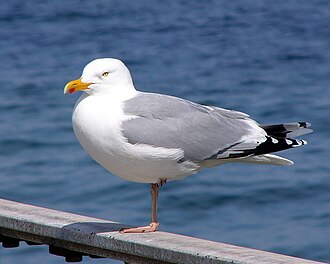
Adults have a pale grey back and upperwings, with black wingtips (primaries) featuring white 'mirrors' (spots). The head, neck, underparts, and tail are pure white. Juveniles are mottled brown with dark streaking, gradually acquiring adult plumage over 3-4 years.
- 2
Forma del becco
Forma e colore del becco, un segno di campo chiave.
Strong, slightly hooked yellow bill with a prominent red spot on the lower mandible (gonys). Juveniles have a dark bill that gradually lightens.
- 3
Colore degli occhi
Colore dell'iride e segni distintivi sugli occhi.
Pale yellow iris with a red orbital ring in adults. Juveniles have dark eyes.
- 4
Colore delle zampe
Colore di zampe e piedi.
Pinkish-flesh in adults. Juveniles have pinkish-grey legs.
- 5
Caratteristiche distintive
Tratti distintivi che separano questa specie.
Large size, pale grey mantle, black wingtips with white mirrors, yellow bill with red spot, pink legs. The red spot on the bill is a key feature for chick begging behavior.
- 6
Aspetto giovanile
Come i giovani si differenziano dagli adulti.
First-year birds are entirely mottled brown with a dark bill and dark eyes. Second-year birds show a mix of brown and grey feathers, with some white on the head and underparts, and a paler bill base. Third-year birds are largely grey and white but retain some brown in the wings and tail, and the bill is still duller yellow with a less prominent red spot. Full adult plumage is achieved in the fourth year.
- 7
Cambiamenti stagionali
Variazione del piumaggio tra stagione riproduttiva e non.
Adult plumage is largely consistent year-round. In non-breeding plumage (winter), adults may show some faint streaking on the head and nape, which is lost by the breeding season.
- 8
Dimorfismo sessuale
Differenze tra maschi e femmine.
Males are generally slightly larger and heavier than females, but plumage is identical. This difference is often not discernible in the field.
Segni di campo chiave
- Size and Shape. Look for a large, robust gull with a powerful build and a strong, slightly hooked bill.
- Mantle Color. Note the pale grey color of the back and upperwings. This is a key distinction from darker-mantled gulls.
- Wingtip Pattern. Observe the black wingtips (primaries) with prominent white 'mirrors' (spots) on the outer two primaries. This pattern is characteristic.
- Leg Color. Check for pinkish-flesh colored legs in adults. This immediately rules out Yellow-legged and Lesser Black-backed Gulls.
- Bill Color and Markings. Identify the yellow bill with a distinct red spot on the lower mandible. Juveniles have dark bills that gradually lighten.
- Vocalizations. Listen for the loud, raucous 'long call' – a series of 'kyow' or 'gah' notes followed by a drawn-out 'kyaaaah'.
- Juvenile Plumage. In young birds, look for heavily mottled brown plumage, dark bill, and dark eyes. Note the gradual transition to adult plumage over several years.
Esplora European Herring Gull
Identifica uccelli ovunque
Gratis su iOS, Android e Web. Identificazione per foto e suono, database completo e la tua lista personale.