
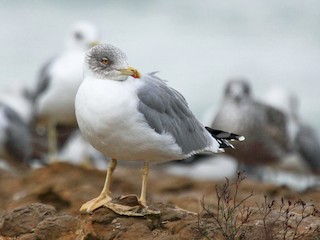
Come identificare Yellow-legged Gull
Larus michahellis
Visto un uccello? Identificalo all'istante con l'app Birdby
Apri l'appPer identificare correttamente Yellow-legged Gull (Larus michahellis), controlla ciascuna di queste caratteristiche. Gli uccelli possono essere complicati da riconoscere, perché comportamento, habitat e canto spesso confermano ciò che una sola foto non può.
Dimensioni a colpo d'occhio
- Lunghezza
- 52-60 cm
- Apertura alare
- 120-140 cm
- Peso
- 700-1500 g
Caratteristiche fisiche da controllare
- 1
Piumaggio
Colorazione e disegno generale del piumaggio.
Adult breeding plumage: White head, neck, underparts, and tail. Mantle and upperwings are medium grey. Primary wingtips are black with prominent white 'mirrors' (apical spots) on P9 and P10. Adult non-breeding plumage: Similar to breeding, but with fine streaking on the head and nape, particularly around the eye and hindneck. Juvenile plumage: Complex and highly variable, typically mottled brown and grey with dark streaking, dark bill, and dark eyes. Progresses through several immature plumages over 3-4 years.
- 2
Forma del becco
Forma e colore del becco, un segno di campo chiave.
Strong, relatively heavy bill, yellow with a prominent red spot (gonys spot) on the lower mandible in adults. Juveniles have a dark bill, which gradually lightens and develops the red spot.
- 3
Colore degli occhi
Colore dell'iride e segni distintivi sugli occhi.
Pale yellow with a red orbital ring in adults. Juveniles have dark brown eyes, which lighten with age.
- 4
Colore delle zampe
Colore di zampe e piedi.
Bright yellow in adults, often duller or greenish-yellow in non-breeding season. Juveniles have pinkish-grey legs, gradually turning yellow.
- 5
Caratteristiche distintive
Tratti distintivi che separano questa specie.
Bright yellow legs, yellow eye with red orbital ring, prominent red gonys spot on the bill, and a relatively dark grey mantle compared to Herring Gull. The black primary pattern with distinct white mirrors is also characteristic.
- 6
Aspetto giovanile
Come i giovani si differenziano dagli adulti.
First-winter birds are heavily mottled brown and grey, with a dark bill, dark eyes, and pinkish-grey legs. The tail is dark with a narrow white base. The primaries are dark. Second-winter birds show a mix of juvenile and adult-like feathers, with a paler head, greyer mantle, and a developing yellow bill base. Third-winter birds are largely adult-like but may retain some dark markings on the primaries or tail, and the bill may not be fully yellow with a red spot.
- 7
Cambiamenti stagionali
Variazione del piumaggio tra stagione riproduttiva e non.
Adults show only minor seasonal changes, primarily the development of fine streaking on the head and nape during the non-breeding season. The intensity of leg and orbital ring color may also vary slightly.
- 8
Dimorfismo sessuale
Differenze tra maschi e femmine.
Males are generally slightly larger and heavier than females, but plumage is identical. Size difference is often not discernible in the field.
Segni di campo chiave
- Leg Color. Adults have bright yellow legs. This is a primary distinguishing feature from Herring Gulls (pink legs) and a shared feature with Lesser Black-backed Gulls (darker mantle).
- Mantle Color. Medium grey mantle, darker than Herring Gull but significantly paler than Lesser Black-backed Gull. Compare with local Herring Gulls for accurate assessment.
- Eye and Orbital Ring. Piercing pale yellow eye with a distinct red orbital ring in adults. This contrasts with the dark eye of juveniles and the less prominent orbital ring of some other large gulls.
- Bill. Strong yellow bill with a prominent red gonys spot on the lower mandible in adults. Juveniles have a dark bill that gradually lightens.
- Primary Pattern. Black primary wingtips with two prominent white 'mirrors' (apical spots) on the outermost two primaries (P9 and P10). The extent of black on the primaries is intermediate between Herring and Lesser Black-backed Gulls.
- Voice. Listen for the deeper, more resonant 'laughing' call, which is distinct from the higher-pitched calls of Herring Gulls.
- Juvenile Plumage. First-winter birds are heavily mottled brown and grey, with a dark bill, dark eyes, and pinkish-grey legs. The overall impression is 'dirtier' and more streaky than juvenile Herring Gulls, and less uniformly dark than juvenile Lesser Black-backed Gulls.
Esplora Yellow-legged Gull
Identifica uccelli ovunque
Gratis su iOS, Android e Web. Identificazione per foto e suono, database completo e la tua lista personale.