
Visto un uccello? Identificalo all'istante con l'app Birdby
Apri l'appInformazioni
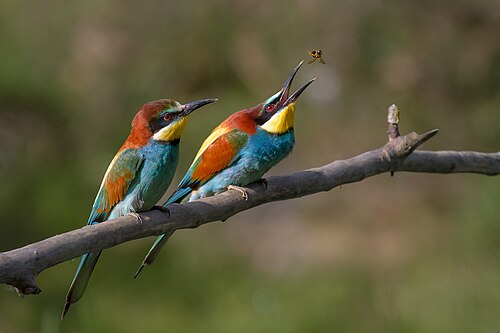
The European Bee-eater is a strikingly colorful migratory bird known for its vibrant plumage, graceful flight, and specialized diet of flying insects, particularly bees and wasps. It is a highly social species, often nesting in colonies and foraging in groups.
Dimensioni e longevità
- Lunghezza
- 27-29 cm (including elongated central tail feathers)
- Apertura alare
- 36-40 cm
- Peso
- 50-70 g
- Longevità
- 5-8 years in the wild, up to 10 years recorded
- Dieta
- Insectivore, primarily feeding on large flying insects such as bees, wasps, hornets, dragonflies, butterflies, and beetles.
Caratteristiche fisiche
- Piumaggio
- Adults exhibit a rich chestnut crown and mantle, transitioning to a yellow upper back. The rump is golden-yellow, and the tail is greenish-blue with elongated central tail feathers. The wings are a mix of rufous, green, and blue. Underparts are turquoise-blue, fading to green on the belly. A prominent black eye-stripe extends from the beak through the eye. The throat is bright yellow, bordered by a narrow black band.
- Forma del becco
- Long, slender, decurved (downward-curving) black beak, adapted for catching insects in flight.
- Colore degli occhi
- Bright red iris.
- Colore delle zampe
- Dull reddish-brown to greyish-brown.
- Caratteristiche distintive
- Vibrant multi-colored plumage (chestnut, yellow, blue, green), long decurved black bill, black eye-stripe, yellow throat with black border, and elongated central tail feathers (especially in adults).
- Aspetto giovanile
- Juveniles are duller overall, with a greener crown and mantle, lacking the rich chestnut of adults. The yellow throat is less vibrant, and the black border is often absent or indistinct. The central tail feathers are not elongated, giving the tail a more uniform appearance. The eye-stripe is present but may be less sharply defined.
- Cambiamenti stagionali
- No significant seasonal plumage changes. Plumage may appear slightly duller due to wear towards the end of the breeding season before the post-breeding molt.
- Dimorfismo sessuale
- Males and females are largely similar in plumage. Males typically have slightly brighter and more extensive chestnut on the crown and mantle, and their central tail streamers are often longer. Females may have a slightly greener tinge to the crown and a less distinct black throat border. These differences are subtle and not always reliable for field identification.
Come identificare
- 1
Plumage Coloration
Look for the striking combination of chestnut on the crown/mantle, golden-yellow on the back, bright yellow throat bordered by black, and turquoise-blue underparts. This multi-colored pattern is unique among European birds.
- 2
Flight and Silhouette
Observe its graceful, undulating flight pattern with rapid wing beats and glides. In flight, note the long, slender body, pointed wings, and often visible elongated central tail feathers. They often soar high on thermals.
- 3
Beak Shape
The long, slender, and distinctly decurved black beak is a key identification feature, adapted for its insectivorous diet.
- 4
Vocalizations
Listen for its distinctive, liquid, rolling 'prruup' or 'prrree-up' call, often given in flight. This sound is highly characteristic and often heard before the bird is seen.
- 5
Perching Behavior
Bee-eaters often perch conspicuously on wires, bare branches, or posts in open areas, providing excellent views for identification.
Habitat e areale
- Biomi
- Open woodlands, savannas, grasslands, agricultural areas, river valleys, and coastal dunes.
- Areale geografico
- Breeds across southern Europe, North Africa, and western Asia. Winters in tropical Africa, with some populations wintering in India and parts of the Arabian Peninsula.
- Fascia altitudinale
- Typically found from sea level up to 1,500 meters, occasionally higher in some parts of its range.
- Ambienti preferiti
- Requires open areas for foraging and sandy or loess cliffs, riverbanks, or quarries for nesting. Often found near water sources, which attract a high density of flying insects.
Comportamento
- Periodo di attività
- Diurnal.
- Abitudini alimentari
- Highly aerial insectivores. They perch on prominent vantage points (wires, branches, posts) and sally forth to catch insects in mid-air. Larger prey, especially stinging insects, are taken back to the perch and repeatedly bashed against it to remove the sting and exoskeleton before consumption. They are adept at removing the venom sac from bees and wasps.
- Comportamento sociale
- Highly social, especially during the breeding season. They nest in colonies, sometimes numbering hundreds of pairs. They forage in small groups and often roost communally.
- Tipo di volo
- Graceful, undulating flight with rapid wing beats interspersed with glides. Highly agile in pursuit of insects. Often seen soaring on thermals.
- Migrazione
- Long-distance migratory species. European populations migrate south to sub-Saharan Africa for the winter, typically departing in late August to September and returning in April to May. Asian populations migrate to India and parts of the Arabian Peninsula.
- Territorialità
- While nesting in colonies, individual pairs defend a small area around their nest burrow. Foraging areas are generally not strictly territorial, especially when hunting in groups.
Canto e richiami
- Canto
- The 'song' is more of a continuous, liquid, rolling trill, often described as 'prruup' or 'prrree-up', delivered while perched or in flight. It's a distinctive, mellow, and far-carrying sound.
- Richiamo
- The most common call is a soft, liquid 'prruup' or 'prrree-up', often repeated. Also a sharper 'kip' or 'kew' call when alarmed or interacting. Calls are often given in flight, making their presence known before they are seen.
- Quando vocalizza
- Vocalizes frequently throughout the day, especially during foraging, social interactions, and during migration. Most vocal during the breeding season.
Riproduzione
- Stagione riproduttiva
- May to July in Europe, varying slightly with latitude.
- Abitudini di nidificazione
- Colonial nesters. They excavate long tunnels (1-3 meters, sometimes up to 4 meters) in sandy or loess cliffs, riverbanks, quarries, or even flat ground. Both sexes participate in digging the burrow, which ends in an unlined nesting chamber.
- Dimensione della covata
- 4-7 eggs, typically.
- Descrizione dell'uovo
- Typically 4-7 (range 3-10) pure white, glossy, spherical eggs.
- Periodo di incubazione
- 19-21 days, primarily by the female, but males also participate.
- Periodo di involo
- 20-30 days after hatching. Young are fed by both parents and often by 'helpers' (often offspring from previous years or unpaired adults) within the colony.
- Cure parentali
- Both parents share incubation and feeding duties. Cooperative breeding is common, with non-breeding individuals (often related to the breeding pair) assisting in feeding the chicks, significantly increasing breeding success.
Dove trovarlo
River Valleys and Sand Pits
Look for nesting colonies in sandy or loess cliffs along rivers, in disused sand and gravel pits, or in quarries.
Open Agricultural Land
Foraging birds can be found over open fields, vineyards, and orchards where insect prey is abundant.
Coastal Areas
In some regions, they may nest in coastal dunes or cliffs and forage over coastal scrubland.
Migration Hotspots
During spring and autumn migration, they can be seen in large flocks passing through various habitats, often along coastlines or mountain passes.
Consigli sul campo
- Listen for Calls. Their distinctive 'prruup' call is often the first indication of their presence, especially when they are flying high overhead.
- Scan Open Areas. Look for them perched on prominent wires, fences, or dead branches in open, sunny habitats. They are often quite conspicuous.
- Visit Nesting Colonies. During the breeding season, locating a nesting colony (often in sandy banks) offers the best chance for prolonged observation of their social behavior and feeding activities. Maintain a respectful distance to avoid disturbance.
- Observe Flight. Watch their agile, undulating flight as they sally out from a perch to catch insects. Their aerial acrobatics are a joy to behold.
- Timing. Best observed during the breeding season (late spring to summer) in their European range, or during migration periods.
Specie simili
Blue-cheeked Bee-eater
Merops persicus
The Blue-cheeked Bee-eater has a prominent blue cheek patch, a green crown and mantle, and a rufous throat. Its overall coloration is greener compared to the European Bee-eater's chestnut and yellow tones. The central tail streamers are also longer.
Green Bee-eater
Merops orientalis
The Green Bee-eater is smaller and predominantly green, with a black gorget and a rufous wash on the crown. It lacks the extensive chestnut and yellow of the European Bee-eater. Its range is primarily in Africa and Asia, with limited overlap.
Fatti rapidi
- Diet Specialization:
- Primarily bees and wasps, which they expertly disarm.
- Nesting:
- Colonial burrow nesters in sandy cliffs.
- Migration:
- Long-distance migrant to sub-Saharan Africa.
- Social Behavior:
- Highly social, often with cooperative breeding.
- Distinctive Call:
- Liquid, rolling 'prruup' or 'prrree-up'.
Curiosità
- European Bee-eaters are one of the few bird species known to regularly remove the stingers from their prey before consumption. They do this by repeatedly bashing the insect against a hard surface and rubbing it to extract the venom sac.
- They are highly efficient hunters, capable of catching hundreds of insects per day, playing a significant role in insect population control.
- Cooperative breeding is common, where young birds from previous broods or other non-breeding adults help feed the chicks of a breeding pair, increasing the survival rate of the offspring.
- Their burrows can be surprisingly long, sometimes extending several meters into a bank, providing a safe and stable environment for their eggs and chicks.
- Despite their name, bees and wasps typically only make up a portion of their diet, often supplemented by other large flying insects like dragonflies and butterflies.
Classificazione scientifica
- Regno
- Animalia
- Phylum
- Chordata
- Classe
- Aves
- Ordine
- Coraciiformes
- Famiglia
- Meropidae
- Genere
- Merops
- Specie
- Merops apiaster
Esplora European Bee-eater
Identifica uccelli ovunque
Gratis su iOS, Android e Web. Identificazione per foto e suono, database completo e la tua lista personale.