
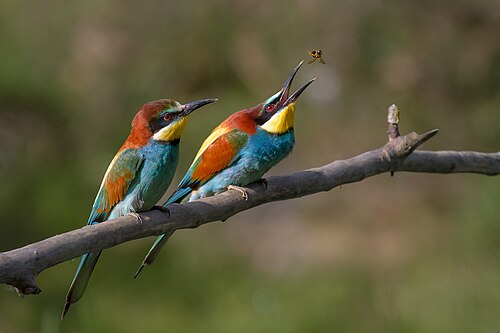
Come identificare European Bee-eater
Merops apiaster
Visto un uccello? Identificalo all'istante con l'app Birdby
Apri l'appPer identificare correttamente European Bee-eater (Merops apiaster), controlla ciascuna di queste caratteristiche. Gli uccelli possono essere complicati da riconoscere, perché comportamento, habitat e canto spesso confermano ciò che una sola foto non può.
Dimensioni a colpo d'occhio
- Lunghezza
- 27-29 cm (including elongated central tail feathers)
- Apertura alare
- 36-40 cm
- Peso
- 50-70 g
Caratteristiche fisiche da controllare
- 1
Piumaggio
Colorazione e disegno generale del piumaggio.
Adults exhibit a rich chestnut crown and mantle, transitioning to a yellow upper back. The rump is golden-yellow, and the tail is greenish-blue with elongated central tail feathers. The wings are a mix of rufous, green, and blue. Underparts are turquoise-blue, fading to green on the belly. A prominent black eye-stripe extends from the beak through the eye. The throat is bright yellow, bordered by a narrow black band.
- 2
Forma del becco
Forma e colore del becco, un segno di campo chiave.
Long, slender, decurved (downward-curving) black beak, adapted for catching insects in flight.
- 3
Colore degli occhi
Colore dell'iride e segni distintivi sugli occhi.
Bright red iris.
- 4
Colore delle zampe
Colore di zampe e piedi.
Dull reddish-brown to greyish-brown.
- 5
Caratteristiche distintive
Tratti distintivi che separano questa specie.
Vibrant multi-colored plumage (chestnut, yellow, blue, green), long decurved black bill, black eye-stripe, yellow throat with black border, and elongated central tail feathers (especially in adults).
- 6
Aspetto giovanile
Come i giovani si differenziano dagli adulti.
Juveniles are duller overall, with a greener crown and mantle, lacking the rich chestnut of adults. The yellow throat is less vibrant, and the black border is often absent or indistinct. The central tail feathers are not elongated, giving the tail a more uniform appearance. The eye-stripe is present but may be less sharply defined.
- 7
Cambiamenti stagionali
Variazione del piumaggio tra stagione riproduttiva e non.
No significant seasonal plumage changes. Plumage may appear slightly duller due to wear towards the end of the breeding season before the post-breeding molt.
- 8
Dimorfismo sessuale
Differenze tra maschi e femmine.
Males and females are largely similar in plumage. Males typically have slightly brighter and more extensive chestnut on the crown and mantle, and their central tail streamers are often longer. Females may have a slightly greener tinge to the crown and a less distinct black throat border. These differences are subtle and not always reliable for field identification.
Segni di campo chiave
- Plumage Coloration. Look for the striking combination of chestnut on the crown/mantle, golden-yellow on the back, bright yellow throat bordered by black, and turquoise-blue underparts. This multi-colored pattern is unique among European birds.
- Flight and Silhouette. Observe its graceful, undulating flight pattern with rapid wing beats and glides. In flight, note the long, slender body, pointed wings, and often visible elongated central tail feathers. They often soar high on thermals.
- Beak Shape. The long, slender, and distinctly decurved black beak is a key identification feature, adapted for its insectivorous diet.
- Vocalizations. Listen for its distinctive, liquid, rolling 'prruup' or 'prrree-up' call, often given in flight. This sound is highly characteristic and often heard before the bird is seen.
- Perching Behavior. Bee-eaters often perch conspicuously on wires, bare branches, or posts in open areas, providing excellent views for identification.
Esplora European Bee-eater
Identifica uccelli ovunque
Gratis su iOS, Android e Web. Identificazione per foto e suono, database completo e la tua lista personale.