
Visto un uccello? Identificalo all'istante con l'app Birdby
Apri l'appInformazioni
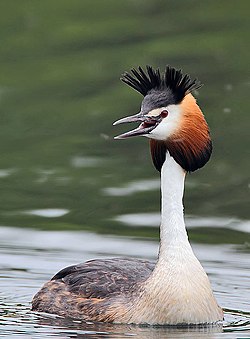
The Great Crested Grebe is a large, elegant waterbird renowned for its elaborate courtship display. It is easily recognized by its distinctive head plumes and long, slender neck. Primarily aquatic, it is an expert diver, feeding mainly on fish.
Dimensioni e longevità
- Lunghezza
- 46-51 cm (18-20 in)
- Apertura alare
- 70-85 cm (28-33 in)
- Peso
- 800-1400 g (1.8-3.1 lbs)
- Longevità
- Up to 15 years in the wild
- Dieta
- Carnivore (primarily piscivorous)
Caratteristiche fisiche
- Piumaggio
- Adults in breeding plumage have a striking appearance: a white face and neck, black crown, and prominent chestnut-red and black ear tufts (frills) that can be erected. The back and upperparts are dark brown to blackish, while the underparts are silky white. Non-breeding plumage is duller, with reduced or absent ear tufts and a less defined black cap. Juveniles have distinctive black and white stripes on the head and neck.
- Forma del becco
- Long, slender, pointed, and reddish-pink to orange-red, often with a darker culmen.
- Colore degli occhi
- Bright red.
- Colore delle zampe
- Dark grey to blackish, set far back on the body, adapted for propulsion underwater.
- Caratteristiche distintive
- The most distinctive features are the double crest and rufous-black facial ruff during breeding season. Its long, elegant neck and upright posture on water are also characteristic.
- Aspetto giovanile
- Young birds are easily identified by their striped heads and necks, resembling a 'zebra-striped' pattern, which fades as they mature.
- Cambiamenti stagionali
- The most significant change is the development of the elaborate head crests and ruffs in breeding plumage, which are reduced or absent in non-breeding (winter) plumage. The facial coloration also becomes duller in winter.
- Dimorfismo sessuale
- Males and females are generally similar in plumage, though males can be slightly larger and have more prominent crests and ruffs during courtship.
Come identificare
- 1
Size and Shape
Look for a large, slender-necked waterbird with an elegant profile. It sits low in the water.
- 2
Head Plumage (Breeding)
The most striking feature: a black double crest and prominent chestnut-red and black facial ruffs. White face and throat.
- 3
Head Plumage (Non-breeding)
Crests and ruffs are reduced or absent, but the overall white face and dark cap remain, though duller. Red eye is still visible.
- 4
Bill
Long, pointed, reddish-pink to orange-red bill, often with a darker culmen.
- 5
Juveniles
Distinctive black and white stripes on the head and neck, which are unmistakable.
- 6
Behavior
Frequent diving for fish. Elaborate courtship displays involving synchronized movements and head-shaking. Often carries chicks on its back.
- 7
Vocalization
Listen for the characteristic harsh, rattling 'krr-r-r-r' calls, especially during the breeding season.
Habitat e areale
- Biomi
- Freshwater wetlands, lakes, slow-moving rivers, reservoirs, and coastal lagoons.
- Areale geografico
- Widespread across Eurasia, Africa, and parts of Australasia. In Europe, it breeds from the British Isles and Scandinavia south to the Mediterranean, and east across Russia. African populations are largely resident, while Eurasian populations are migratory or partially migratory.
- Fascia altitudinale
- Typically found at low to moderate elevations, primarily in lowland freshwater systems.
- Ambienti preferiti
- Prefers large, open bodies of freshwater with ample emergent vegetation (reeds, rushes) for nesting and cover, and clear water for hunting fish. Also found on estuaries and sheltered coastal waters in winter.
Comportamento
- Periodo di attività
- Diurnal.
- Abitudini alimentari
- Primarily piscivorous, diving to catch fish (e.g., perch, roach, pike, eels). They also consume aquatic invertebrates, amphibians, and occasionally their own feathers (to aid digestion and pellet formation). Dives typically last 15-30 seconds.
- Comportamento sociale
- Highly territorial during the breeding season, forming monogamous pairs. Outside of breeding, they can be found in small flocks, especially on larger bodies of water or coastal areas during winter.
- Tipo di volo
- Reluctant to fly, preferring to dive or swim away from danger. When in flight, they have a distinctive 'hunchbacked' appearance with rapid wingbeats, and their long neck and legs extend beyond the body. They require a long 'runway' across the water to take off.
- Migrazione
- Northern and eastern European populations are migratory, moving to ice-free waters in Western Europe, the Mediterranean, and North Africa for winter. Southern and western European populations are largely resident or undertake short-distance movements. African and Australasian populations are generally resident.
- Territorialità
- Strongly territorial during breeding, defending nesting sites and foraging areas with aggressive displays and vocalizations. Courtship displays are elaborate and involve synchronized head-shaking, diving, and 'penguin dance' rituals.
Canto e richiami
- Canto
- Not a true songbird. Vocalizations are generally harsh, guttural, and often described as 'rattling' or 'growling' calls, particularly during courtship.
- Richiamo
- Common calls include a loud, far-carrying 'krr-r-r-r' or 'kek-kek-kek' rattle, a 'hoo-hoo-hoo' hooting call, and various 'churring' or 'growling' notes. Alarm calls are sharper 'whit' or 'kek' notes.
- Quando vocalizza
- Most vocal during the breeding season, especially during courtship and territorial defense. Less vocal outside of breeding.
Riproduzione
- Stagione riproduttiva
- Typically April to July in temperate regions, varying geographically.
- Abitudini di nidificazione
- Nests are large, floating platforms made of decaying aquatic vegetation, anchored to emergent plants or submerged branches. Both parents build the nest.
- Dimensione della covata
- 3-7 eggs, usually 4-5.
- Descrizione dell'uovo
- Typically 3-7 eggs, initially pale bluish-white, but quickly become stained brown by nest material. Oval-shaped.
- Periodo di incubazione
- 27-29 days, incubated by both parents.
- Periodo di involo
- Chicks are precocial and can swim shortly after hatching. They are carried on the parents' backs for the first few weeks and become independent after 79-110 days.
- Cure parentali
- Both parents share incubation duties and care for the young. Chicks are often seen riding on the parents' backs, even when diving, for warmth and protection.
Dove trovarlo
Large Freshwater Lakes
Ideal habitats with open water for foraging and reedbeds for nesting. Look along the edges of reedbeds.
Reservoirs and Gravel Pits
Man-made water bodies often provide suitable conditions, especially those with established vegetation.
Slow-moving Rivers
Wider, calmer sections of rivers with good fish populations and bankside vegetation.
Coastal Lagoons and Estuaries
During winter, they may move to sheltered coastal waters, particularly in milder climates.
Consigli sul campo
- Scan Open Water. They spend most of their time on the water, so scan open areas for their distinctive profile. Look for ripples indicating a recent dive.
- Look for Courtship Displays. During spring and early summer, observe pairs for their elaborate and fascinating courtship rituals, which are a highlight for birdwatchers.
- Check for Chicks. In summer, look for adults with small, striped chicks riding on their backs, a truly endearing sight.
- Use Optics. A good pair of binoculars or a spotting scope is essential for observing their intricate plumage details and behaviors from a distance without disturbance.
- Be Patient. Grebes can be shy. Find a good vantage point and wait quietly for them to emerge from cover or resume their activities.
Specie simili
Red-necked Grebe
Podiceps grisegena
The Red-necked Grebe lacks the prominent head crests and ruffs of the Great Crested Grebe. It has a grey neck (not white), a black cap extending further down the face, and a thicker, darker bill with a yellow base. Its overall posture is also less elegant.
Horned Grebe (Slavonian Grebe)
Podiceps auritus
Significantly smaller than the Great Crested Grebe. In breeding plumage, it has golden-orange ear tufts and a black head and neck, lacking the rufous ruff. In non-breeding plumage, it is much smaller, with a cleaner white cheek and a more defined black cap than a non-breeding Great Crested Grebe.
Fatti rapidi
- Primary Diet:
- Fish
- Nesting Style:
- Floating nest platform
- Distinctive Feature:
- Elaborate head crests and ruffs
- Movement:
- Expert diver, reluctant flyer
- Chicks:
- Ride on parents' backs
Curiosità
- The Great Crested Grebe's courtship display, known as the 'penguin dance' or 'weed dance', is one of the most complex and beautiful in the avian world, involving synchronized head-shaking, diving, and presenting weeds to each other.
- They regularly eat their own feathers, which are thought to help form indigestible pellets that protect the stomach lining from sharp fish bones.
- Despite being excellent divers, their legs are set so far back on their bodies that they are extremely clumsy on land and rarely leave the water.
- The species was hunted almost to extinction in the 19th century for its beautiful head plumes, which were used to decorate hats and clothing. Conservation efforts have led to a significant recovery.
Classificazione scientifica
- Regno
- Animalia
- Phylum
- Chordata
- Classe
- Aves
- Ordine
- Podicipediformes
- Famiglia
- Podicipedidae
- Genere
- Podiceps
- Specie
- Podiceps cristatus
Esplora Great Crested Grebe
Identifica uccelli ovunque
Gratis su iOS, Android e Web. Identificazione per foto e suono, database completo e la tua lista personale.