
Come identificare Great Crested Grebe
Podiceps cristatus
Visto un uccello? Identificalo all'istante con l'app Birdby
Apri l'appPer identificare correttamente Great Crested Grebe (Podiceps cristatus), controlla ciascuna di queste caratteristiche. Gli uccelli possono essere complicati da riconoscere, perché comportamento, habitat e canto spesso confermano ciò che una sola foto non può.
Dimensioni a colpo d'occhio
- Lunghezza
- 46-51 cm (18-20 in)
- Apertura alare
- 70-85 cm (28-33 in)
- Peso
- 800-1400 g (1.8-3.1 lbs)
Caratteristiche fisiche da controllare
- 1
Piumaggio
Colorazione e disegno generale del piumaggio.
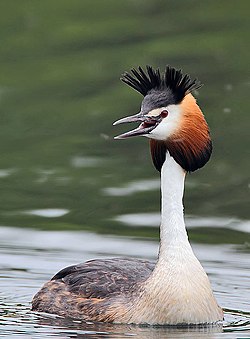
Adults in breeding plumage have a striking appearance: a white face and neck, black crown, and prominent chestnut-red and black ear tufts (frills) that can be erected. The back and upperparts are dark brown to blackish, while the underparts are silky white. Non-breeding plumage is duller, with reduced or absent ear tufts and a less defined black cap. Juveniles have distinctive black and white stripes on the head and neck.
- 2
Forma del becco
Forma e colore del becco, un segno di campo chiave.
Long, slender, pointed, and reddish-pink to orange-red, often with a darker culmen.
- 3
Colore degli occhi
Colore dell'iride e segni distintivi sugli occhi.
Bright red.
- 4
Colore delle zampe
Colore di zampe e piedi.
Dark grey to blackish, set far back on the body, adapted for propulsion underwater.
- 5
Caratteristiche distintive
Tratti distintivi che separano questa specie.
The most distinctive features are the double crest and rufous-black facial ruff during breeding season. Its long, elegant neck and upright posture on water are also characteristic.
- 6
Aspetto giovanile
Come i giovani si differenziano dagli adulti.
Young birds are easily identified by their striped heads and necks, resembling a 'zebra-striped' pattern, which fades as they mature.
- 7
Cambiamenti stagionali
Variazione del piumaggio tra stagione riproduttiva e non.
The most significant change is the development of the elaborate head crests and ruffs in breeding plumage, which are reduced or absent in non-breeding (winter) plumage. The facial coloration also becomes duller in winter.
- 8
Dimorfismo sessuale
Differenze tra maschi e femmine.
Males and females are generally similar in plumage, though males can be slightly larger and have more prominent crests and ruffs during courtship.
Segni di campo chiave
- Size and Shape. Look for a large, slender-necked waterbird with an elegant profile. It sits low in the water.
- Head Plumage (Breeding). The most striking feature: a black double crest and prominent chestnut-red and black facial ruffs. White face and throat.
- Head Plumage (Non-breeding). Crests and ruffs are reduced or absent, but the overall white face and dark cap remain, though duller. Red eye is still visible.
- Bill. Long, pointed, reddish-pink to orange-red bill, often with a darker culmen.
- Juveniles. Distinctive black and white stripes on the head and neck, which are unmistakable.
- Behavior. Frequent diving for fish. Elaborate courtship displays involving synchronized movements and head-shaking. Often carries chicks on its back.
- Vocalization. Listen for the characteristic harsh, rattling 'krr-r-r-r' calls, especially during the breeding season.
Esplora Great Crested Grebe
Identifica uccelli ovunque
Gratis su iOS, Android e Web. Identificazione per foto e suono, database completo e la tua lista personale.