
Visto un uccello? Identificalo all'istante con l'app Birdby
Apri l'appInformazioni
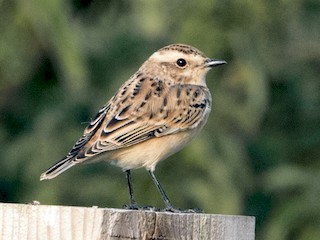
The Whinchat (Saxicola rubetra) is a small, migratory passerine bird in the Old World flycatcher family Muscicapidae. It is known for its distinctive white supercilium and often perches prominently on vegetation, fences, or wires, frequently flicking its tail. It is an insectivorous species, breeding across much of temperate Europe and western Asia, and wintering in sub-Saharan Africa.
Dimensioni e longevità
- Lunghezza
- 12-14 cm
- Apertura alare
- 21-24 cm
- Peso
- 13-26 g
- Longevità
- 2-5 years (up to 8 years recorded)
- Dieta
- Insectivore
Caratteristiche fisiche
- Piumaggio
- Males in breeding plumage have a striking appearance: a prominent white supercilium (eyebrow) contrasting with a dark brown cheek and crown, a white throat, and an orange-buff breast and flanks. The upperparts are streaky brown with dark centers to the feathers. The rump is plain brown, and the tail is dark with white at the base of the outer tail feathers. The wings are dark with a distinct white patch (speculum) formed by white bases to the primary coverts and white edges to the tertials. Females are duller overall, with a less distinct supercilium, paler brown cheeks, and a more muted buff-orange breast. Non-breeding males resemble females but retain some of the breeding male's distinctiveness.
- Forma del becco
- Small, slender, pointed, and dark (blackish-brown).
- Colore degli occhi
- Dark brown.
- Colore delle zampe
- Dark brown to black.
- Caratteristiche distintive
- Prominent white supercilium, dark cheek patch, orange-buff breast, white wing patch (speculum), and white at the base of the outer tail feathers, often visible in flight or when perched.
- Aspetto giovanile
- Juveniles are heavily mottled and streaked brown above and below, lacking the distinct facial pattern and bright coloration of adults. They have a pale supercilium but it is less defined than in adult females. The white wing patch is present but may be less conspicuous.
- Cambiamenti stagionali
- Males undergo a pre-nuptial molt in late winter/early spring, acquiring their vibrant breeding plumage. After breeding, a post-nuptial molt occurs, leading to a duller, more female-like non-breeding plumage. Females also undergo molts, but their seasonal plumage changes are less dramatic.
- Dimorfismo sessuale
- Pronounced in breeding plumage, with males being much brighter and more distinctly marked. Females are duller, with a less defined facial pattern and paler underparts. In non-breeding plumage, males resemble females but can still be distinguished by slightly stronger markings.
Come identificare
- 1
Facial Pattern
Look for the prominent white supercilium (eyebrow) contrasting with a dark cheek patch and crown. This is a key field mark, especially in males.
- 2
Breast Coloration
Observe the orange-buff breast and flanks, which are brighter in males and duller in females.
- 3
Wing Patch
Note the distinct white patch (speculum) on the dark wings, visible both when perched and in flight.
- 4
Tail Pattern
Look for the dark tail with white at the base of the outer tail feathers, often flicked when perched.
- 5
Perching Behavior
Whinchats frequently perch on prominent, elevated spots like tall weeds, fence posts, or wires, often flicking their tail.
- 6
Song and Calls
Listen for the scratchy, warbling song with mimicry, and the sharp 'tack-tack' alarm call.
Habitat e areale
- Biomi
- Temperate grasslands, heathlands, agricultural areas, open woodlands, moorlands, and alpine meadows.
- Areale geografico
- Breeds across most of temperate Europe and western Asia, from Ireland and Portugal east to western Siberia. Winters in sub-Saharan Africa, from Senegal east to Ethiopia and south to South Africa.
- Fascia altitudinale
- From sea level up to 2,000 meters in breeding areas, and similar ranges in wintering grounds.
- Ambienti preferiti
- Prefers open, grassy habitats with scattered bushes, tall herbaceous vegetation, or low scrub for perching and nesting. Often found in meadows, pastures, clearings, young plantations, and along hedgerows. Avoids dense forests and arid regions.
Comportamento
- Periodo di attività
- Diurnal.
- Abitudini alimentari
- Primarily insectivorous, feeding on a wide variety of invertebrates including beetles, grasshoppers, crickets, flies, caterpillars, spiders, and worms. It typically forages by perching on a prominent lookout post (e.g., a tall weed, fence post, or bush) and sallying out to catch prey on the ground or in the air. It also gleans insects from vegetation.
- Comportamento sociale
- Generally solitary or found in pairs during the breeding season. During migration, they can form loose flocks, especially at stopover sites.
- Tipo di volo
- Undulating flight, often low over vegetation. When disturbed, it flies a short distance before perching again, often flicking its tail and wings. Migration flight is strong and direct.
- Migrazione
- Long-distance migratory species. Breeds in Europe and western Asia, migrating south to winter in sub-Saharan Africa. Autumn migration typically occurs from August to October, and spring migration from March to May. They often cross the Sahara Desert.
- Territorialità
- Males are territorial during the breeding season, defending their nesting and foraging areas with song and displays. They can be quite aggressive towards intruders.
Canto e richiami
- Canto
- A varied, warbling, and often scratchy song, typically delivered from a prominent perch. It includes mimicry of other bird species and often has a 'churring' quality. The song is a rapid succession of short, high-pitched phrases, often starting with a few clear notes and becoming more jumbled and scratchy.
- Richiamo
- Common calls include a sharp, 'tack-tack' or 'tsack-tsack' call, often given when alarmed or agitated. Also a soft, whistled 'hoo-eet' or 'whee-t' contact call.
- Quando vocalizza
- Most vocal during the breeding season (spring and early summer) when males are establishing territories and attracting mates. Calls are given year-round, especially when disturbed or in contact with other individuals.
Riproduzione
- Stagione riproduttiva
- May to July in most of its breeding range.
- Abitudini di nidificazione
- Nests are typically built on the ground, well-concealed within dense vegetation, often at the base of a tussock of grass or under a small bush. The nest is a cup-shaped structure made of grass, moss, and roots, lined with finer materials like hair and feathers.
- Dimensione della covata
- 4-7 eggs, usually 5-6.
- Descrizione dell'uovo
- 4-7 eggs, typically pale blue or greenish-blue, sometimes with fine reddish-brown speckles, particularly at the broader end. Eggs measure approximately 18-20 mm by 14-15 mm.
- Periodo di incubazione
- 13-15 days, primarily by the female.
- Periodo di involo
- 12-14 days after hatching. Young are fed by both parents.
- Cure parentali
- Both parents participate in feeding the nestlings and fledglings. The female primarily incubates, but the male often brings food to her on the nest.
Dove trovarlo
Meadows and Pastures
Look in open grassy areas with scattered bushes or tall herbaceous plants, especially those used for grazing.
Heathlands and Moorlands
These open, shrubby habitats provide ideal perching and nesting sites.
Agricultural Margins
Check along hedgerows, field edges, and areas with uncultivated strips.
Alpine Meadows
In mountainous regions, they can be found in open, grassy areas at higher elevations.
Consigli sul campo
- Look for prominent perches. Whinchats are often easy to spot as they prefer to perch conspicuously on the tops of tall weeds, fence posts, or low bushes. Scan these elevated points.
- Listen for their song and calls. Their distinctive song and sharp 'tack-tack' call can often lead you to their location, especially during the breeding season.
- Observe tail flicking. A characteristic behavior is the frequent flicking of the tail and sometimes wings while perched, which can help confirm identification.
- Visit suitable habitats during migration. During spring and autumn migration, they can be found in a wider variety of open habitats as they refuel.
Specie simili
Stonechat
Saxicola rubicola
The Stonechat male has a black head, white collar, and orange-red breast, lacking the Whinchat's prominent white supercilium and streaky back. Females are duller but still show a dark head and often a pale throat patch, differing from the Whinchat's facial pattern. Stonechats also lack the distinct white wing patch of the Whinchat.
Siberian Stonechat
Saxicola maurus
Similar to Stonechat, but males typically have a more extensive white rump and often a more prominent white patch on the neck. Distinguishing from Whinchat is similar to Stonechat, primarily by the lack of a strong white supercilium and the presence of a black head in breeding males.
European Robin
Erithacus rubecula
While also having an orange-red breast, the Robin lacks the Whinchat's white supercilium, dark cheek patch, and streaky back. Robins have a more upright posture and a different foraging style.
Fatti rapidi
- Status:
- Migratory
- Diet:
- Insects and other invertebrates
- Habitat:
- Open grasslands with scattered bushes
- Distinguishing Mark:
- White supercilium, orange-buff breast, white wing patch
- Nesting:
- Ground nest, well-concealed
Curiosità
- The Whinchat is a long-distance migrant, undertaking journeys of thousands of kilometers between its European breeding grounds and African wintering grounds, often crossing the Sahara Desert.
- Its scientific name 'Saxicola' means 'rock-dweller', and 'rubetra' is derived from 'rubus' (bramble), referring to its preferred habitat of open areas with scattered bushes and brambles.
- Males often incorporate mimicry of other bird species into their complex songs, making each individual's song unique.
- Despite its 'Least Concern' conservation status globally, Whinchat populations have declined in some parts of its European range due to habitat loss and agricultural intensification.
Classificazione scientifica
- Regno
- Animalia
- Phylum
- Chordata
- Classe
- Aves
- Ordine
- Passeriformes
- Famiglia
- Muscicapidae
- Genere
- Saxicola
- Specie
- Saxicola rubetra
Esplora Whinchat
Identifica uccelli ovunque
Gratis su iOS, Android e Web. Identificazione per foto e suono, database completo e la tua lista personale.