
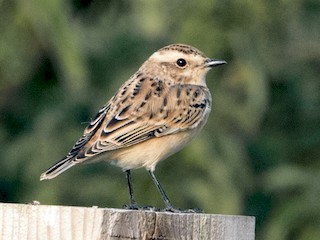
Come identificare Whinchat
Saxicola rubetra
Visto un uccello? Identificalo all'istante con l'app Birdby
Apri l'appPer identificare correttamente Whinchat (Saxicola rubetra), controlla ciascuna di queste caratteristiche. Gli uccelli possono essere complicati da riconoscere, perché comportamento, habitat e canto spesso confermano ciò che una sola foto non può.
Dimensioni a colpo d'occhio
- Lunghezza
- 12-14 cm
- Apertura alare
- 21-24 cm
- Peso
- 13-26 g
Caratteristiche fisiche da controllare
- 1
Piumaggio
Colorazione e disegno generale del piumaggio.
Males in breeding plumage have a striking appearance: a prominent white supercilium (eyebrow) contrasting with a dark brown cheek and crown, a white throat, and an orange-buff breast and flanks. The upperparts are streaky brown with dark centers to the feathers. The rump is plain brown, and the tail is dark with white at the base of the outer tail feathers. The wings are dark with a distinct white patch (speculum) formed by white bases to the primary coverts and white edges to the tertials. Females are duller overall, with a less distinct supercilium, paler brown cheeks, and a more muted buff-orange breast. Non-breeding males resemble females but retain some of the breeding male's distinctiveness.
- 2
Forma del becco
Forma e colore del becco, un segno di campo chiave.
Small, slender, pointed, and dark (blackish-brown).
- 3
Colore degli occhi
Colore dell'iride e segni distintivi sugli occhi.
Dark brown.
- 4
Colore delle zampe
Colore di zampe e piedi.
Dark brown to black.
- 5
Caratteristiche distintive
Tratti distintivi che separano questa specie.
Prominent white supercilium, dark cheek patch, orange-buff breast, white wing patch (speculum), and white at the base of the outer tail feathers, often visible in flight or when perched.
- 6
Aspetto giovanile
Come i giovani si differenziano dagli adulti.
Juveniles are heavily mottled and streaked brown above and below, lacking the distinct facial pattern and bright coloration of adults. They have a pale supercilium but it is less defined than in adult females. The white wing patch is present but may be less conspicuous.
- 7
Cambiamenti stagionali
Variazione del piumaggio tra stagione riproduttiva e non.
Males undergo a pre-nuptial molt in late winter/early spring, acquiring their vibrant breeding plumage. After breeding, a post-nuptial molt occurs, leading to a duller, more female-like non-breeding plumage. Females also undergo molts, but their seasonal plumage changes are less dramatic.
- 8
Dimorfismo sessuale
Differenze tra maschi e femmine.
Pronounced in breeding plumage, with males being much brighter and more distinctly marked. Females are duller, with a less defined facial pattern and paler underparts. In non-breeding plumage, males resemble females but can still be distinguished by slightly stronger markings.
Segni di campo chiave
- Facial Pattern. Look for the prominent white supercilium (eyebrow) contrasting with a dark cheek patch and crown. This is a key field mark, especially in males.
- Breast Coloration. Observe the orange-buff breast and flanks, which are brighter in males and duller in females.
- Wing Patch. Note the distinct white patch (speculum) on the dark wings, visible both when perched and in flight.
- Tail Pattern. Look for the dark tail with white at the base of the outer tail feathers, often flicked when perched.
- Perching Behavior. Whinchats frequently perch on prominent, elevated spots like tall weeds, fence posts, or wires, often flicking their tail.
- Song and Calls. Listen for the scratchy, warbling song with mimicry, and the sharp 'tack-tack' alarm call.
Esplora Whinchat
Identifica uccelli ovunque
Gratis su iOS, Android e Web. Identificazione per foto e suono, database completo e la tua lista personale.