
Visto un uccello? Identificalo all'istante con l'app Birdby
Apri l'appInformazioni
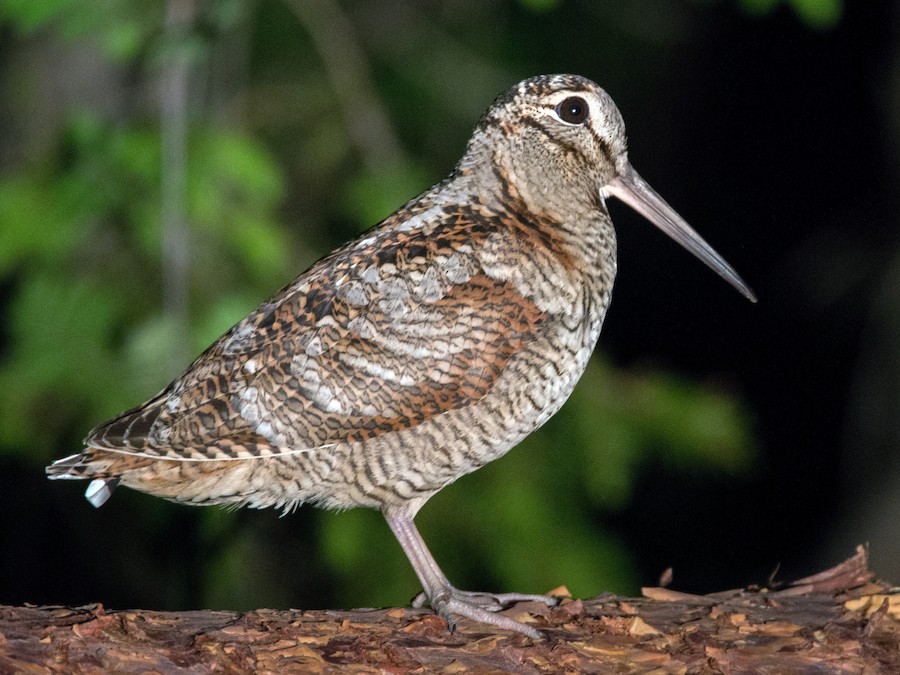
The Eurasian Woodcock, known as 'Beccaccia' in Italian, is a medium-sized wading bird with cryptic plumage, perfectly adapted for camouflage in its woodland habitat. It is primarily nocturnal or crepuscular, feeding on invertebrates in soft ground with its long bill. Renowned for its distinctive 'roding' display flight during the breeding season, it is a migratory species across much of its range.
Dimensioni e longevità
- Lunghezza
- 33-38 cm (13-15 in)
- Apertura alare
- 55-65 cm (22-26 in)
- Peso
- 140-420 g (4.9-14.8 oz), with males typically 140-300 g and females 200-420 g
- Longevità
- Up to 15 years in the wild, typically 3-5 years
- Dieta
- Insectivore/Vermivore, primarily earthworms, but also insects, larvae, spiders, and some plant material
Caratteristiche fisiche
- Piumaggio
- Upperparts are a complex pattern of rufous, brown, black, and grey, providing excellent camouflage against leaf litter. Underparts are buffy-white with fine dark barring. The head has broad black bands running from the bill to the nape, separated by buffy-white stripes. The crown is dark with two prominent black bars. The tail is short, dark, and tipped with rufous-brown.
- Forma del becco
- Very long (6-8 cm), straight, and slender, pale pinkish-brown at the base, darkening towards the tip. The tip is flexible and sensitive, used for probing.
- Colore degli occhi
- Large, dark brown eyes set high and far back on the head, providing a wide field of vision (almost 360 degrees).
- Colore delle zampe
- Short, stout legs, typically pale pinkish-grey to brownish-grey.
- Caratteristiche distintive
- Cryptic plumage, large eyes set high on the head, long straight bill, and a distinctive 'roding' flight display. The dark bars on the crown are a key field mark.
- Aspetto giovanile
- Juveniles resemble adults but may have slightly duller plumage and less distinct patterning. Their flight feathers are typically less worn than adults.
- Cambiamenti stagionali
- No significant seasonal changes in plumage. The cryptic coloration remains consistent year-round.
- Dimorfismo sessuale
- Minimal to no sexual dimorphism in plumage. Females are generally slightly larger and heavier than males, especially during the breeding season when carrying eggs.
Come identificare
- 1
Plumage and Camouflage
Look for its incredibly cryptic brown, black, and rufous mottled plumage, which makes it almost invisible against leaf litter. This is its primary defense.
- 2
Head Pattern
Observe the distinctive head pattern: two broad black bands across the crown, separated by buffy-white stripes. Its large, dark eyes are set high and far back on the head.
- 3
Bill
Note the very long, straight, and slender bill, which is characteristic of a probing feeder.
- 4
Flight (when flushed)
If flushed, it will typically burst from cover with a rapid, erratic, zig-zagging flight for a short distance before dropping back into dense vegetation. This is a key identification cue.
- 5
Roding Display (males)
During the breeding season (dusk/dawn), listen and look for the male's 'roding' flight: a slow, deliberate flight above the treetops, accompanied by guttural croaks and high-pitched whistles.
- 6
Habitat
Its preference for dense, damp woodlands with soft soil is a strong indicator. If you see a 'snipe-like' bird in such a habitat, it's likely a Woodcock.
Habitat e areale
- Biomi
- Temperate and boreal forests, mixed woodlands, dense scrub, and thickets.
- Areale geografico
- Widespread across the Palearctic. Breeding range extends from Western Europe (including the UK and Ireland) across Scandinavia, Russia, and into East Asia (Japan, China). Winters in Western and Southern Europe, North Africa, and South Asia.
- Fascia altitudinale
- Typically found from sea level up to 2,000 meters (6,500 ft), occasionally higher in some mountainous regions during migration.
- Ambienti preferiti
- Prefers damp, deciduous or mixed woodlands with dense undergrowth, soft soil for probing, and scattered clearings. Often found near water sources or boggy areas.
Comportamento
- Periodo di attività
- Crepuscular and nocturnal, especially for feeding. During the breeding season, males perform their 'roding' display at dusk and dawn.
- Abitudini alimentari
- Primarily nocturnal or crepuscular. Forages by probing its long bill into soft soil and leaf litter to extract earthworms, insect larvae, and other invertebrates. The flexible bill tip allows it to grasp prey while the bill is still in the ground. Also picks food from the surface.
- Comportamento sociale
- Mostly solitary, especially outside the breeding season. During migration, loose aggregations can occur at stopover sites. Males are polygynous during breeding.
- Tipo di volo
- Typically flies low and fast through dense cover when flushed. During the 'roding' display, males fly slowly and deliberately above the treetops, often in a circular pattern, with characteristic wing beats and vocalizations. Flight is generally direct and powerful.
- Migrazione
- Partially migratory. Northern and eastern populations are fully migratory, moving to warmer wintering grounds in Western and Southern Europe, North Africa, and South Asia. Western and southern European populations may be resident or undertake shorter, altitudinal migrations. Migration occurs mainly at night.
- Territorialità
- Males establish breeding territories, which they defend through their 'roding' display. Females defend nesting territories.
Canto e richiami
- Canto
- The 'song' is part of the male's 'roding' display flight. It consists of a series of low, guttural croaks or grunts ('orrrt-orrrt-orrrt') followed by a high-pitched, whistling 'psissp' or 'twick'. This sequence is repeated rhythmically.
- Richiamo
- When flushed, a sharp, explosive 'scap' or 'squawk'. Other calls include soft 'chip' notes and a low 'churr' during courtship.
- Quando vocalizza
- Primarily vocalizes during the breeding season (March-July), especially at dusk and dawn during the 'roding' display. Alarm calls can be heard year-round if the bird is disturbed.
Riproduzione
- Stagione riproduttiva
- March to July, with peak activity in April-May.
- Abitudini di nidificazione
- Nests on the ground, typically in a shallow scrape lined with leaves, moss, and grass, well-hidden at the base of a tree, bush, or under dense vegetation in woodland. The female alone builds the nest.
- Dimensione della covata
- Usually 4 eggs, rarely 3 or 5.
- Descrizione dell'uovo
- Typically 4 eggs, oval to pyriform in shape. Color varies from pale buff to creamy-white or yellowish-brown, heavily blotched and spotted with dark brown, grey, or reddish-brown, often concentrated at the broad end.
- Periodo di incubazione
- 20-24 days, incubated solely by the female.
- Periodo di involo
- Chicks are precocial and leave the nest shortly after hatching (within hours). They are able to feed themselves but are brooded and protected by the female. They become fully independent and capable of flight at about 15-20 days.
- Cure parentali
- Only the female cares for the eggs and young. She broods the chicks and leads them to feeding areas. She is known to carry young chicks between her legs or on her back if danger approaches.
Dove trovarlo
Damp Deciduous or Mixed Woodlands
Focus on areas with dense undergrowth, leaf litter, and soft, moist soil, especially near streams or boggy patches. Look for areas with mature trees providing good cover.
Forest Edges and Clearings
While they prefer dense cover, they may forage at the edges of woodlands or in small clearings, particularly at dusk or dawn.
Wintering Grounds
In winter, they can be found in similar habitats in milder climates, often in coastal woodlands or sheltered valleys.
Consigli sul campo
- Timing is Key. The best time to observe Eurasian Woodcocks is at dusk or dawn, especially during the breeding season (March-July) when males perform their 'roding' display. Outside of this, they are largely nocturnal and very secretive.
- Listen for Roding. Learn the distinctive 'orrrt-orrrt-orrrt psissp' call of the roding male. This is often the first indication of their presence.
- Walk Quietly. Move slowly and quietly through suitable woodland habitat. You are more likely to flush one by surprise than to spot one sitting still due to their camouflage.
- Look for Droppings. Look for their distinctive droppings, which are often white and splashy, sometimes with a dark center, found on paths or open ground in their habitat.
- Use Binoculars. Even if you flush one, it will likely be a brief view. Binoculars will help confirm identification quickly.
Specie simili
American Woodcock
Scolopax minor
Smaller size (25-30 cm), shorter bill, and different head pattern (three black bars on the crown, not two broad bands). Found only in North America. The 'peent' call of the American Woodcock is also distinct from the Eurasian Woodcock's roding call.
Great Snipe
Gallinago media
More upright posture, shorter bill relative to body size, and a more streaked appearance on the flanks. Lacks the prominent head banding of the Woodcock. Found in open, wet grasslands and bogs, not dense woodlands. Flight is more direct and less erratic than a flushed Woodcock.
Common Snipe
Gallinago gallinago
Smaller than the Woodcock, with a more slender body and a longer, thinner bill. Has prominent stripes on the head and back, and a more pointed tail. Found in open wetlands. Its 'chipper' display flight and 'drumming' sound are very different from the Woodcock's roding.
Fatti rapidi
- Vision:
- Almost 360-degree monocular vision, allowing them to see predators from nearly all directions without moving their head.
- Bill Flexibility:
- The tip of their bill is flexible and can be opened independently of the rest of the bill, allowing them to grasp prey underground.
- Carrying Young:
- Females are known to carry their young chicks to safety by holding them between their legs or on their back during disturbance.
- Roding:
- The male's aerial display flight, called 'roding', is a unique courtship ritual performed at dusk and dawn.
- Camouflage:
- Their plumage provides exceptional camouflage, making them incredibly difficult to spot on the forest floor.
Curiosità
- The term 'woodcock's eye' refers to the bird's large, dark eyes set high on its head, giving it excellent peripheral vision.
- In some cultures, the woodcock is considered a delicacy, and its hunting is a traditional practice.
- The woodcock's brain is unique among birds, being inverted, with the cerebellum located above the cerebrum.
- Despite its plump appearance, the woodcock is a strong flyer and undertakes long migratory journeys.
- The 'roding' display is not just for attracting mates; it also serves to mark territory and deter rival males.
Classificazione scientifica
- Regno
- Animalia
- Phylum
- Chordata
- Classe
- Aves
- Ordine
- Charadriiformes
- Famiglia
- Scolopacidae
- Genere
- Scolopax
- Specie
- Scolopax rusticola
Esplora Eurasian Woodcock
Identifica uccelli ovunque
Gratis su iOS, Android e Web. Identificazione per foto e suono, database completo e la tua lista personale.