
Come identificare Eurasian Woodcock
Scolopax rusticola
Visto un uccello? Identificalo all'istante con l'app Birdby
Apri l'appPer identificare correttamente Eurasian Woodcock (Scolopax rusticola), controlla ciascuna di queste caratteristiche. Gli uccelli possono essere complicati da riconoscere, perché comportamento, habitat e canto spesso confermano ciò che una sola foto non può.
Dimensioni a colpo d'occhio
- Lunghezza
- 33-38 cm (13-15 in)
- Apertura alare
- 55-65 cm (22-26 in)
- Peso
- 140-420 g (4.9-14.8 oz), with males typically 140-300 g and females 200-420 g
Caratteristiche fisiche da controllare
- 1
Piumaggio
Colorazione e disegno generale del piumaggio.
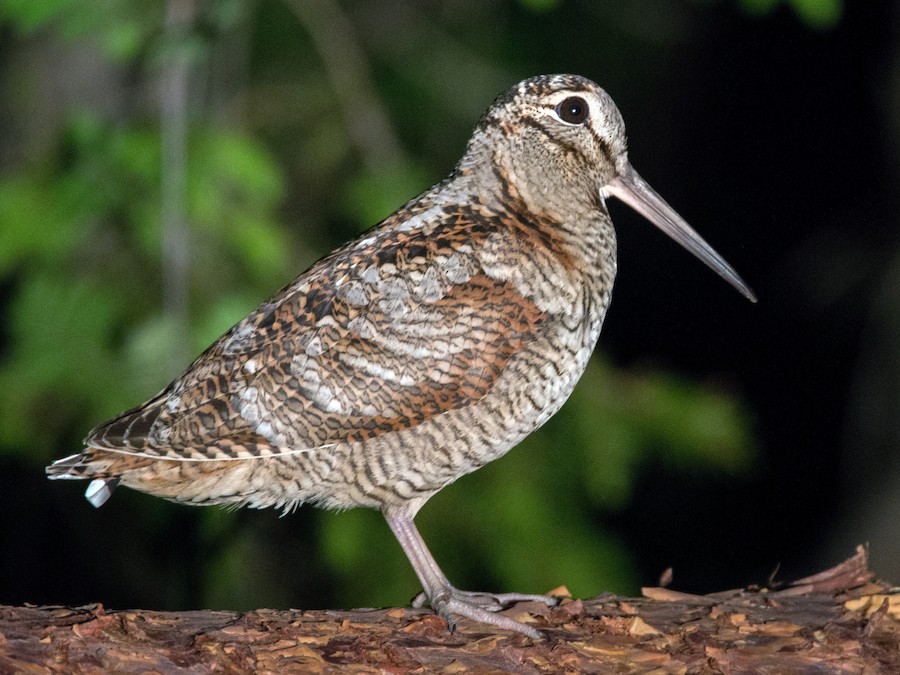
Upperparts are a complex pattern of rufous, brown, black, and grey, providing excellent camouflage against leaf litter. Underparts are buffy-white with fine dark barring. The head has broad black bands running from the bill to the nape, separated by buffy-white stripes. The crown is dark with two prominent black bars. The tail is short, dark, and tipped with rufous-brown.
- 2
Forma del becco
Forma e colore del becco, un segno di campo chiave.
Very long (6-8 cm), straight, and slender, pale pinkish-brown at the base, darkening towards the tip. The tip is flexible and sensitive, used for probing.
- 3
Colore degli occhi
Colore dell'iride e segni distintivi sugli occhi.
Large, dark brown eyes set high and far back on the head, providing a wide field of vision (almost 360 degrees).
- 4
Colore delle zampe
Colore di zampe e piedi.
Short, stout legs, typically pale pinkish-grey to brownish-grey.
- 5
Caratteristiche distintive
Tratti distintivi che separano questa specie.
Cryptic plumage, large eyes set high on the head, long straight bill, and a distinctive 'roding' flight display. The dark bars on the crown are a key field mark.
- 6
Aspetto giovanile
Come i giovani si differenziano dagli adulti.
Juveniles resemble adults but may have slightly duller plumage and less distinct patterning. Their flight feathers are typically less worn than adults.
- 7
Cambiamenti stagionali
Variazione del piumaggio tra stagione riproduttiva e non.
No significant seasonal changes in plumage. The cryptic coloration remains consistent year-round.
- 8
Dimorfismo sessuale
Differenze tra maschi e femmine.
Minimal to no sexual dimorphism in plumage. Females are generally slightly larger and heavier than males, especially during the breeding season when carrying eggs.
Segni di campo chiave
- Plumage and Camouflage. Look for its incredibly cryptic brown, black, and rufous mottled plumage, which makes it almost invisible against leaf litter. This is its primary defense.
- Head Pattern. Observe the distinctive head pattern: two broad black bands across the crown, separated by buffy-white stripes. Its large, dark eyes are set high and far back on the head.
- Bill. Note the very long, straight, and slender bill, which is characteristic of a probing feeder.
- Flight (when flushed). If flushed, it will typically burst from cover with a rapid, erratic, zig-zagging flight for a short distance before dropping back into dense vegetation. This is a key identification cue.
- Roding Display (males). During the breeding season (dusk/dawn), listen and look for the male's 'roding' flight: a slow, deliberate flight above the treetops, accompanied by guttural croaks and high-pitched whistles.
- Habitat. Its preference for dense, damp woodlands with soft soil is a strong indicator. If you see a 'snipe-like' bird in such a habitat, it's likely a Woodcock.
Esplora Eurasian Woodcock
Identifica uccelli ovunque
Gratis su iOS, Android e Web. Identificazione per foto e suono, database completo e la tua lista personale.