
Visto un uccello? Identificalo all'istante con l'app Birdby
Apri l'appInformazioni
The Wood Sandpiper (Tringa glareola) is a small, elegant wader belonging to the family Scolopacidae. It is known for its distinctive pale supercilium, finely spotted upperparts, and relatively long, greenish legs. It is a highly migratory species, breeding in the boreal forests and taiga wetlands of Eurasia and migrating to Africa, South Asia, and Australasia for the non-breeding season.
Dimensioni e longevità
- Lunghezza
- 18-21 cm
- Apertura alare
- 36-40 cm
- Peso
- 34-98 g (average 50-60 g)
- Longevità
- Up to 10 years in the wild
- Dieta
- Insectivore
Caratteristiche fisiche
- Piumaggio
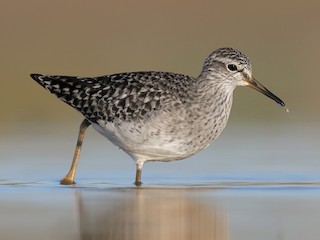
- Upperparts are dark brown to olive-brown, heavily spotted and streaked with white or pale buff, giving a 'scaly' appearance. Underparts are white, with fine streaking on the breast and flanks, especially in breeding plumage. A prominent pale supercilium extends behind the eye. The rump is white, and the tail is white with narrow dark bars.
- Forma del becco
- Relatively slender, straight, and dark, often with a paler greenish or yellowish base.
- Colore degli occhi
- Dark brown
- Colore delle zampe
- Long, greenish-yellow to olive-green legs, which can appear duller in non-breeding birds or juveniles.
- Caratteristiche distintive
- Prominent pale supercilium, finely spotted upperparts, white rump, barred tail, and greenish legs. In flight, the lack of a wing-bar and the white rump are key features.
- Aspetto giovanile
- Juveniles have more uniformly buff-spotted upperparts, often appearing 'neater' than adults. The breast streaking is less defined, and the legs may be duller.
- Cambiamenti stagionali
- Breeding plumage is more intensely marked with darker upperparts and more prominent white spotting. Non-breeding plumage is duller, with less distinct spotting and streaking, and a more uniform grey-brown appearance on the upperparts.
- Dimorfismo sessuale
- Males and females are generally similar in plumage, though females may be slightly larger on average. No obvious sexual dimorphism in coloration.
Come identificare
- 1
Size and Shape
A small, elegant wader with a relatively long neck and legs, and a slender bill. Often appears 'perky' with a slight head-bob.
- 2
Plumage (Upperparts)
Look for dark olive-brown upperparts heavily spotted and streaked with white or pale buff, giving a finely 'scaly' or 'spangled' appearance. This is a key distinction from the uniform dark upperparts of the Green Sandpiper.
- 3
Supercilium
A prominent, long, pale supercilium (stripe above the eye) that extends well behind the eye is a strong field mark.
- 4
Rump and Tail
In flight, observe the bright white rump contrasting sharply with the dark wings. The tail is white with fine dark barring, especially visible when fanned.
- 5
Legs
Long, greenish-yellow to olive-green legs are characteristic. The color can vary with age and season but is generally lighter than the dark legs of a Green Sandpiper.
- 6
Call
Listen for its distinctive sharp, high-pitched 'chip-chip-chip' or 'chiff-chiff-chiff' call, especially when flushed.
- 7
Behavior
Often forages actively in shallow water, wading and probing. It frequently bobs its head and tail when standing, though less pronounced than a Common Sandpiper.
Habitat e areale
- Biomi
- Boreal forests, taiga, tundra, wetlands, marshes, bogs, wet meadows, shallow freshwater pools, rice paddies, sewage farms.
- Areale geografico
- Breeds across northern Eurasia from Scandinavia east to Siberia and Kamchatka. Winters in Africa (south of the Sahara), South Asia (India, Southeast Asia), and Australasia (Australia, New Zealand). Migrates through much of Europe, the Middle East, and Central Asia.
- Fascia altitudinale
- Primarily lowlands, but can be found at moderate elevations during migration.
- Ambienti preferiti
- Shallow freshwater wetlands with emergent vegetation, muddy edges, and open water. During breeding, prefers open taiga bogs and wet clearings. During migration and winter, found in a variety of freshwater habitats, including flooded fields, ponds, and sewage works.
Comportamento
- Periodo di attività
- Diurnal, but may also forage during twilight hours.
- Abitudini alimentari
- Forages actively in shallow water or on muddy edges, often wading up to its belly. It probes with its bill, picks items from the surface, and sometimes uses a 'sewing machine' action. Diet consists mainly of insects (larvae, beetles, flies), small crustaceans, and other invertebrates.
- Comportamento sociale
- Solitary or in small loose groups during migration and winter. During breeding, pairs are territorial. Can form larger flocks at favored stopover sites or wintering grounds.
- Tipo di volo
- Flight is light and buoyant, often with rapid wingbeats. When flushed, it typically flies a short distance, often circling before landing. Displays a distinctive white rump in flight, contrasting with dark wings. Often bobs its head and tail when standing.
- Migrazione
- Long-distance migratory. Breeds in the northern Palearctic and winters in the Afrotropics, Indomalaya, and Australasia. Migration occurs in broad fronts, with significant stopovers at suitable wetland habitats. Spring migration is typically from March to May, and autumn migration from July to October.
- Territorialità
- Territorial during the breeding season, with males defending nesting areas. Less territorial during migration and winter, though individual feeding spaces may be maintained.
Canto e richiami
- Canto
- The breeding song is a repetitive, fluty 'twee-twee-twee-twee...' or 'tew-tew-tew-tew...' often given during display flights.
- Richiamo
- The most common call is a sharp, high-pitched 'chip-chip-chip' or 'chiff-chiff-chiff' when flushed or alarmed. Also a softer 'tew-ee' or 'twee-oo' call.
- Quando vocalizza
- Most vocal during the breeding season, especially during display flights. Calls are also given during migration and when alarmed.
Riproduzione
- Stagione riproduttiva
- May to July
- Abitudini di nidificazione
- Nests on the ground, typically in a shallow scrape lined with grass, moss, or leaves, often concealed in tussocks or under low vegetation near water. Sometimes uses old thrush nests in trees, a unique behavior among sandpipers.
- Dimensione della covata
- 3-4 eggs
- Descrizione dell'uovo
- Typically 4 eggs, pyriform (pear-shaped), pale olive to buff-brown, heavily spotted and blotched with dark brown or black, especially at the broader end.
- Periodo di incubazione
- 22-23 days
- Periodo di involo
- 28-31 days
- Cure parentali
- Both parents incubate and care for the young, though the female often leaves before the young fledge, leaving the male to complete parental duties.
Dove trovarlo
Freshwater Wetlands
Look in shallow freshwater marshes, bogs, wet meadows, and the edges of ponds and lakes, especially those with emergent vegetation.
Flooded Fields and Rice Paddies
During migration and in wintering grounds, they frequently utilize flooded agricultural areas, including rice paddies and sewage farms.
Taiga and Boreal Forests
In breeding areas, seek them in open bogs, wet clearings, and marshy areas within the taiga and boreal forest zones.
Consigli sul campo
- Scan shallow water edges. Wood Sandpipers prefer to forage in very shallow water or on muddy banks. Use binoculars to scan these areas carefully.
- Listen for calls. Their distinctive 'chip-chip-chip' call is often the first indication of their presence, especially when they are flushed.
- Observe flight pattern. If a small wader flies up, look for the white rump and the absence of a wing-bar to help confirm identification.
- Check for head/tail bobbing. While not as pronounced as a Common Sandpiper, they do exhibit a characteristic head and tail bobbing motion when at rest or foraging.
Specie simili
Green Sandpiper
Tringa ochropus
The Green Sandpiper has dark, uniform upperparts (not spotted), a dark rump (not white), and a prominent white wing-bar in flight. Its legs are shorter and darker (grey-green). It also has a more upright posture and a different call ('weet-weet-weet').
Common Sandpiper
Actitis hypoleucos
The Common Sandpiper is smaller, has a distinctive 'shoulder patch' of white extending up the side of the breast, and a dark rump. Its flight is characterized by stiff, bowed wings and it often bobs its tail constantly. Legs are shorter and duller.
Marsh Sandpiper
Tringa stagnatilis
The Marsh Sandpiper is more slender, with much longer, finer legs and a very fine, needle-like bill. Its plumage is paler overall, and it lacks the prominent spotting of the Wood Sandpiper. Its supercilium is less distinct.
Fatti rapidi
- Status:
- Least Concern
- Diet:
- Insects and invertebrates
- Habitat:
- Freshwater wetlands, bogs, flooded fields
- Migration:
- Long-distance migrant
- Key ID Feature:
- White rump, spotted upperparts, pale supercilium, greenish legs
Curiosità
- The Wood Sandpiper is one of the few waders known to occasionally use old tree nests of other birds, particularly thrushes, for nesting, a highly unusual behavior for a ground-nesting species.
- Its scientific name 'glareola' comes from Latin 'glarea' meaning 'gravel', referring to its preferred habitat of gravelly or muddy shores.
- Despite its name, the Wood Sandpiper is more associated with wet, open areas within or adjacent to woodlands rather than dense forests themselves.
- During its long migrations, individuals can cover thousands of kilometers, often making significant stopovers to refuel at suitable wetland habitats.
Classificazione scientifica
- Regno
- Animalia
- Phylum
- Chordata
- Classe
- Aves
- Ordine
- Charadriiformes
- Famiglia
- Scolopacidae
- Genere
- Tringa
- Specie
- Tringa glareola
Esplora Wood Sandpiper
Identifica uccelli ovunque
Gratis su iOS, Android e Web. Identificazione per foto e suono, database completo e la tua lista personale.