
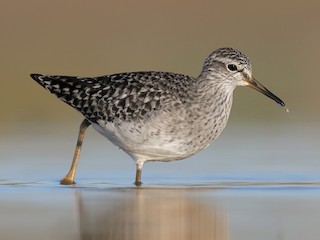
Come identificare Wood Sandpiper
Tringa glareola
Visto un uccello? Identificalo all'istante con l'app Birdby
Apri l'appPer identificare correttamente Wood Sandpiper (Tringa glareola), controlla ciascuna di queste caratteristiche. Gli uccelli possono essere complicati da riconoscere, perché comportamento, habitat e canto spesso confermano ciò che una sola foto non può.
Dimensioni a colpo d'occhio
- Lunghezza
- 18-21 cm
- Apertura alare
- 36-40 cm
- Peso
- 34-98 g (average 50-60 g)
Caratteristiche fisiche da controllare
- 1
Piumaggio
Colorazione e disegno generale del piumaggio.
Upperparts are dark brown to olive-brown, heavily spotted and streaked with white or pale buff, giving a 'scaly' appearance. Underparts are white, with fine streaking on the breast and flanks, especially in breeding plumage. A prominent pale supercilium extends behind the eye. The rump is white, and the tail is white with narrow dark bars.
- 2
Forma del becco
Forma e colore del becco, un segno di campo chiave.
Relatively slender, straight, and dark, often with a paler greenish or yellowish base.
- 3
Colore degli occhi
Colore dell'iride e segni distintivi sugli occhi.
Dark brown
- 4
Colore delle zampe
Colore di zampe e piedi.
Long, greenish-yellow to olive-green legs, which can appear duller in non-breeding birds or juveniles.
- 5
Caratteristiche distintive
Tratti distintivi che separano questa specie.
Prominent pale supercilium, finely spotted upperparts, white rump, barred tail, and greenish legs. In flight, the lack of a wing-bar and the white rump are key features.
- 6
Aspetto giovanile
Come i giovani si differenziano dagli adulti.
Juveniles have more uniformly buff-spotted upperparts, often appearing 'neater' than adults. The breast streaking is less defined, and the legs may be duller.
- 7
Cambiamenti stagionali
Variazione del piumaggio tra stagione riproduttiva e non.
Breeding plumage is more intensely marked with darker upperparts and more prominent white spotting. Non-breeding plumage is duller, with less distinct spotting and streaking, and a more uniform grey-brown appearance on the upperparts.
- 8
Dimorfismo sessuale
Differenze tra maschi e femmine.
Males and females are generally similar in plumage, though females may be slightly larger on average. No obvious sexual dimorphism in coloration.
Segni di campo chiave
- Size and Shape. A small, elegant wader with a relatively long neck and legs, and a slender bill. Often appears 'perky' with a slight head-bob.
- Plumage (Upperparts). Look for dark olive-brown upperparts heavily spotted and streaked with white or pale buff, giving a finely 'scaly' or 'spangled' appearance. This is a key distinction from the uniform dark upperparts of the Green Sandpiper.
- Supercilium. A prominent, long, pale supercilium (stripe above the eye) that extends well behind the eye is a strong field mark.
- Rump and Tail. In flight, observe the bright white rump contrasting sharply with the dark wings. The tail is white with fine dark barring, especially visible when fanned.
- Legs. Long, greenish-yellow to olive-green legs are characteristic. The color can vary with age and season but is generally lighter than the dark legs of a Green Sandpiper.
- Call. Listen for its distinctive sharp, high-pitched 'chip-chip-chip' or 'chiff-chiff-chiff' call, especially when flushed.
- Behavior. Often forages actively in shallow water, wading and probing. It frequently bobs its head and tail when standing, though less pronounced than a Common Sandpiper.
Esplora Wood Sandpiper
Identifica uccelli ovunque
Gratis su iOS, Android e Web. Identificazione per foto e suono, database completo e la tua lista personale.