
Spotted a bird? Identify it instantly with the Birdby app
Open the appAbout
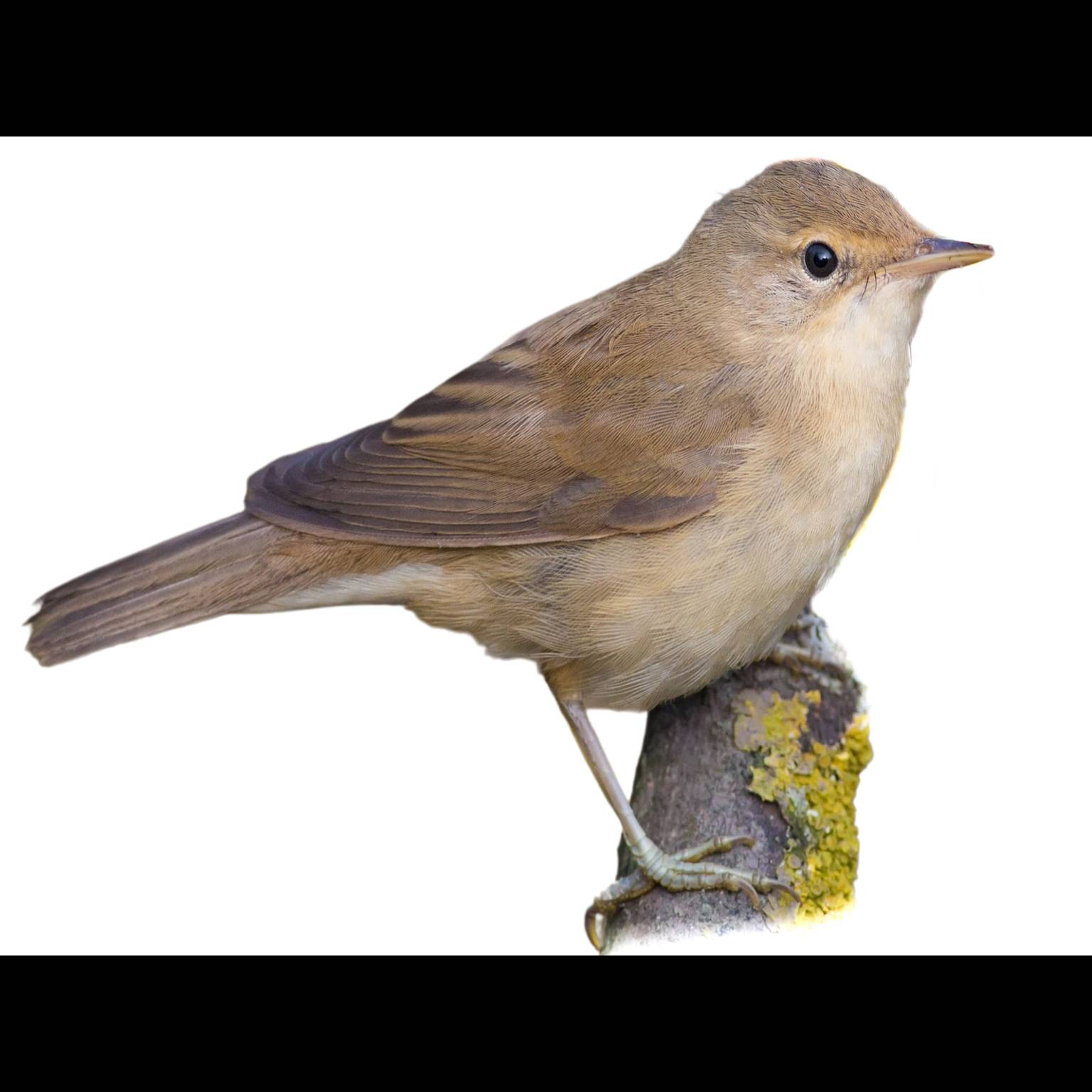
The Eurasian Reed Warbler is a small, plain, migratory passerine bird found primarily in reed beds across Europe, Asia, and Africa. It is known for its distinctive chattering song and its elusive nature, often remaining hidden within dense vegetation.
Size & lifespan
- Length
- 12.5-14 cm
- Wingspan
- 17-21 cm
- Weight
- 10-15 g
- Lifespan
- 2-3 years (up to 10 years recorded)
- Diet
- Insectivore
Physical characteristics
- Plumage
- Upperparts are uniformly plain, warm brown, lacking streaks or prominent markings. Underparts are buffish-white, becoming slightly darker buff on the flanks and undertail coverts. The throat is whitish. It has a faint, pale supercilium (eyebrow stripe) that is often indistinct, and a dark eye-stripe. The primary projection is relatively short.
- Beak shape
- Slender, pointed, and dark horn-colored, with a paler base to the lower mandible.
- Eye color
- Dark brown.
- Leg color
- Dark grey to brownish-grey.
- Distinguishing features
- Overall plain, unstreaked brown plumage, short primary projection, and a relatively flat head profile. The faint supercilium and lack of strong facial markings are key. Often seen clambering acrobatically through reeds.
- Juvenile appearance
- Juveniles resemble adults but often have a slightly richer, more rufous-brown tone to their upperparts and a more yellowish wash to their underparts, especially on the flanks.
- Seasonal changes
- No significant seasonal plumage changes. Plumage may appear slightly fresher and darker after the post-breeding molt.
- Sexual dimorphism
- None; males and females are identical in plumage.
How to identify
- 1
Plumage
Look for plain, unstreaked warm brown upperparts and buffish-white underparts. Absence of strong markings is key.
- 2
Supercilium
Note the faint or indistinct pale supercilium. It is not prominent like in a Sedge Warbler.
- 3
Primary Projection
Observe the length of the primary feathers beyond the tertials. In Eurasian Reed Warbler, it is relatively short, appearing less than half the length of the tertials. This helps distinguish it from Marsh Warbler.
- 4
Habitat
Always check the habitat. If it's in a dense reedbed, it's a strong indicator. While other warblers use reeds, this species is a specialist.
- 5
Song
Listen for the characteristic fast, repetitive, chattering, and somewhat monotonous song. This is often the most reliable way to identify it, especially from the Marsh Warbler.
- 6
Behavior
Watch its movements. It often clambers acrobatically up and down reed stems, often staying hidden within the vegetation.
Habitat & range
- Biomes
- Temperate forests, wetlands, grasslands (specifically reedbeds).
- Geographic range
- Breeds across most of Europe and temperate Asia, from the UK and France eastward to western Siberia and Kazakhstan. Winters in sub-Saharan Africa, primarily in the Sahel zone and southern Africa.
- Elevation range
- Typically found from sea level up to around 1,000 meters, occasionally higher in suitable reedbed habitats.
- Preferred environments
- Dense reedbeds (Phragmites australis) along the edges of lakes, rivers, ponds, and marshes. Also utilizes other tall emergent vegetation like sedges and cattails, especially during migration or in areas where reeds are less dominant.
Behavior
- Activity time
- Diurnal.
- Feeding habits
- Primarily insectivorous, foraging for insects and their larvae (e.g., flies, beetles, moths, dragonflies, damselflies) among the reeds and other vegetation. It gleans insects from leaves and stems, often hanging upside down or performing short aerial sallies. Occasionally consumes small spiders and berries.
- Social behavior
- Generally solitary or found in pairs during the breeding season. Migrates in loose flocks, but often appears solitary due to its secretive nature.
- Flight pattern
- Short, weak, and undulating flight within the reedbed, often low over the water. When migrating, flight is strong and direct.
- Migration pattern
- Long-distance migratory. Breeds in the Palearctic and winters in sub-Saharan Africa. Autumn migration typically occurs from August to October, and spring migration from April to May. They undertake arduous journeys across the Sahara Desert.
- Territoriality
- Males establish and defend breeding territories within reedbeds, primarily through song. Territories are relatively small and focused on nesting and foraging areas.
Song & calls
- Song
- A fast, repetitive, chattering, and often scratchy song, typically delivered from within dense reeds or from a prominent reed stem. It consists of a rapid series of 'karr-karr-karr-karr' or 'chirrup-chirrup-chirrup' notes, often interspersed with harsher 'churr' sounds. It can be quite monotonous but energetic.
- Call
- A sharp, hard 'churr' or 'tack' call, often given when alarmed or agitated. Also a softer 'tchek' or 'tuc' call.
- When they vocalize
- Males sing frequently during the breeding season, from arrival in spring until late summer, primarily in the morning and evening, but also throughout the day. Calls are given year-round, especially when disturbed.
Breeding & reproduction
- Breeding season
- May to July in Europe.
- Nesting habits
- The nest is a deep, cup-shaped structure woven from reed stems, grass blades, and spider silk, often lined with finer materials like reed flowers or hair. It is typically suspended between 2-4 vertical reed stems, usually 30-100 cm above water or ground level, making it difficult for predators to access.
- Clutch size
- 3-5 eggs (occasionally 2 or 6).
- Egg description
- 3-5 eggs, typically pale greenish-white or bluish-white, heavily speckled and blotched with dark olive-brown, grey, and black, often concentrated at the broad end.
- Incubation period
- 10-12 days, primarily by the female.
- Fledging period
- 10-14 days after hatching. Young are fed by both parents.
- Parental care
- Both parents participate in feeding the nestlings and fledglings. The female primarily incubates, but both sexes defend the nest.
Where to find
Reedbeds
The primary habitat. Look along the edges of lakes, slow-moving rivers, ponds, and marshes with extensive stands of common reed (Phragmites australis).
Wetlands
Any wetland area with tall emergent vegetation will likely host them during breeding or migration.
Coastal Marshes
Coastal areas with brackish or freshwater marshes can also be good spots.
Field tips
- Listen for the song. Eurasian Reed Warblers are often heard before they are seen. Learn their distinctive chattering song to locate them.
- Be patient and observe. They are secretive birds. Find a good vantage point near a reedbed and wait quietly. They will eventually pop up to sing or forage.
- Look for movement in reeds. Scan the reed tops for any subtle movement or a bird briefly perching on a prominent reed stem to sing.
- Visit at dawn or dusk. Vocalization is often most intense during these periods, increasing your chances of hearing and locating them.
- Use binoculars. Essential for getting a good view of these small, often distant birds within their dense habitat.
Similar species
Marsh Warbler
Acrocephalus palustris
The Marsh Warbler is extremely similar in appearance, often considered indistinguishable in the field by sight alone. Key differences are subtle: Marsh Warbler typically has a slightly longer primary projection, a slightly more rounded head, and often a slightly warmer, more olive-brown tone to the upperparts. The most reliable distinction is by song: Marsh Warbler's song is highly mimetic, incorporating imitations of other birds, and is more varied and melodious than the Reed Warbler's monotonous chatter.
Sedge Warbler
Acrocephalus schoenobaenus
The Sedge Warbler is easily distinguished by its prominent, creamy supercilium, streaked crown, and streaked back. It also has a more upright posture and a more varied, often mimetic song, though less so than the Marsh Warbler.
Great Reed Warbler
Acrocephalus arundinaceus
The Great Reed Warbler is significantly larger (around 19 cm) and bulkier than the Eurasian Reed Warbler. It has a much stronger bill, a more prominent supercilium, and a louder, harsher, and more powerful song, often described as 'karr-karr-kree-kree'.
Quick facts
- Specialized Habitat:
- Strictly associated with reedbeds.
- Migration:
- Long-distance migrant to sub-Saharan Africa.
- Song:
- Repetitive, chattering, and scratchy.
- Appearance:
- Plain brown upperparts, buffish-white underparts, faint supercilium.
- Diet:
- Almost exclusively insects.
Fun facts
- Eurasian Reed Warblers are famous for being a common host species for the Common Cuckoo (Cuculus canorus), which lays its eggs in their nests.
- Despite their small size, they undertake an incredible migratory journey across the Sahara Desert twice a year.
- Their nests are engineering marvels, woven around vertical reed stems to withstand wind and water level changes.
- The scientific name 'Acrocephalus' means 'top of the head' or 'pointed head', referring to their head shape, and 'scirpaceus' refers to 'reeds' (Scirpus is a genus of sedges), highlighting their habitat preference.
Scientific classification
- Kingdom
- Animalia
- Phylum
- Chordata
- Class
- Aves
- Order
- Passeriformes
- Family
- Acrocephalidae
- Genus
- Acrocephalus
- Species
- Acrocephalus scirpaceus
Explore the Eurasian Reed Warbler
Identify birds anywhere
Free on iOS, Android, and Web. Photo & sound identification, full species database, and your personal life list.