
Spotted a bird? Identify it instantly with the Birdby app
Open the appAbout
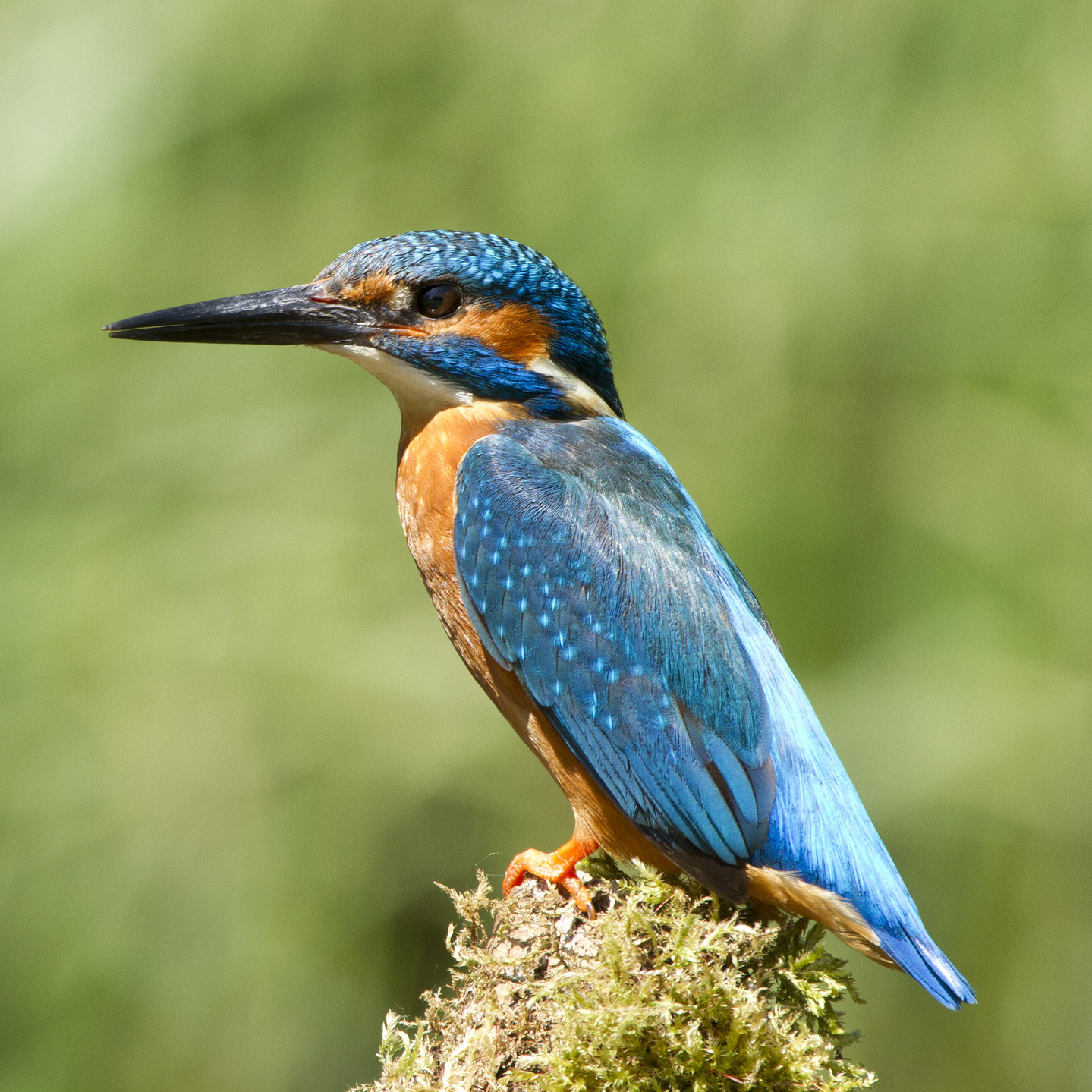
The Common Kingfisher is a small, brightly coloured bird found across Eurasia and North Africa. Renowned for its iridescent blue and orange plumage, it is a specialist fish-eater, typically found along clear, slow-moving water bodies. Its rapid, direct flight and distinctive high-pitched call often draw attention before its vibrant colours are fully appreciated.
Size & lifespan
- Length
- 16-17 cm
- Wingspan
- 24-26 cm
- Weight
- 25-46 g
- Lifespan
- Typically 1-2 years in the wild, though can live up to 7 years.
- Diet
- Carnivore (primarily piscivorous)
Physical characteristics
- Plumage
- Adults have iridescent metallic blue-green upperparts, a rufous-orange belly, and a white throat patch. A rufous stripe extends from the eye to the nape, bordered by a white patch on the side of the neck. The rump is a striking cobalt blue, particularly noticeable in flight.
- Beak shape
- Long, straight, dagger-like bill, black in males, with a reddish-orange base to the lower mandible in females.
- Eye color
- Dark brown
- Leg color
- Bright red
- Distinguishing features
- Small size, stocky body, short tail, large head, and long bill. The combination of iridescent blue-green back, cobalt blue rump, and rufous underparts is unmistakable. Its rapid, whirring flight close to the water surface is also characteristic.
- Juvenile appearance
- Juveniles are duller overall, with less vibrant blue and orange plumage. Their upperparts are often more greenish, and the underparts are paler. The bill is shorter and black, and their legs and feet are duller, often brownish-red. They also have dusky tips to the feathers on the breast, giving a slightly mottled appearance.
- Seasonal changes
- No significant seasonal plumage changes. Plumage may appear slightly duller when worn before moulting.
- Sexual dimorphism
- Subtle. Males have an entirely black bill. Females typically have a reddish-orange base to the lower mandible, which can vary in extent and intensity. Otherwise, plumage is identical.
How to identify
- 1
Plumage Coloration
Look for the unmistakable combination of iridescent blue-green upperparts, a bright rufous-orange belly, and a white throat. The cobalt blue rump is a key field mark, especially in flight.
- 2
Flight Pattern
Observe its rapid, direct, low-level flight over water. It appears as a 'blue flash' and often follows the curves of the river or stream.
- 3
Bill Shape and Color
Note the long, straight, dagger-like black bill. In females, look for a reddish-orange base to the lower mandible.
- 4
Habitat
Always found near clear, slow-moving freshwater bodies with perches and suitable nesting banks. If you're by such a water source, keep an eye out.
- 5
Vocalization
Listen for its sharp, high-pitched 'chee-chee' or 'chick-chick' call, often given in flight. This call is frequently heard before the bird is seen.
- 6
Perching Behavior
They often perch motionless on low branches, reeds, or rocks overlooking the water, patiently waiting for prey. Look for a small, stocky bird with a disproportionately large head.
Habitat & range
- Biomes
- Temperate forests, wetlands, riparian zones, agricultural landscapes, urban parks.
- Geographic range
- Widespread across Eurasia and North Africa. Its range extends from Ireland and Spain in the west, across Europe, Asia, and North Africa, reaching Japan and Southeast Asia in the east. Absent from Iceland, northern Scandinavia, and much of Siberia.
- Elevation range
- Typically found from sea level up to 1,000 meters, occasionally higher in some parts of its range where suitable water bodies exist.
- Preferred environments
- Clear, slow-moving or still freshwater bodies with abundant small fish, such as rivers, streams, canals, lakes, ponds, and reservoirs. Requires perches (branches, reeds) overlooking the water and suitable vertical earth banks for nesting.
Behavior
- Activity time
- Diurnal. Most active during daylight hours, particularly in the morning and late afternoon.
- Feeding habits
- A highly specialized piscivore. It hunts by perching on a branch or reed overlooking the water, then diving headfirst to catch small fish (typically 2-10 cm long) or aquatic insects. It can also hover briefly before diving. Prey is usually carried back to a perch and swallowed headfirst. Regurgitates pellets of indigestible bones and scales.
- Social behavior
- Generally solitary, except during the breeding season when pairs form. Highly territorial, especially around nesting and prime feeding sites. Juveniles disperse after fledging.
- Flight pattern
- Very fast, direct, and low over the water, with rapid, whirring wingbeats. Appears as a 'blue flash' as it flies past. Often flies in a straight line, following the contours of the watercourse.
- Migration pattern
- Mostly resident in temperate and warmer parts of its range. Northern populations are partially migratory, moving south or to coastal areas during harsh winters when freshwater bodies freeze over. Migrations are typically short-distance.
- Territoriality
- Highly territorial, especially during the breeding season. Both sexes defend their feeding and nesting territories against intruders, often with aggressive chases and vocalizations.
Song & calls
- Song
- The Common Kingfisher does not have a complex song. Its vocalizations are primarily calls.
- Call
- A distinctive, high-pitched, sharp 'chee-chee' or 'chick-chick' call, often repeated two or three times. It is typically given in flight, especially when disturbed or flying past. Also a softer 'tseep' call when perched.
- When they vocalize
- Calls are given year-round, but most frequently when in flight or when disturbed. More vocal during the breeding season.
Breeding & reproduction
- Breeding season
- Typically March to September, with two to three broods per year in favourable conditions.
- Nesting habits
- Nests in a burrow excavated in a vertical earth bank, usually overlooking water. Both sexes dig the tunnel, which can be 30-90 cm long, ending in an unlined nesting chamber. Often reuses burrows in subsequent years.
- Clutch size
- 5-7 eggs
- Egg description
- 5-7 (occasionally 4-10) glossy, pure white, spherical eggs.
- Incubation period
- 19-21 days, shared by both parents.
- Fledging period
- 23-27 days. Young are fed by both parents and leave the nest fully feathered and capable of flight.
- Parental care
- Both parents share incubation duties and feed the young. After fledging, parents continue to feed the young for a few days before they become independent.
Where to find
Rivers and Streams
Look along clear, unpolluted rivers and streams with slow-moving sections and overhanging vegetation or exposed perches.
Lakes and Ponds
Check the edges of freshwater lakes, ponds, and reservoirs, especially those with reedy margins or quiet coves.
Canals and Ditches
Canals and larger drainage ditches with clear water and fish populations can also host kingfishers.
Gravel Pits and Quarries
Flooded gravel pits and quarries often provide ideal habitat with clear water and vertical banks for nesting.
Field tips
- Patience is Key. Kingfishers can be elusive. Find a suitable spot near water, remain still and quiet, and wait. They often return to favoured perches.
- Look for Movement. Scan the water's edge and low branches for any sudden movement or a 'blue flash' as it flies past. Their flight is very fast.
- Listen for Calls. Their distinctive 'chee-chee' call is often the first indication of their presence, especially when they are flying.
- Early Morning/Late Afternoon. These are often the best times to spot them as they are actively feeding.
- Binoculars Essential. Due to their small size and often rapid movements, binoculars are crucial for good views and identification.
- Look for Droppings/Pellets. Favoured perches may have white droppings or regurgitated pellets (small, greyish, oval masses of fish bones and scales) beneath them, indicating recent kingfisher activity.
Similar species
Pied Kingfisher
Ceryle rudis
Much larger, black and white plumage, crested head, and often hovers extensively. Found in Africa and Asia.
White-throated Kingfisher
Halcyon smyrnensis
Larger, with a bright blue back, chestnut head and belly, and a prominent white throat and breast. Found in Asia.
Belted Kingfisher
Megaceryle alcyon
Found in North America. Much larger, shaggy crest, blue-grey and white plumage with a prominent breast band. Females have an additional rufous band.
Quick facts
- Diet:
- Small fish and aquatic insects
- Habitat:
- Clear freshwater bodies with perches and nesting banks
- Distinguishing Feature:
- Iridescent blue-green back, rufous belly, cobalt rump, dagger-like bill
- Flight:
- Fast, direct, low over water ('blue flash')
- Call:
- High-pitched 'chee-chee' or 'chick-chick'
Fun facts
- The Common Kingfisher's iridescent blue colour is not due to pigment, but rather to the structural properties of its feathers, which scatter light in a way that produces the blue hue (structural colouration).
- Despite its small size, a kingfisher can consume up to 60% of its body weight in fish per day.
- They have a nictitating membrane (a transparent third eyelid) that covers their eyes when they dive, protecting them and allowing them to see underwater.
- Kingfishers are highly sensitive to water quality and are often considered an indicator species for healthy aquatic ecosystems.
- Both parents are involved in digging the nest tunnel, which can take up to two weeks to complete.
Scientific classification
- Kingdom
- Animalia
- Phylum
- Chordata
- Class
- Aves
- Order
- Coraciiformes
- Family
- Alcedinidae
- Genus
- Alcedo
- Species
- Alcedo atthis
Explore the Common Kingfisher
Identify birds anywhere
Free on iOS, Android, and Web. Photo & sound identification, full species database, and your personal life list.