
Spotted a bird? Identify it instantly with the Birdby app
Open the appAbout
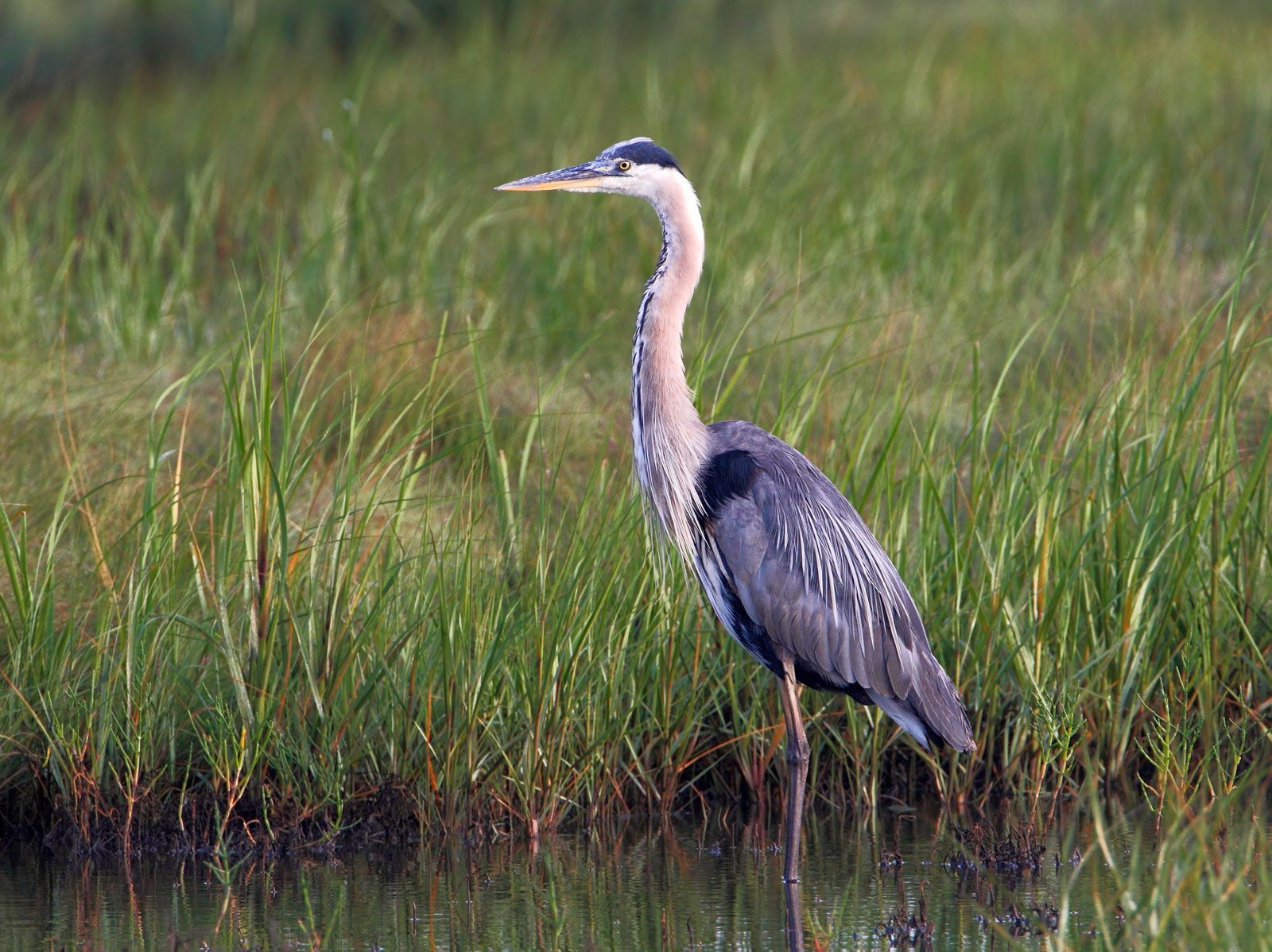
The Great Blue Heron is a large wading bird common near the coasts and in wetlands of most of North and Central America, as well as the Caribbean and the Galápagos Islands. It is a versatile predator, primarily feeding on fish, but also consuming a wide variety of other aquatic and terrestrial prey. Known for its stately presence and slow, deliberate movements, it is a familiar sight in many aquatic habitats.
Size & lifespan
- Length
- 97-137 cm (38-54 in)
- Wingspan
- 167-201 cm (66-79 in)
- Weight
- 2.1-2.5 kg (4.6-5.5 lbs)
- Lifespan
- Average 15 years in the wild, up to 24 years recorded
- Diet
- Carnivore, primarily piscivorous (fish-eating), but also eats amphibians, reptiles, insects, rodents, and other small birds.
Physical characteristics
- Plumage
- Adults are largely blue-gray with a white face, a black stripe extending from above the eye to the back of the head, and long, black plumes on the head. The neck is rufous-gray with black and white streaking on the front. The underparts are streaked black and white. The flight feathers are darker, often blackish. The 'Great White Heron' (A. h. occidentalis) morph is entirely white.
- Beak shape
- Long, thick, dagger-like, yellowish-orange, becoming brighter orange during breeding season.
- Eye color
- Yellow
- Leg color
- Dull greenish-yellow to dark gray, becoming brighter orange during breeding season.
- Distinguishing features
- Large size, S-shaped neck in flight and at rest, slow and deliberate movements, long legs, and a prominent black stripe over the eye.
- Juvenile appearance
- Juveniles are duller overall, with a grayish-brown crown (lacking the distinct black stripe and plumes of adults), a more mottled gray-brown body, and less distinct streaking on the neck and underparts. Their bill is duller, often grayish-yellow.
- Seasonal changes
- Plumage does not change significantly seasonally, but bill and leg coloration become brighter (more orange) during the breeding season. Breeding adults develop longer, more prominent plumes on the head and back.
- Sexual dimorphism
- Males and females are generally similar in plumage and size, though males may be slightly larger and have slightly longer plumes during breeding season.
How to identify
- 1
Size and Shape
Look for a very large, tall wading bird with long legs, a long S-shaped neck, and a dagger-like bill. In flight, the neck is typically tucked in, and legs trail behind.
- 2
Plumage Color
Observe the overall blue-gray body, white face with a prominent black stripe over the eye, and rufous-gray neck with streaking. The 'Great White Heron' morph is entirely white.
- 3
Behavior
Watch for its characteristic slow, deliberate movements while wading or standing motionless, waiting to strike prey. Its flight is slow and powerful.
- 4
Vocalization
Listen for its harsh, guttural 'fraaaank' call, especially when startled or in flight.
- 5
Habitat
Great Blue Herons are almost always found near water, whether fresh or salt, in a variety of wetland environments.
Habitat & range
- Biomes
- Wetlands, marshes, swamps, coastlines, lakes, rivers, ponds, estuaries, mangroves.
- Geographic range
- Throughout North America from southern Alaska and Canada south through the United States, Mexico, Central America, the Caribbean, and northern South America (Colombia, Venezuela, and the Galápagos Islands).
- Elevation range
- Sea level up to approximately 1,500 meters (5,000 feet), occasionally higher.
- Preferred environments
- Shallow freshwater and saltwater environments, including tidal flats, marshes, lake edges, riverbanks, and even suburban ponds, as long as there is suitable prey and undisturbed nesting sites.
Behavior
- Activity time
- Primarily diurnal and crepuscular (active at dawn and dusk), but will also forage at night, especially during full moons or in areas with artificial light.
- Feeding habits
- Stands motionless in shallow water, waiting for prey to come within striking distance, then spears it with its sharp bill. Also walks slowly through water or on land, stalking prey. May also hover briefly or dive from a low perch. Primarily eats fish, but also frogs, salamanders, snakes, crustaceans, insects, small mammals (like voles), and small birds.
- Social behavior
- Generally solitary when foraging, but often nests colonially in 'rookeries' with other herons and sometimes other wading birds. May gather in small groups at rich feeding grounds.
- Flight pattern
- Slow, powerful wingbeats with its neck typically pulled into an S-shape and its long legs trailing straight behind. Appears large and somewhat prehistoric in flight.
- Migration pattern
- Northern populations are migratory, moving south for the winter to the southern U.S., Mexico, and Central America. Southern populations are largely resident year-round. Migration occurs during the day, often in small flocks.
- Territoriality
- Defends a small foraging territory from other herons, especially during the breeding season. Nesting territories within a colony are also defended.
Song & calls
- Song
- Great Blue Herons do not have a true song. Their vocalizations are primarily calls.
- Call
- A harsh, guttural 'fraaaank' or 'kraak' call, often given when disturbed, in flight, or during territorial disputes. Also produces a variety of squawks, croaks, and hisses at the nest.
- When they vocalize
- Most vocal when disturbed, in flight, or around the nesting colony, especially during breeding season.
Breeding & reproduction
- Breeding season
- Varies geographically; typically February to May in the southern U.S., March to July in the northern U.S. and Canada.
- Nesting habits
- Nests colonially in 'rookeries,' often in tall trees (dead or alive) near water, but also in mangroves, on cliffs, or on artificial structures. Nests are large, bulky platforms made of sticks, lined with smaller twigs, moss, or grass. Both parents build the nest.
- Clutch size
- 2-6 eggs
- Egg description
- 2-6 (typically 3-5) pale blue to greenish-blue, unmarked eggs. Oval-shaped.
- Incubation period
- 25-30 days, incubated by both parents.
- Fledging period
- 60-90 days after hatching, young begin to fledge, but remain dependent on parents for several weeks.
- Parental care
- Both parents share incubation duties and feed the young by regurgitation. Young are altricial (helpless at hatching) and require extensive parental care.
Where to find
Freshwater Wetlands
Look along the edges of lakes, rivers, ponds, and marshes.
Coastal Areas
Check tidal flats, estuaries, salt marshes, and mangrove swamps.
Suburban Ponds
Often found in parks, golf courses, and even backyard ponds if fish are present and disturbance is minimal.
Rookeries
During breeding season, locate large colonies of nests in tall trees near water.
Field tips
- Patience is Key. Great Blue Herons are often motionless for long periods while hunting. Scan the water's edge carefully.
- Look for Movement. Even a slight head turn or a slow step can reveal their presence.
- Binoculars are Recommended. Their size makes them visible, but binoculars help appreciate their detailed plumage and observe their hunting behavior without disturbance.
- Observe at Dawn and Dusk. These are often prime foraging times, though they can be seen throughout the day.
- Check for Rookeries. In spring and early summer, look for large stick nests in tall trees, often in groups.
Similar species
Great Egret
Ardea alba
The Great Egret is entirely white, while the Great Blue Heron is primarily blue-gray. Great Egrets have black legs and a yellow bill (non-breeding) or black bill (breeding), whereas Great Blue Herons have duller, greenish-yellow to dark gray legs and a yellowish-orange bill.
Sandhill Crane
Antigone canadensis
Sandhill Cranes are typically gray with a red patch on the crown. In flight, cranes fly with their necks extended straight out, unlike herons which fly with their necks pulled into an S-shape. Cranes also have a distinctive trumpeting call.
Tricolored Heron
Egretta tricolor
The Tricolored Heron is much smaller, with a dark blue-gray back, white belly, and a purplish neck. It has a thinner, more pointed bill and yellow legs. Its flight is more agile than the Great Blue Heron's.
Reddish Egret
Egretta rufescens
The Reddish Egret has a reddish-brown head and neck, and a dark gray body. It is smaller than the Great Blue Heron and is known for its distinctive 'dancing' foraging behavior. Its bill is pinkish with a black tip.
Quick facts
- Tallest Heron in North America:
- Can stand over 4 feet tall.
- S-shaped Neck:
- A key identification feature in flight and at rest.
- Versatile Hunter:
- Eats a wide variety of aquatic and terrestrial prey.
- Colonial Nesters:
- Breeds in large groups called rookeries.
- Great White Heron Morph:
- A distinct all-white form found primarily in Florida and the Caribbean.
Fun facts
- Despite their large size, Great Blue Herons weigh only 4-6 pounds due to hollow bones, which aids in flight.
- They have specialized feathers on their chest that continuously grow and fray, producing a powder-down. This powder is used to clean fish slime and other oils from their plumage, especially after a meal.
- A Great Blue Heron can swallow a fish almost as large as its own body, thanks to its flexible neck and expandable throat.
- They have excellent vision, including good night vision, which allows them to hunt successfully in low light conditions.
- The 'Great White Heron' (Ardea herodias occidentalis) was once considered a separate species but is now recognized as a white morph of the Great Blue Heron, primarily found in southern Florida and the Caribbean.
Scientific classification
- Kingdom
- Animalia
- Phylum
- Chordata
- Class
- Aves
- Order
- Pelecaniformes
- Family
- Ardeidae
- Genus
- Ardea
- Species
- Ardea herodias
Explore the Great Blue Heron
Identify birds anywhere
Free on iOS, Android, and Web. Photo & sound identification, full species database, and your personal life list.