
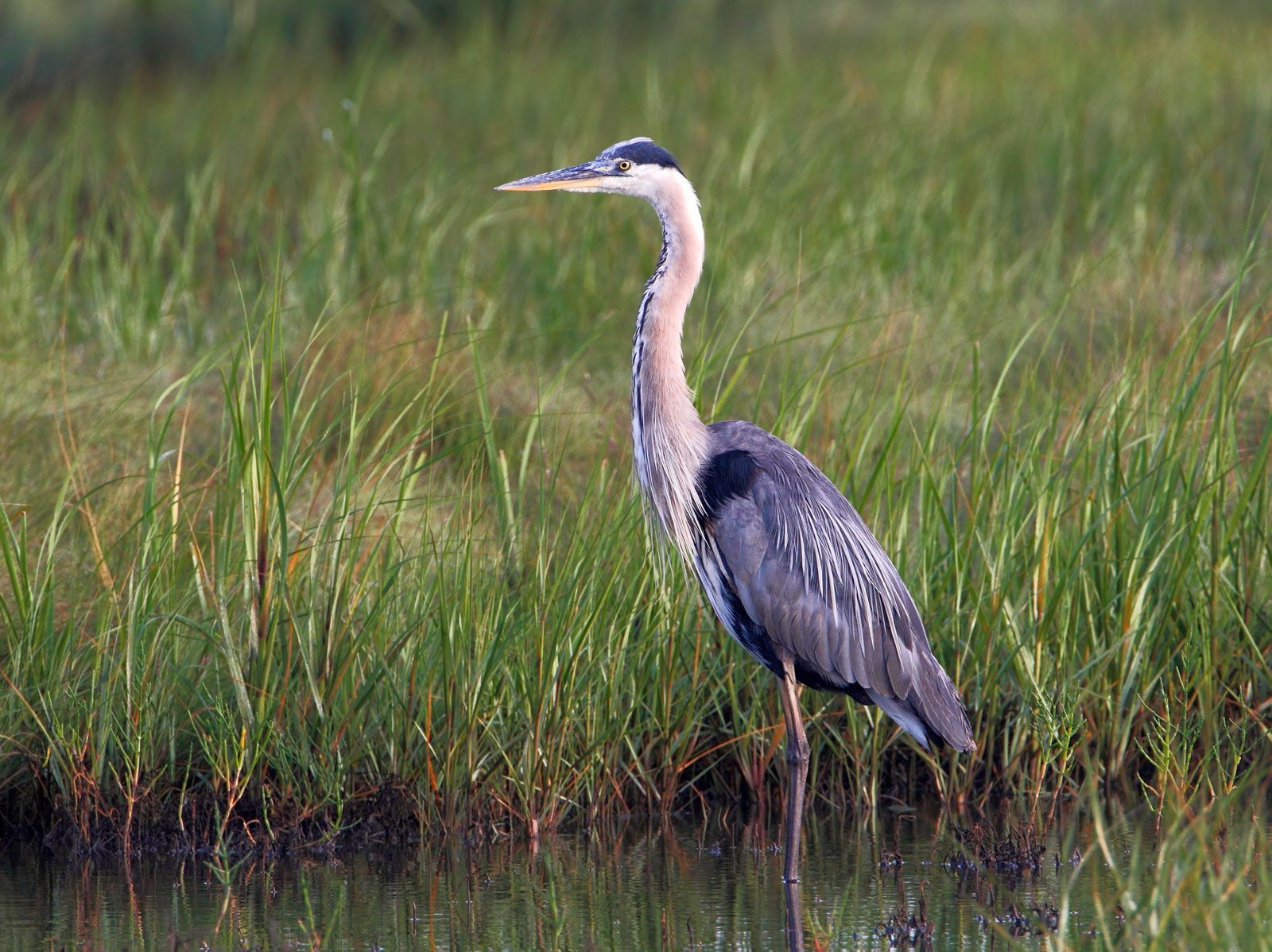
Where does the Great Blue Heron live?
Ardea herodias
Spotted a bird? Identify it instantly with the Birdby app
Open the appThe Great Blue Heron lives in specific habitats and regions. Knowing where, and when, to look improves your chances of a successful sighting.
Biomes
Wetlands, marshes, swamps, coastlines, lakes, rivers, ponds, estuaries, mangroves.
Geographic range
Throughout North America from southern Alaska and Canada south through the United States, Mexico, Central America, the Caribbean, and northern South America (Colombia, Venezuela, and the Galápagos Islands).
Preferred environments
Shallow freshwater and saltwater environments, including tidal flats, marshes, lake edges, riverbanks, and even suburban ponds, as long as there is suitable prey and undisturbed nesting sites.
Elevation range
Sea level up to approximately 1,500 meters (5,000 feet), occasionally higher.
Where to look
Freshwater Wetlands
Look along the edges of lakes, rivers, ponds, and marshes.
Coastal Areas
Check tidal flats, estuaries, salt marshes, and mangrove swamps.
Suburban Ponds
Often found in parks, golf courses, and even backyard ponds if fish are present and disturbance is minimal.
Rookeries
During breeding season, locate large colonies of nests in tall trees near water.
Field tips
- Patience is Key. Great Blue Herons are often motionless for long periods while hunting. Scan the water's edge carefully.
- Look for Movement. Even a slight head turn or a slow step can reveal their presence.
- Binoculars are Recommended. Their size makes them visible, but binoculars help appreciate their detailed plumage and observe their hunting behavior without disturbance.
- Observe at Dawn and Dusk. These are often prime foraging times, though they can be seen throughout the day.
- Check for Rookeries. In spring and early summer, look for large stick nests in tall trees, often in groups.
Migration
Northern populations are migratory, moving south for the winter to the southern U.S., Mexico, and Central America. Southern populations are largely resident year-round. Migration occurs during the day, often in small flocks.
Explore the Great Blue Heron
Identify birds anywhere
Free on iOS, Android, and Web. Photo & sound identification, full species database, and your personal life list.