
Spotted a bird? Identify it instantly with the Birdby app
Open the appAbout
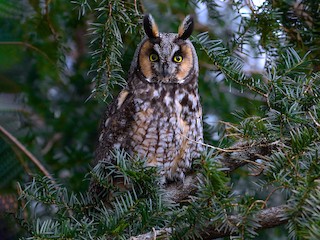
The Long-eared Owl (Asio otus) is a medium-sized owl with prominent ear tufts, often held erect, giving it its common name. It is a highly nocturnal and cryptic species, well-camouflaged against tree bark, making it difficult to spot during the day. Known for its slender build and orange eyes, it primarily preys on small mammals, especially voles and mice. It has a wide distribution across the Northern Hemisphere.
Size & lifespan
- Length
- 31-37 cm (12-15 in)
- Wingspan
- 86-98 cm (34-39 in)
- Weight
- Males: 178-300 g (6.3-10.6 oz), Females: 220-435 g (7.8-15.3 oz)
- Lifespan
- Up to 10-12 years in the wild, with a maximum recorded of 27 years in captivity.
- Diet
- Carnivore, primarily small mammals (voles, mice, shrews, young rats), occasionally small birds, bats, and insects.
Physical characteristics
- Plumage
- Overall mottled brown and buff, with intricate streaking and barring. The upperparts are dark brown with fine greyish-white vermiculations. Underparts are buffy-white with heavy dark brown streaking, especially on the breast and belly, and fine cross-barring on the flanks. Facial disc is rusty-orange to buff, bordered by dark brown, with a prominent white 'X' pattern between the eyes. Ear tufts are long, dark, and erectile, typically held upright when alert or disturbed, but flattened when relaxed or in flight.
- Beak shape
- Small, sharply hooked, and blackish-grey.
- Eye color
- Bright orange to orange-yellow, set within the facial disc.
- Leg color
- Feathered down to the toes, which are yellowish-grey with black talons.
- Distinguishing features
- Long, prominent ear tufts (though not always visible), slender body, bright orange eyes, and a distinctive 'X' pattern on the facial disc. Its cryptic plumage provides excellent camouflage.
- Juvenile appearance
- Nestlings are covered in white down. Fledglings have a fluffy, buffy-white downy plumage with dark facial masks and short ear tufts. They gradually acquire adult-like plumage over their first few months, but often appear more uniformly buff and less intricately patterned than adults, with less distinct facial markings.
- Seasonal changes
- No significant seasonal plumage changes. Plumage remains consistent year-round.
- Sexual dimorphism
- Females are generally slightly larger and heavier than males, but plumage differences are negligible. Males may have slightly paler plumage overall.
How to identify
- 1
Ear Tufts
Look for long, prominent, dark ear tufts, often held erect, giving the head a 'long-eared' profile. These are the most distinctive feature, though they can be flattened when relaxed.
- 2
Eye Color
Observe the bright orange to orange-yellow eyes, which stand out against the facial disc.
- 3
Facial Disc Pattern
Note the rusty-orange to buff facial disc with a distinctive white 'X' pattern between the eyes, bordered by dark brown.
- 4
Plumage Pattern
Examine the intricate mottled brown and buff plumage with heavy dark streaking on the underparts and fine cross-barring on the flanks. This provides excellent camouflage against tree bark.
- 5
Body Shape
Identify its slender, elongated body shape, especially when perched upright and alert.
- 6
Vocalization
Listen for the male's soft, monotonous, low-pitched 'hoo-hoo-hoo' song or the cat-like 'mew' calls. The high-pitched 'pee-eep' calls of fledglings are also a strong indicator.
- 7
Habitat and Activity
Look for them roosting silently in dense conifers or thickets during the day, often in communal roosts during winter. They are strictly nocturnal hunters in open fields adjacent to woodlands.
Habitat & range
- Biomes
- Forests, woodlands, open country with scattered trees, riparian zones, scrublands, and sometimes suburban parks.
- Geographic range
- Holarctic distribution, breeding across much of North America (southern Canada, most of the United States), Europe, and Asia (from western Europe to Japan). Winters in the southern parts of its breeding range and further south.
- Elevation range
- Sea level up to 2,000-3,000 meters (6,500-9,800 ft), depending on geographic location and availability of suitable habitat.
- Preferred environments
- Prefers mosaics of dense coniferous or deciduous woodlands for roosting and nesting, adjacent to open grasslands, meadows, or agricultural fields for hunting. Often found near water sources.
Behavior
- Activity time
- Strictly nocturnal, active from dusk to dawn. Roosts silently and cryptically during the day in dense cover.
- Feeding habits
- Strictly nocturnal hunter. Hunts primarily by flying low over open ground, using its acute hearing to locate prey in dense vegetation or under snow. It has exceptionally sensitive asymmetrical ears, allowing precise triangulation of sound. Prey is typically caught with its talons. Pellets (regurgitated indigestible remains) are often found beneath roosts.
- Social behavior
- Generally solitary or found in pairs during the breeding season. During winter, they often form communal roosts, sometimes numbering dozens of individuals, in dense conifers or thickets. These roosts can be quite conspicuous if located.
- Flight pattern
- Silent, buoyant, and somewhat erratic flight with deep, moth-like wingbeats. Often glides for short distances. When hunting, it flies low and slowly over open fields.
- Migration pattern
- Northern populations are migratory, moving south for the winter. Southern populations are largely resident. Migration occurs at night, often in loose flocks. Migratory routes are not well-defined, but they generally follow broad fronts.
- Territoriality
- Territorial during the breeding season, defending nesting areas. Males perform display flights and vocalizations to establish and defend territories. Communal roosts in winter are not territorial.
Song & calls
- Song
- The male's primary song is a soft, low, monotonous 'hoo-hoo-hoo-hoo...' series, repeated 10-20 times at intervals of 2-3 seconds. It's a quiet, ventriloquial sound, often difficult to pinpoint. It can also produce a soft, purring 'oooo-oo-oo-oo' call.
- Call
- Various calls include a cat-like 'mew' or 'waah' call, often given by females or in alarm. Young owls produce a distinctive, high-pitched, squeaky 'pee-eep' or 'squeak' call, especially when begging for food, which can be heard from a distance.
- When they vocalize
- Mainly vocal during the breeding season (late winter to early summer), primarily at night. Young owls are very vocal when fledging and begging for food.
Breeding & reproduction
- Breeding season
- Typically March to July, with peak egg-laying in April-May, varying geographically.
- Nesting habits
- Does not build its own nest. Primarily uses abandoned nests of other birds, especially crows, magpies, and various raptors (e.g., Red-tailed Hawk, Goshawk). Nests are usually in trees, often conifers, 3-20 meters (10-65 ft) above the ground. Occasionally uses tree cavities or artificial nest baskets.
- Clutch size
- 3-10 eggs, typically 4-6. Clutch size can be larger in years of high prey abundance.
- Egg description
- White, unspotted, elliptical to oval. Smooth texture.
- Incubation period
- 25-30 days, primarily by the female.
- Fledging period
- Young leave the nest (branch) at about 21-28 days, often before they can fly well. They become fully independent and capable of sustained flight around 35-40 days.
- Parental care
- Female incubates and broods the young. Male provides food for the female and young. Both parents feed the fledglings for several weeks after they leave the nest.
Where to find
Dense Conifer Stands
During winter, check dense stands of conifers (pines, spruces, cedars) or thickets, especially those bordering open fields. They often form communal roosts here.
Riparian Woodlands
Look in woodlands along rivers or streams, particularly those with a mix of deciduous and coniferous trees, which provide good nesting and roosting sites.
Shelterbelts and Hedgerows
In agricultural areas, shelterbelts, hedgerows, and small woodlots adjacent to open fields are prime locations for both roosting and hunting.
Abandoned Nests
Scan for old crow, magpie, or raptor nests in trees, as Long-eared Owls frequently reuse these for breeding.
Field tips
- Look for Pellets. Search the ground beneath dense conifers or deciduous trees for owl pellets. Long-eared Owl pellets are typically dark, compact, and contain small mammal bones and fur. Finding pellets is a strong indicator of a roost site.
- Scan Dense Cover. During the day, carefully scan dense foliage in trees, especially conifers. Their cryptic plumage makes them incredibly difficult to spot, so look for an unusual shape or the outline of an owl.
- Listen at Dusk/Dawn. Listen for their calls, especially the male's soft hoots or the begging calls of young, around dusk or dawn during the breeding season. Their calls are often quiet and ventriloquial.
- Winter Roosts. In winter, once one owl is found in a communal roost, others are often nearby. Look for multiple owls perched close together in the same tree or adjacent trees.
- Avoid Disturbance. If you find a roosting owl, observe from a distance and avoid disturbing it, especially during the day when they are vulnerable. Repeated disturbance can cause them to abandon roosts or nests.
Similar species
Short-eared Owl
Asio flammeus
The Short-eared Owl has much shorter ear tufts (often not visible), yellow eyes (not orange), a more rounded head, and a distinctive dark patch around the eyes. It is typically found in open grasslands and marshes, hunting during the day or at dusk/dawn, whereas the Long-eared Owl prefers woodlands and is strictly nocturnal. In flight, the Short-eared Owl shows a prominent dark carpal patch on the underwing, which the Long-eared Owl lacks.
Great Horned Owl
Bubo virginianus
The Great Horned Owl is significantly larger and bulkier than the Long-eared Owl, with much thicker ear tufts that are set wider apart. It has yellow eyes (not orange) and a more robust build. Its plumage is generally coarser and more heavily barred. The Great Horned Owl's call is a deep, resonant hoot, very different from the Long-eared Owl's soft hoots and cat-like mews.
Strix Owls (e.g., Tawny Owl, Barred Owl)
Strix aluco, Strix varia
Strix owls lack ear tufts entirely, giving them a round-headed appearance. Their eyes are typically dark (Tawny Owl) or yellow (Barred Owl), not orange. Their facial discs are more prominent and rounded. Their calls are also distinctly different, often involving hooting or barking sequences.
Quick facts
- Primary Diet:
- Small mammals (voles, mice)
- Activity:
- Nocturnal
- Key ID Feature:
- Long ear tufts, orange eyes, slender build
- Nesting:
- Uses abandoned nests of other birds
- Winter Behavior:
- Forms communal roosts
Fun facts
- The 'ears' of the Long-eared Owl are actually feather tufts and not related to its auditory canals. Its true ear openings are asymmetrical, aiding in precise sound localization.
- Long-eared Owls are masters of camouflage. When threatened or trying to avoid detection, they often compress their feathers, stretch their bodies, and hold their ear tufts erect, making them look like a broken branch.
- Their diet is so specialized that their breeding success is often directly tied to the population cycles of their primary prey, such as voles.
- Despite their wide distribution, they are considered one of the most difficult owls to find due to their nocturnal habits and cryptic plumage.
- The begging calls of young Long-eared Owls are sometimes mistaken for the squeaking of rusty gates or other mechanical sounds due to their high-pitched, repetitive nature.
Scientific classification
- Kingdom
- Animalia
- Phylum
- Chordata
- Class
- Aves
- Order
- Strigiformes
- Family
- Strigidae
- Genus
- Asio
- Species
- Asio otus
Explore the Long-eared Owl
Identify birds anywhere
Free on iOS, Android, and Web. Photo & sound identification, full species database, and your personal life list.