
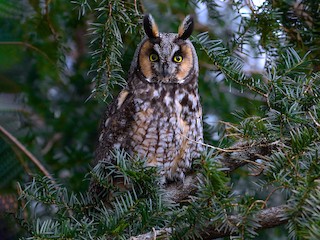
Long-eared Owl look-alikes
Asio otus
Spotted a bird? Identify it instantly with the Birdby app
Open the appSeveral birds can be mistaken for the Long-eared Owl. Compare the key differences below to confirm your sighting.
Birds to compare
Short-eared Owl
Asio flammeus
Key differences
The Short-eared Owl has much shorter ear tufts (often not visible), yellow eyes (not orange), a more rounded head, and a distinctive dark patch around the eyes. It is typically found in open grasslands and marshes, hunting during the day or at dusk/dawn, whereas the Long-eared Owl prefers woodlands and is strictly nocturnal. In flight, the Short-eared Owl shows a prominent dark carpal patch on the underwing, which the Long-eared Owl lacks.
Great Horned Owl
Bubo virginianus
Key differences
The Great Horned Owl is significantly larger and bulkier than the Long-eared Owl, with much thicker ear tufts that are set wider apart. It has yellow eyes (not orange) and a more robust build. Its plumage is generally coarser and more heavily barred. The Great Horned Owl's call is a deep, resonant hoot, very different from the Long-eared Owl's soft hoots and cat-like mews.
Strix Owls (e.g., Tawny Owl, Barred Owl)
Strix aluco, Strix varia
Key differences
Strix owls lack ear tufts entirely, giving them a round-headed appearance. Their eyes are typically dark (Tawny Owl) or yellow (Barred Owl), not orange. Their facial discs are more prominent and rounded. Their calls are also distinctly different, often involving hooting or barking sequences.
Explore the Long-eared Owl
Identify birds anywhere
Free on iOS, Android, and Web. Photo & sound identification, full species database, and your personal life list.