
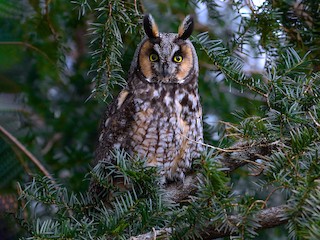
Where does the Long-eared Owl live?
Asio otus
Spotted a bird? Identify it instantly with the Birdby app
Open the appThe Long-eared Owl lives in specific habitats and regions. Knowing where, and when, to look improves your chances of a successful sighting.
Biomes
Forests, woodlands, open country with scattered trees, riparian zones, scrublands, and sometimes suburban parks.
Geographic range
Holarctic distribution, breeding across much of North America (southern Canada, most of the United States), Europe, and Asia (from western Europe to Japan). Winters in the southern parts of its breeding range and further south.
Preferred environments
Prefers mosaics of dense coniferous or deciduous woodlands for roosting and nesting, adjacent to open grasslands, meadows, or agricultural fields for hunting. Often found near water sources.
Elevation range
Sea level up to 2,000-3,000 meters (6,500-9,800 ft), depending on geographic location and availability of suitable habitat.
Where to look
Dense Conifer Stands
During winter, check dense stands of conifers (pines, spruces, cedars) or thickets, especially those bordering open fields. They often form communal roosts here.
Riparian Woodlands
Look in woodlands along rivers or streams, particularly those with a mix of deciduous and coniferous trees, which provide good nesting and roosting sites.
Shelterbelts and Hedgerows
In agricultural areas, shelterbelts, hedgerows, and small woodlots adjacent to open fields are prime locations for both roosting and hunting.
Abandoned Nests
Scan for old crow, magpie, or raptor nests in trees, as Long-eared Owls frequently reuse these for breeding.
Field tips
- Look for Pellets. Search the ground beneath dense conifers or deciduous trees for owl pellets. Long-eared Owl pellets are typically dark, compact, and contain small mammal bones and fur. Finding pellets is a strong indicator of a roost site.
- Scan Dense Cover. During the day, carefully scan dense foliage in trees, especially conifers. Their cryptic plumage makes them incredibly difficult to spot, so look for an unusual shape or the outline of an owl.
- Listen at Dusk/Dawn. Listen for their calls, especially the male's soft hoots or the begging calls of young, around dusk or dawn during the breeding season. Their calls are often quiet and ventriloquial.
- Winter Roosts. In winter, once one owl is found in a communal roost, others are often nearby. Look for multiple owls perched close together in the same tree or adjacent trees.
- Avoid Disturbance. If you find a roosting owl, observe from a distance and avoid disturbing it, especially during the day when they are vulnerable. Repeated disturbance can cause them to abandon roosts or nests.
Migration
Northern populations are migratory, moving south for the winter. Southern populations are largely resident. Migration occurs at night, often in loose flocks. Migratory routes are not well-defined, but they generally follow broad fronts.
Explore the Long-eared Owl
Identify birds anywhere
Free on iOS, Android, and Web. Photo & sound identification, full species database, and your personal life list.