
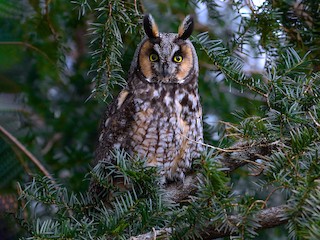
How to identify the Long-eared Owl
Asio otus
Spotted a bird? Identify it instantly with the Birdby app
Open the appTo correctly identify the Long-eared Owl (Asio otus), check each of these features. Birds can be tricky: habit, habitat, and call often confirm a sighting that a single photo cannot.
Size at a glance
- Length
- 31-37 cm (12-15 in)
- Wingspan
- 86-98 cm (34-39 in)
- Weight
- Males: 178-300 g (6.3-10.6 oz), Females: 220-435 g (7.8-15.3 oz)
Physical features to check
- 1
Plumage
Overall feather coloration and pattern.
Overall mottled brown and buff, with intricate streaking and barring. The upperparts are dark brown with fine greyish-white vermiculations. Underparts are buffy-white with heavy dark brown streaking, especially on the breast and belly, and fine cross-barring on the flanks. Facial disc is rusty-orange to buff, bordered by dark brown, with a prominent white 'X' pattern between the eyes. Ear tufts are long, dark, and erectile, typically held upright when alert or disturbed, but flattened when relaxed or in flight.
- 2
Beak shape
Shape and color of the bill: a key field mark.
Small, sharply hooked, and blackish-grey.
- 3
Eye color
Iris color and any distinctive eye markings.
Bright orange to orange-yellow, set within the facial disc.
- 4
Leg color
Leg and foot color.
Feathered down to the toes, which are yellowish-grey with black talons.
- 5
Distinguishing features
Standout features that separate this species.
Long, prominent ear tufts (though not always visible), slender body, bright orange eyes, and a distinctive 'X' pattern on the facial disc. Its cryptic plumage provides excellent camouflage.
- 6
Juvenile appearance
How young birds differ from adults.
Nestlings are covered in white down. Fledglings have a fluffy, buffy-white downy plumage with dark facial masks and short ear tufts. They gradually acquire adult-like plumage over their first few months, but often appear more uniformly buff and less intricately patterned than adults, with less distinct facial markings.
- 7
Seasonal changes
Plumage variation between breeding and non-breeding seasons.
No significant seasonal plumage changes. Plumage remains consistent year-round.
- 8
Sexual dimorphism
How males and females differ.
Females are generally slightly larger and heavier than males, but plumage differences are negligible. Males may have slightly paler plumage overall.
Key field marks
- Ear Tufts. Look for long, prominent, dark ear tufts, often held erect, giving the head a 'long-eared' profile. These are the most distinctive feature, though they can be flattened when relaxed.
- Eye Color. Observe the bright orange to orange-yellow eyes, which stand out against the facial disc.
- Facial Disc Pattern. Note the rusty-orange to buff facial disc with a distinctive white 'X' pattern between the eyes, bordered by dark brown.
- Plumage Pattern. Examine the intricate mottled brown and buff plumage with heavy dark streaking on the underparts and fine cross-barring on the flanks. This provides excellent camouflage against tree bark.
- Body Shape. Identify its slender, elongated body shape, especially when perched upright and alert.
- Vocalization. Listen for the male's soft, monotonous, low-pitched 'hoo-hoo-hoo' song or the cat-like 'mew' calls. The high-pitched 'pee-eep' calls of fledglings are also a strong indicator.
- Habitat and Activity. Look for them roosting silently in dense conifers or thickets during the day, often in communal roosts during winter. They are strictly nocturnal hunters in open fields adjacent to woodlands.
Explore the Long-eared Owl
Identify birds anywhere
Free on iOS, Android, and Web. Photo & sound identification, full species database, and your personal life list.