
Spotted a bird? Identify it instantly with the Birdby app
Open the appAbout
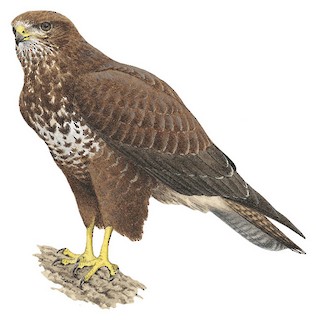
The Common Buzzard (Buteo buteo) is a medium-sized raptor with a robust build, broad wings, and a relatively short tail. It is one of the most widespread and familiar birds of prey across Europe and Asia, known for its soaring flight and variable plumage. Its diet primarily consists of small mammals, birds, and carrion, making it an opportunistic hunter.
Size & lifespan
- Length
- 40-58 cm
- Wingspan
- 100-130 cm
- Weight
- 427-1364 g (females typically larger and heavier than males)
- Lifespan
- Typically 8-10 years in the wild, up to 25 years in captivity.
- Diet
- Carnivore (primarily small mammals like voles, mice, rabbits; also small birds, reptiles, amphibians, large insects, and carrion).
Physical characteristics
- Plumage
- Highly variable, ranging from very dark brown to pale cream, often with mottled or streaked underparts. Most common morphs are brown above with paler, streaked underparts. A dark carpal patch (wrist patch) on the underwing is a key identification feature. The tail is typically barred, though the extent of barring varies.
- Beak shape
- Strong, hooked beak, dark grey to black with a yellow cere.
- Eye color
- Typically yellow to reddish-brown in adults, paler in juveniles.
- Leg color
- Yellow, with black talons.
- Distinguishing features
- Broad, rounded wings held in a shallow 'V' shape (dihedral) when soaring. Relatively short, broad tail. Dark carpal patches on the underwing are often prominent. Highly variable plumage makes identification challenging but also unique.
- Juvenile appearance
- Juveniles tend to have paler eyes (often greyish-yellow), less distinct barring on the tail, and often more streaking on the underparts, particularly on the belly and flanks. The dark carpal patches are usually present.
- Seasonal changes
- No significant seasonal plumage changes. Plumage variation is primarily individual (morphs) rather than seasonal.
- Sexual dimorphism
- Females are generally larger and heavier than males, but plumage is similar.
How to identify
- 1
Flight Profile
Look for broad, rounded wings held in a shallow 'V' (dihedral) when soaring. The tail is relatively short and broad. This distinguishes it from falcons (pointed wings) and accipiters (shorter, rounded wings, longer tail, flap-glide flight).
- 2
Underwing Markings
Identify the prominent dark carpal (wrist) patches on the underside of the wings. This is a key field mark, though their prominence can vary with plumage morph.
- 3
Plumage Variability
Be aware that Common Buzzards come in a wide range of plumages, from very dark to very pale. Focus on structural features and flight style rather than just color. Most have some degree of streaking or barring on the underparts and a barred tail.
- 4
Vocalization
Listen for the distinctive, drawn-out, mewing 'pee-yow' call, often given while soaring. This is a very reliable identification cue.
- 5
Behavior
Observe its hunting style: often perching on a prominent lookout or soaring high on thermals. It's a generalist predator, not specialized like some other raptors.
Habitat & range
- Biomes
- Forests, woodlands, agricultural land, heathland, moorland, mountains, and coastal areas.
- Geographic range
- Widespread across Europe and Asia, from the Atlantic coast to Japan. Also found in parts of North Africa.
- Elevation range
- Sea level up to 2,500 meters, occasionally higher in mountainous regions.
- Preferred environments
- Prefers a mosaic of woodland (for nesting) and open country (for hunting). Often seen perched on prominent trees, posts, or soaring over open fields.
Behavior
- Activity time
- Diurnal.
- Feeding habits
- Primarily a perch-and-pounce hunter, often sitting on a vantage point to scan for prey. Also hunts by soaring or hovering over open ground. Will readily take carrion, especially in winter or during periods of food scarcity. Known to follow agricultural machinery to catch disturbed prey.
- Social behavior
- Generally solitary or seen in pairs during the breeding season. May gather in small groups at abundant food sources or during migration.
- Flight pattern
- Characterized by broad, rounded wings held in a shallow dihedral when soaring. Often circles high on thermals. Flight is typically slow and deliberate, with deep, powerful wing beats when actively flying. Can hover briefly in a headwind.
- Migration pattern
- Northern and eastern populations are migratory, moving south and west for the winter. Western and southern European populations are largely resident or undertake short-distance dispersal. Migratory birds can form large kettles during autumn migration.
- Territoriality
- Territorial during the breeding season, defending nesting and hunting areas. Pairs often engage in aerial displays to assert territory.
Song & calls
- Song
- The Common Buzzard does not have a complex song. Its vocalizations are primarily calls.
- Call
- Most characteristic call is a drawn-out, mewing 'pee-yow' or 'kyaaaah', often likened to a cat's meow. This call is typically given in flight, especially during soaring displays or when disturbed. Also has a shorter, sharper 'kek-kek-kek' alarm call.
- When they vocalize
- Most vocal during the breeding season, particularly during courtship displays and when defending the nest. Also calls when soaring or when disturbed.
Breeding & reproduction
- Breeding season
- Typically March to August, with egg-laying from April to May.
- Nesting habits
- Nests are usually built high in trees (often deciduous or coniferous), close to the main trunk or in a fork. Nests are large structures made of sticks, lined with moss, leaves, and sometimes wool. Both sexes contribute to nest building and maintenance.
- Clutch size
- 2-4 eggs.
- Egg description
- Typically 2-4 eggs (range 1-6), dull white or pale bluish-white, often sparsely marked with reddish-brown or grey blotches.
- Incubation period
- 33-35 days, primarily by the female, with the male providing food.
- Fledging period
- 42-50 days after hatching. Young remain dependent on parents for several weeks after fledging.
- Parental care
- Both parents care for the young. The female primarily incubates and broods, while the male provides most of the food during the early nestling stage. Both parents feed the older nestlings and fledglings.
Where to find
Woodland Edges and Clearings
Look for them soaring over the interface between forests and open fields, or perched on tall trees at the woodland edge.
Agricultural Land
Often seen perched on fence posts, telegraph poles, or isolated trees in farmland, scanning for prey.
Moorland and Heathland
In upland areas, they can be seen soaring over open moorland, especially where there are scattered trees or rocky outcrops.
Motorways and Roadsides
Commonly seen perched on roadside trees or lamp posts, looking for roadkill or small mammals in the verges.
Field tips
- Scan the Sky. Common Buzzards spend a lot of time soaring, especially on sunny days. Look up frequently, particularly over open areas or hillsides.
- Check Prominent Perches. They often use high vantage points like isolated trees, telegraph poles, or fence posts to survey their hunting grounds. Use binoculars to scan these spots.
- Listen for Calls. Their distinctive 'mewing' call is often the first indication of their presence, even before you see them.
- Observe Flight Style. Familiarize yourself with their characteristic broad-winged, shallow-dihedral soaring flight to distinguish them from other raptors.
- Look for Kettles. During migration, especially in autumn, look for groups of buzzards (and other raptors) circling together in 'kettles' as they gain height on thermals.
Similar species
Rough-legged Buzzard
Buteo lagopus
Rough-legged Buzzards are typically paler overall, with a distinctive dark belly patch, a white tail base with a broad dark terminal band, and feathered tarsi (legs). They also have a more pronounced dark carpal patch and often hover more frequently than Common Buzzards.
Honey Buzzard
Pernis apivorus
Honey Buzzards have a smaller head, longer tail, and more slender appearance. Their wings are held flatter or slightly bowed when soaring, and they have fewer, broader bars on the tail (typically 2-3 broad dark bands). They lack the prominent dark carpal patch of the Common Buzzard and have a more pigeon-like head shape.
Eurasian Sparrowhawk
Accipiter nisus
Sparrowhawks are much smaller, with shorter, rounded wings and a longer tail. They have a characteristic 'flap-flap-glide' flight pattern and are typically found in denser woodland. Their flight profile is very different from the broad-winged, soaring buzzard.
Goshawk
Accipiter gentilis
Goshawks are larger than Sparrowhawks but still more agile and powerful than a Buzzard. They have broader, more rounded wings and a longer tail than a Buzzard, and a more direct, powerful flight. They also lack the Buzzard's characteristic soaring profile and mewing call.
Quick facts
- Status:
- Resident and migratory across its range
- Diet:
- Opportunistic carnivore, mainly small mammals and carrion
- Flight:
- Soaring with wings in shallow 'V' (dihedral)
- Call:
- Distinctive mewing 'pee-yow'
- Plumage:
- Highly variable, dark carpal patches are key
Fun facts
- The Common Buzzard is one of the most successful raptors in Europe, having recovered significantly from historical persecution and pesticide use.
- Its plumage is so variable that no two individuals look exactly alike, leading to challenges in identification for beginners.
- Despite its name, the Common Buzzard is not closely related to the New World vultures, which are also sometimes called 'buzzards' (e.g., Turkey Vulture).
- They are highly adaptable and can thrive in a wide range of habitats, from dense forests to open agricultural landscapes.
- During courtship, pairs perform spectacular aerial displays, including 'sky-dancing' with dives and rolls.
Scientific classification
- Kingdom
- Animalia
- Phylum
- Chordata
- Class
- Aves
- Order
- Accipitriformes
- Family
- Accipitridae
- Genus
- Buteo
- Species
- Buteo buteo
Explore the Common Buzzard
Identify birds anywhere
Free on iOS, Android, and Web. Photo & sound identification, full species database, and your personal life list.