
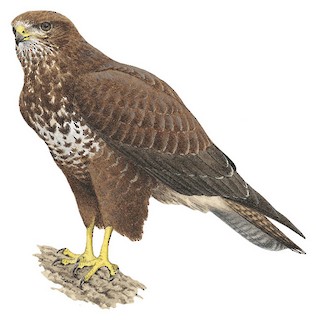
How to identify the Common Buzzard
Buteo buteo
Spotted a bird? Identify it instantly with the Birdby app
Open the appTo correctly identify the Common Buzzard (Buteo buteo), check each of these features. Birds can be tricky: habit, habitat, and call often confirm a sighting that a single photo cannot.
Size at a glance
- Length
- 40-58 cm
- Wingspan
- 100-130 cm
- Weight
- 427-1364 g (females typically larger and heavier than males)
Physical features to check
- 1
Plumage
Overall feather coloration and pattern.
Highly variable, ranging from very dark brown to pale cream, often with mottled or streaked underparts. Most common morphs are brown above with paler, streaked underparts. A dark carpal patch (wrist patch) on the underwing is a key identification feature. The tail is typically barred, though the extent of barring varies.
- 2
Beak shape
Shape and color of the bill: a key field mark.
Strong, hooked beak, dark grey to black with a yellow cere.
- 3
Eye color
Iris color and any distinctive eye markings.
Typically yellow to reddish-brown in adults, paler in juveniles.
- 4
Leg color
Leg and foot color.
Yellow, with black talons.
- 5
Distinguishing features
Standout features that separate this species.
Broad, rounded wings held in a shallow 'V' shape (dihedral) when soaring. Relatively short, broad tail. Dark carpal patches on the underwing are often prominent. Highly variable plumage makes identification challenging but also unique.
- 6
Juvenile appearance
How young birds differ from adults.
Juveniles tend to have paler eyes (often greyish-yellow), less distinct barring on the tail, and often more streaking on the underparts, particularly on the belly and flanks. The dark carpal patches are usually present.
- 7
Seasonal changes
Plumage variation between breeding and non-breeding seasons.
No significant seasonal plumage changes. Plumage variation is primarily individual (morphs) rather than seasonal.
- 8
Sexual dimorphism
How males and females differ.
Females are generally larger and heavier than males, but plumage is similar.
Key field marks
- Flight Profile. Look for broad, rounded wings held in a shallow 'V' (dihedral) when soaring. The tail is relatively short and broad. This distinguishes it from falcons (pointed wings) and accipiters (shorter, rounded wings, longer tail, flap-glide flight).
- Underwing Markings. Identify the prominent dark carpal (wrist) patches on the underside of the wings. This is a key field mark, though their prominence can vary with plumage morph.
- Plumage Variability. Be aware that Common Buzzards come in a wide range of plumages, from very dark to very pale. Focus on structural features and flight style rather than just color. Most have some degree of streaking or barring on the underparts and a barred tail.
- Vocalization. Listen for the distinctive, drawn-out, mewing 'pee-yow' call, often given while soaring. This is a very reliable identification cue.
- Behavior. Observe its hunting style: often perching on a prominent lookout or soaring high on thermals. It's a generalist predator, not specialized like some other raptors.
Explore the Common Buzzard
Identify birds anywhere
Free on iOS, Android, and Web. Photo & sound identification, full species database, and your personal life list.