
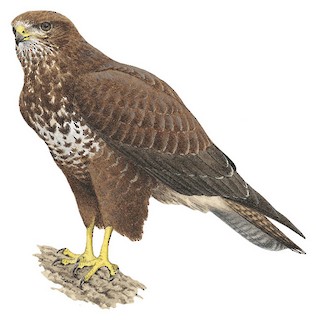
Where does the Common Buzzard live?
Buteo buteo
Spotted a bird? Identify it instantly with the Birdby app
Open the appThe Common Buzzard lives in specific habitats and regions. Knowing where, and when, to look improves your chances of a successful sighting.
Biomes
Forests, woodlands, agricultural land, heathland, moorland, mountains, and coastal areas.
Geographic range
Widespread across Europe and Asia, from the Atlantic coast to Japan. Also found in parts of North Africa.
Preferred environments
Prefers a mosaic of woodland (for nesting) and open country (for hunting). Often seen perched on prominent trees, posts, or soaring over open fields.
Elevation range
Sea level up to 2,500 meters, occasionally higher in mountainous regions.
Where to look
Woodland Edges and Clearings
Look for them soaring over the interface between forests and open fields, or perched on tall trees at the woodland edge.
Agricultural Land
Often seen perched on fence posts, telegraph poles, or isolated trees in farmland, scanning for prey.
Moorland and Heathland
In upland areas, they can be seen soaring over open moorland, especially where there are scattered trees or rocky outcrops.
Motorways and Roadsides
Commonly seen perched on roadside trees or lamp posts, looking for roadkill or small mammals in the verges.
Field tips
- Scan the Sky. Common Buzzards spend a lot of time soaring, especially on sunny days. Look up frequently, particularly over open areas or hillsides.
- Check Prominent Perches. They often use high vantage points like isolated trees, telegraph poles, or fence posts to survey their hunting grounds. Use binoculars to scan these spots.
- Listen for Calls. Their distinctive 'mewing' call is often the first indication of their presence, even before you see them.
- Observe Flight Style. Familiarize yourself with their characteristic broad-winged, shallow-dihedral soaring flight to distinguish them from other raptors.
- Look for Kettles. During migration, especially in autumn, look for groups of buzzards (and other raptors) circling together in 'kettles' as they gain height on thermals.
Migration
Northern and eastern populations are migratory, moving south and west for the winter. Western and southern European populations are largely resident or undertake short-distance dispersal. Migratory birds can form large kettles during autumn migration.
Explore the Common Buzzard
Identify birds anywhere
Free on iOS, Android, and Web. Photo & sound identification, full species database, and your personal life list.