
Spotted a bird? Identify it instantly with the Birdby app
Open the appAbout
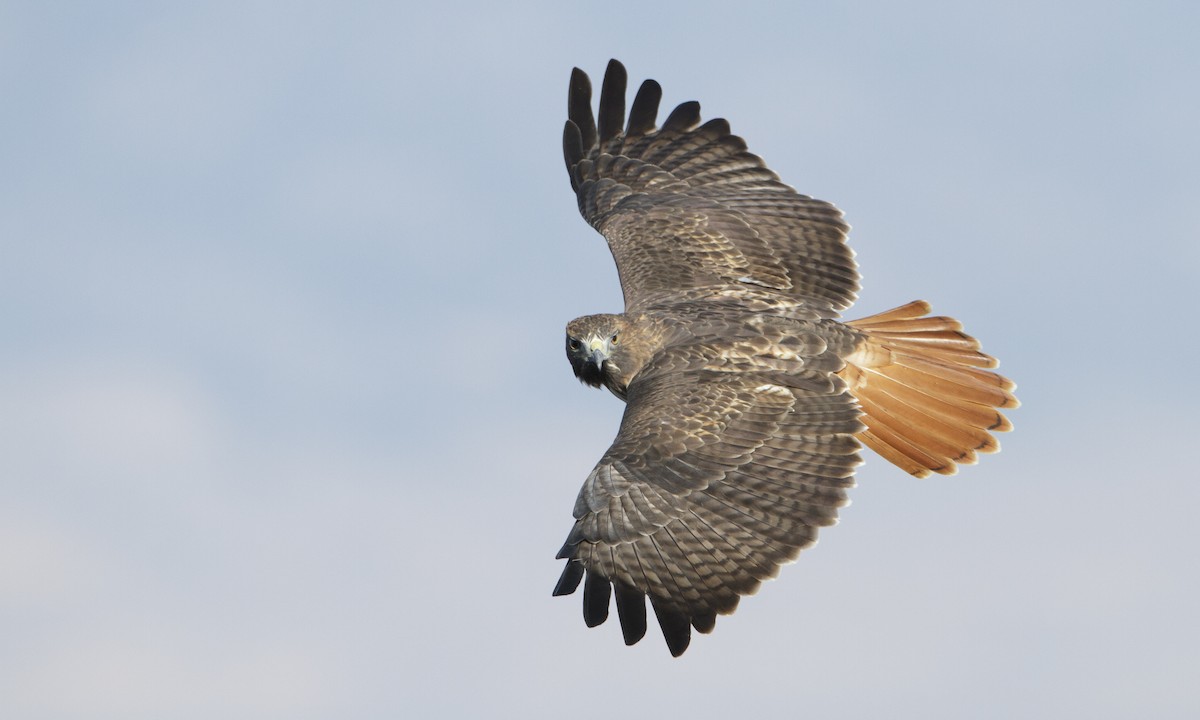
The Red-tailed Hawk is one of the most common and widespread raptors in North America. It is a large hawk with broad, rounded wings and a short, wide tail. Adults are most easily identified by their rufous (reddish-brown) tail, visible from above and below. They are highly adaptable and can be found in a wide variety of habitats, often seen soaring in wide circles high above open country or perched conspicuously on telephone poles, trees, or other elevated structures.
Size & lifespan
- Length
- 45-65 cm (18-26 in)
- Wingspan
- 110-145 cm (43-57 in)
- Weight
- 690-1600 g (1.5-3.5 lbs)
- Lifespan
- Typically 10-15 years in the wild, with records up to 30 years.
- Diet
- Carnivore, primarily preying on small mammals (rodents, rabbits), birds, and reptiles.
Physical characteristics
- Plumage
- Adults typically have a dark brown back and upperwings, a pale underbelly with a dark belly band, and a distinctive rufous tail. The head is usually brown with a pale throat. Plumage can vary significantly across subspecies and morphs, ranging from very pale (Krider's Hawk) to very dark (Harlan's Hawk).
- Beak shape
- Strong, hooked beak, dark gray to black with a yellow cere.
- Eye color
- Adults have dark brown eyes. Juveniles have pale yellow eyes that darken with age.
- Leg color
- Yellow
- Distinguishing features
- The most reliable field mark for adults is the brick-red tail, visible from both dorsal and ventral views. In flight, look for the dark patagial marks (dark leading edge of the underwing) and the pale underwing coverts contrasting with darker flight feathers. The dark belly band is also a key feature.
- Juvenile appearance
- Juveniles lack the red tail; instead, their tail is finely barred brown and white. Their eyes are pale yellow. The dark belly band is often present but can be less defined than in adults. They also have prominent dark patagial marks.
- Seasonal changes
- No significant seasonal plumage changes. Plumage variations are primarily age-related (juvenile to adult) and polymorphic (light, intermediate, dark morphs, and various subspecies).
- Sexual dimorphism
- Females are generally 20-25% larger and heavier than males, but plumage is similar.
How to identify
- 1
Adult Tail Color
Look for the unmistakable brick-red tail, visible from both above and below, especially when soaring or perched. This is the most definitive field mark for adults.
- 2
Underwing Markings
Observe the underwing in flight. Adults and juveniles typically show dark patagial marks (dark patches on the leading edge of the wing near the body) and a pale underwing contrasting with darker flight feathers.
- 3
Belly Band
On the underside, look for a band of dark streaking across the belly, often forming a 'belt'. This can be variable but is a common feature.
- 4
Overall Shape and Flight
Note the broad, rounded wings and short, wide tail. They are powerful soarers, often holding wings in a slight dihedral. Their flight is less agile than accipiters.
- 5
Vocalization
Listen for their characteristic raspy, descending scream, 'kree-eee-ar', which is often given while soaring.
- 6
Perching Behavior
They frequently perch conspicuously on high vantage points such as telephone poles, dead trees, or tall structures, making them relatively easy to spot.
Habitat & range
- Biomes
- Forests, woodlands, grasslands, deserts, agricultural fields, urban and suburban areas, tundra, and mountains.
- Geographic range
- Widespread across North America, from Alaska and northern Canada south through the United States, Mexico, and Central America to the Caribbean.
- Elevation range
- Sea level up to 3,000 meters (10,000 feet) or higher in mountainous regions.
- Preferred environments
- Open country with scattered trees or elevated perches for hunting, often near forest edges, fields, or along highways. They adapt well to human-modified landscapes.
Behavior
- Activity time
- Diurnal, active during daylight hours.
- Feeding habits
- Primarily a sit-and-wait predator, perching on high vantage points to scan for prey. Also hunts by soaring or kiting over open fields. Prey is typically caught on the ground. Diet consists mainly of small mammals (voles, mice, ground squirrels, rabbits), but also includes birds (pheasants, quail, starlings), snakes, lizards, and occasionally insects or carrion.
- Social behavior
- Generally solitary outside of the breeding season. During breeding, they form monogamous pairs. They are not typically colonial nesters.
- Flight pattern
- Characterized by powerful, buoyant soaring on broad wings, often in wide circles. They hold their wings in a slight dihedral (V-shape) when soaring. They can also be seen kiting (hovering in place against the wind) or performing direct, powerful flapping flight.
- Migration pattern
- Northern populations are migratory, moving south for the winter. Southern and central populations are largely resident year-round. Migrants travel during the day, often utilizing thermals and updrafts along mountain ridges or coastlines.
- Territoriality
- Highly territorial during the breeding season, defending their nesting area from other raptors and potential threats. They may perform aerial displays to assert dominance.
Song & calls
- Song
- Red-tailed Hawks do not have a song in the traditional sense. Their vocalizations are primarily calls.
- Call
- A distinctive, raspy, descending scream, often transcribed as "kree-eee-ar" or "kee-eeee-arrr". This call is frequently used in movies as a generic raptor sound. It is often given while soaring or when disturbed near the nest.
- When they vocalize
- Most vocal during the breeding season, especially around the nest site, and when soaring. Can also call when agitated or defending territory.
Breeding & reproduction
- Breeding season
- Varies geographically, typically from March to August in most of North America, but can start as early as December in southern regions.
- Nesting habits
- Nests are large, bulky structures made of sticks, twigs, and bark, lined with softer materials like bark strips, fresh greenery, and down. They are typically built high in tall trees (deciduous or coniferous), often near the main trunk or in a major fork. They may also use artificial structures like transmission towers or cliff ledges.
- Clutch size
- 1-5 eggs
- Egg description
- Typically 1-5 (usually 2-3) eggs, dull white or bluish-white, often unmarked or lightly spotted/blotched with reddish-brown or purplish markings.
- Incubation period
- 28-35 days, primarily by the female, with the male providing food.
- Fledging period
- 42-46 days after hatching. Young remain dependent on parents for several weeks after fledging.
- Parental care
- Both parents participate in raising the young. The female does most of the incubation and brooding, while the male provides most of the food. Both parents feed the nestlings and defend the nest.
Where to find
Open Country
Look for them soaring over fields, prairies, deserts, and agricultural lands.
Roadsides
Often seen perched on telephone poles, fence posts, or trees along highways and rural roads, scanning for prey.
Forest Edges and Woodlands
While they prefer open areas for hunting, they often nest and perch in trees along the edges of forests or in open woodlands.
Urban/Suburban Areas
Increasingly common in developed areas with suitable tall trees for nesting and open spaces for hunting, such as parks, golf courses, and large backyards.
Field tips
- Scan High Perches. Always check the tops of telephone poles, dead trees, and other elevated structures when driving or walking through open country. Red-tailed Hawks are often very visible.
- Look Up. Spend time scanning the sky, especially on sunny days. Red-tailed Hawks are expert soarers and can often be seen circling high overhead, sometimes for extended periods.
- Listen for Calls. Learn their distinctive 'kree-eee-ar' call. Hearing it can often lead you to locate a soaring or perched bird, even if it's initially out of sight.
- Observe Flight Patterns. Watch for their characteristic broad-winged soaring with a slight dihedral. This can help distinguish them from other raptors.
- Check for Dark Patagial Marks. When a hawk is flying overhead, focus on the underwing. The dark patches on the leading edge of the wing near the body are a strong indicator, even on juveniles.
Similar species
Red-shouldered Hawk
Buteo lineatus
Red-shouldered Hawks are smaller, have more slender bodies, and a longer tail. Adults have reddish barring on the breast and belly, and prominent white crescent-shaped patches near the wingtips (visible from below). Their call is a series of clear, whistled 'kee-aah' notes, distinct from the Red-tailed Hawk's raspy scream. They prefer more wooded, riparian habitats.
Rough-legged Hawk
Buteo lagopus
Rough-legged Hawks are winter visitors to much of the Red-tailed Hawk's range. They have feathered legs down to their toes, a smaller bill, and a distinctive dark carpal patch (wrist mark) on the underwing. Their tail is typically white with a broad dark terminal band (adults) or multiple narrow bands (juveniles), lacking the rufous color. They often hover more frequently than Red-tailed Hawks.
Ferruginous Hawk
Buteo regalis
Ferruginous Hawks are larger and bulkier, with a more upright posture when perched. They have rusty (ferruginous) coloration on their back and legs (forming a 'V' in flight), and a pale head. The underwing coverts are white, contrasting with dark flight feathers, and they lack the dark patagial marks of Red-tailed Hawks. Their tail is typically white or pale gray, often with rusty wash.
Swainson's Hawk
Buteo swainsoni
Swainson's Hawks are typically more slender with longer, narrower wings. Adults often have a dark bib on the chest and a pale belly. Their underwings show a distinct two-toned pattern: pale coverts contrasting with dark flight feathers, but without the dark patagial marks. Their tail is typically gray-brown with several narrow dark bands and a broader subterminal band, not rufous. They are primarily insectivorous during migration and winter.
Quick facts
- Diet:
- Small mammals, birds, reptiles
- Habitat:
- Diverse open and semi-open habitats
- Migration:
- Partial migrant (northern populations)
- Call:
- Raspy, descending 'kree-eee-ar'
- Key ID Mark (Adult):
- Red tail
Fun facts
- The Red-tailed Hawk's scream is so iconic that it is frequently used in Hollywood films as the generic sound for any raptor, even when the bird on screen is an eagle or another hawk species.
- Red-tailed Hawks exhibit a wide range of plumage variations, including light, intermediate, and dark morphs, as well as several recognized subspecies with distinct appearances, such as the pale 'Krider's Hawk' and the very dark 'Harlan's Hawk'.
- They have exceptional eyesight, estimated to be 2-8 times better than humans, allowing them to spot small prey from great heights.
- Despite their fierce predatory nature, Red-tailed Hawks are known to occasionally 'play' with objects, dropping and catching them in mid-air.
- Pairs often mate for life and will reuse the same nest site year after year, adding new material each breeding season.
Scientific classification
- Kingdom
- Animalia
- Phylum
- Chordata
- Class
- Aves
- Order
- Accipitriformes
- Family
- Accipitridae
- Genus
- Buteo
- Species
- Buteo jamaicensis
Explore the Red-tailed Hawk
Identify birds anywhere
Free on iOS, Android, and Web. Photo & sound identification, full species database, and your personal life list.