
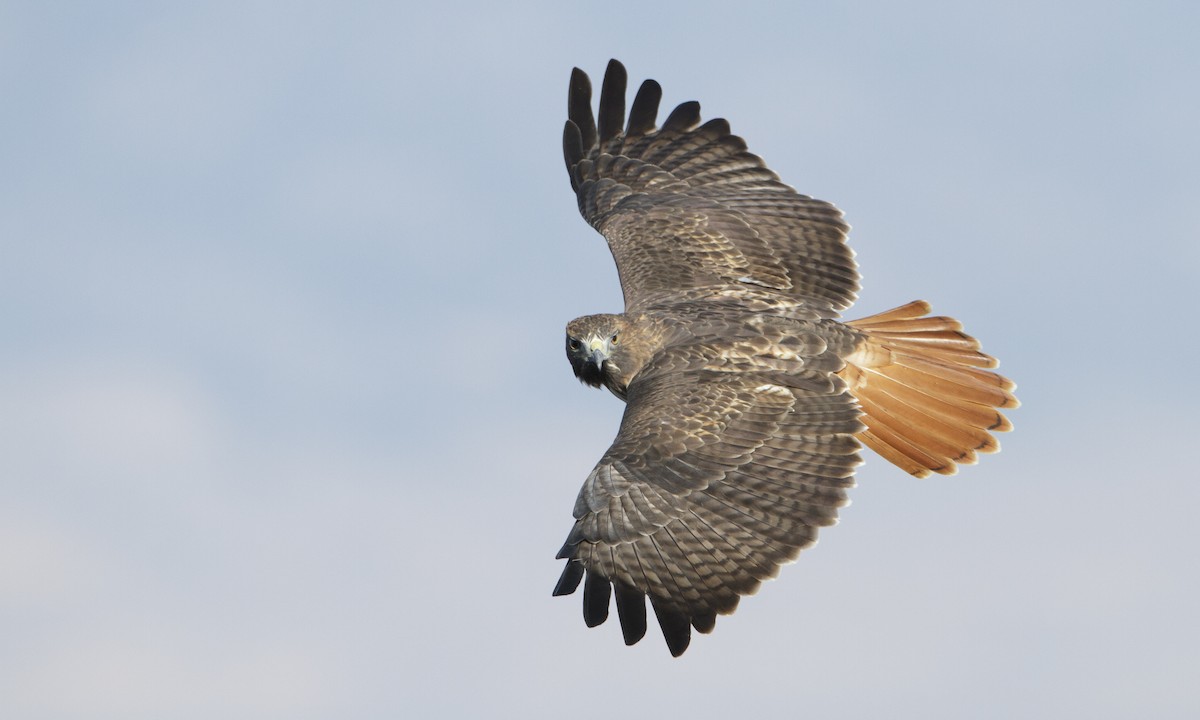
Where does the Red-tailed Hawk live?
Buteo jamaicensis
Spotted a bird? Identify it instantly with the Birdby app
Open the appThe Red-tailed Hawk lives in specific habitats and regions. Knowing where, and when, to look improves your chances of a successful sighting.
Biomes
Forests, woodlands, grasslands, deserts, agricultural fields, urban and suburban areas, tundra, and mountains.
Geographic range
Widespread across North America, from Alaska and northern Canada south through the United States, Mexico, and Central America to the Caribbean.
Preferred environments
Open country with scattered trees or elevated perches for hunting, often near forest edges, fields, or along highways. They adapt well to human-modified landscapes.
Elevation range
Sea level up to 3,000 meters (10,000 feet) or higher in mountainous regions.
Where to look
Open Country
Look for them soaring over fields, prairies, deserts, and agricultural lands.
Roadsides
Often seen perched on telephone poles, fence posts, or trees along highways and rural roads, scanning for prey.
Forest Edges and Woodlands
While they prefer open areas for hunting, they often nest and perch in trees along the edges of forests or in open woodlands.
Urban/Suburban Areas
Increasingly common in developed areas with suitable tall trees for nesting and open spaces for hunting, such as parks, golf courses, and large backyards.
Field tips
- Scan High Perches. Always check the tops of telephone poles, dead trees, and other elevated structures when driving or walking through open country. Red-tailed Hawks are often very visible.
- Look Up. Spend time scanning the sky, especially on sunny days. Red-tailed Hawks are expert soarers and can often be seen circling high overhead, sometimes for extended periods.
- Listen for Calls. Learn their distinctive 'kree-eee-ar' call. Hearing it can often lead you to locate a soaring or perched bird, even if it's initially out of sight.
- Observe Flight Patterns. Watch for their characteristic broad-winged soaring with a slight dihedral. This can help distinguish them from other raptors.
- Check for Dark Patagial Marks. When a hawk is flying overhead, focus on the underwing. The dark patches on the leading edge of the wing near the body are a strong indicator, even on juveniles.
Migration
Northern populations are migratory, moving south for the winter. Southern and central populations are largely resident year-round. Migrants travel during the day, often utilizing thermals and updrafts along mountain ridges or coastlines.
Explore the Red-tailed Hawk
Identify birds anywhere
Free on iOS, Android, and Web. Photo & sound identification, full species database, and your personal life list.