
How to identify the Red-tailed Hawk
Buteo jamaicensis
Spotted a bird? Identify it instantly with the Birdby app
Open the appTo correctly identify the Red-tailed Hawk (Buteo jamaicensis), check each of these features. Birds can be tricky: habit, habitat, and call often confirm a sighting that a single photo cannot.
Size at a glance
- Length
- 45-65 cm (18-26 in)
- Wingspan
- 110-145 cm (43-57 in)
- Weight
- 690-1600 g (1.5-3.5 lbs)
Physical features to check
- 1
Plumage
Overall feather coloration and pattern.
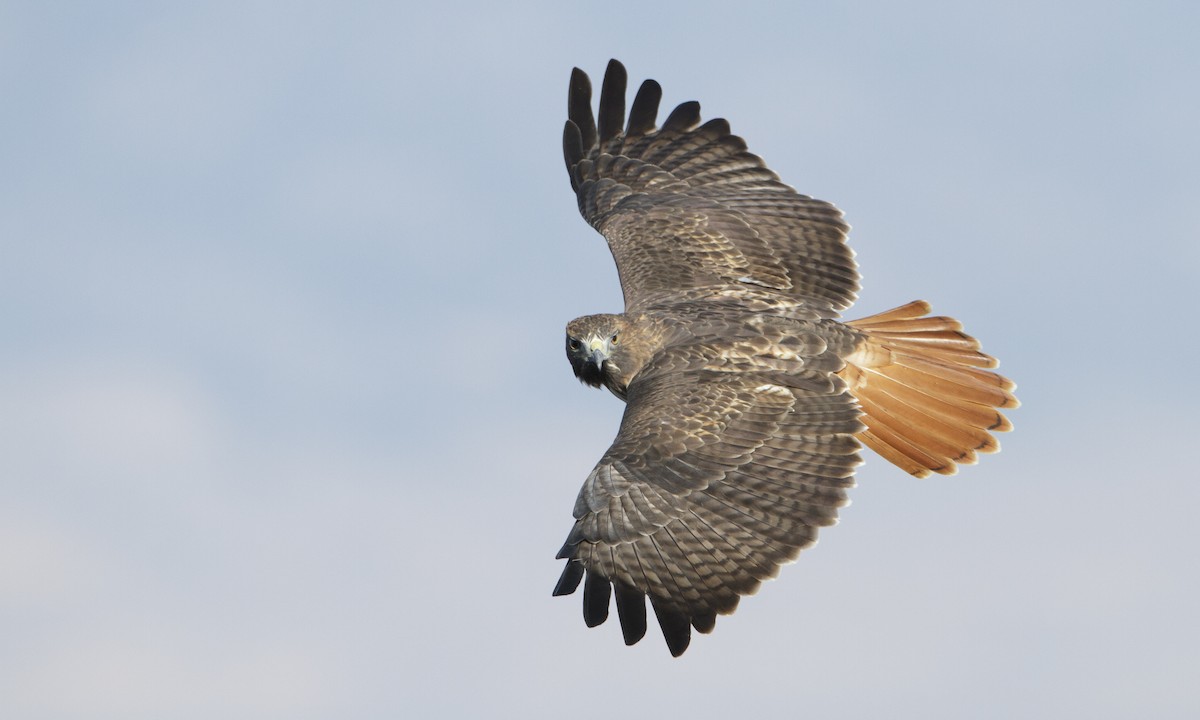
Adults typically have a dark brown back and upperwings, a pale underbelly with a dark belly band, and a distinctive rufous tail. The head is usually brown with a pale throat. Plumage can vary significantly across subspecies and morphs, ranging from very pale (Krider's Hawk) to very dark (Harlan's Hawk).
- 2
Beak shape
Shape and color of the bill: a key field mark.
Strong, hooked beak, dark gray to black with a yellow cere.
- 3
Eye color
Iris color and any distinctive eye markings.
Adults have dark brown eyes. Juveniles have pale yellow eyes that darken with age.
- 4
Leg color
Leg and foot color.
Yellow
- 5
Distinguishing features
Standout features that separate this species.
The most reliable field mark for adults is the brick-red tail, visible from both dorsal and ventral views. In flight, look for the dark patagial marks (dark leading edge of the underwing) and the pale underwing coverts contrasting with darker flight feathers. The dark belly band is also a key feature.
- 6
Juvenile appearance
How young birds differ from adults.
Juveniles lack the red tail; instead, their tail is finely barred brown and white. Their eyes are pale yellow. The dark belly band is often present but can be less defined than in adults. They also have prominent dark patagial marks.
- 7
Seasonal changes
Plumage variation between breeding and non-breeding seasons.
No significant seasonal plumage changes. Plumage variations are primarily age-related (juvenile to adult) and polymorphic (light, intermediate, dark morphs, and various subspecies).
- 8
Sexual dimorphism
How males and females differ.
Females are generally 20-25% larger and heavier than males, but plumage is similar.
Key field marks
- Adult Tail Color. Look for the unmistakable brick-red tail, visible from both above and below, especially when soaring or perched. This is the most definitive field mark for adults.
- Underwing Markings. Observe the underwing in flight. Adults and juveniles typically show dark patagial marks (dark patches on the leading edge of the wing near the body) and a pale underwing contrasting with darker flight feathers.
- Belly Band. On the underside, look for a band of dark streaking across the belly, often forming a 'belt'. This can be variable but is a common feature.
- Overall Shape and Flight. Note the broad, rounded wings and short, wide tail. They are powerful soarers, often holding wings in a slight dihedral. Their flight is less agile than accipiters.
- Vocalization. Listen for their characteristic raspy, descending scream, 'kree-eee-ar', which is often given while soaring.
- Perching Behavior. They frequently perch conspicuously on high vantage points such as telephone poles, dead trees, or tall structures, making them relatively easy to spot.
Explore the Red-tailed Hawk
Identify birds anywhere
Free on iOS, Android, and Web. Photo & sound identification, full species database, and your personal life list.