
Spotted a bird? Identify it instantly with the Birdby app
Open the appAbout
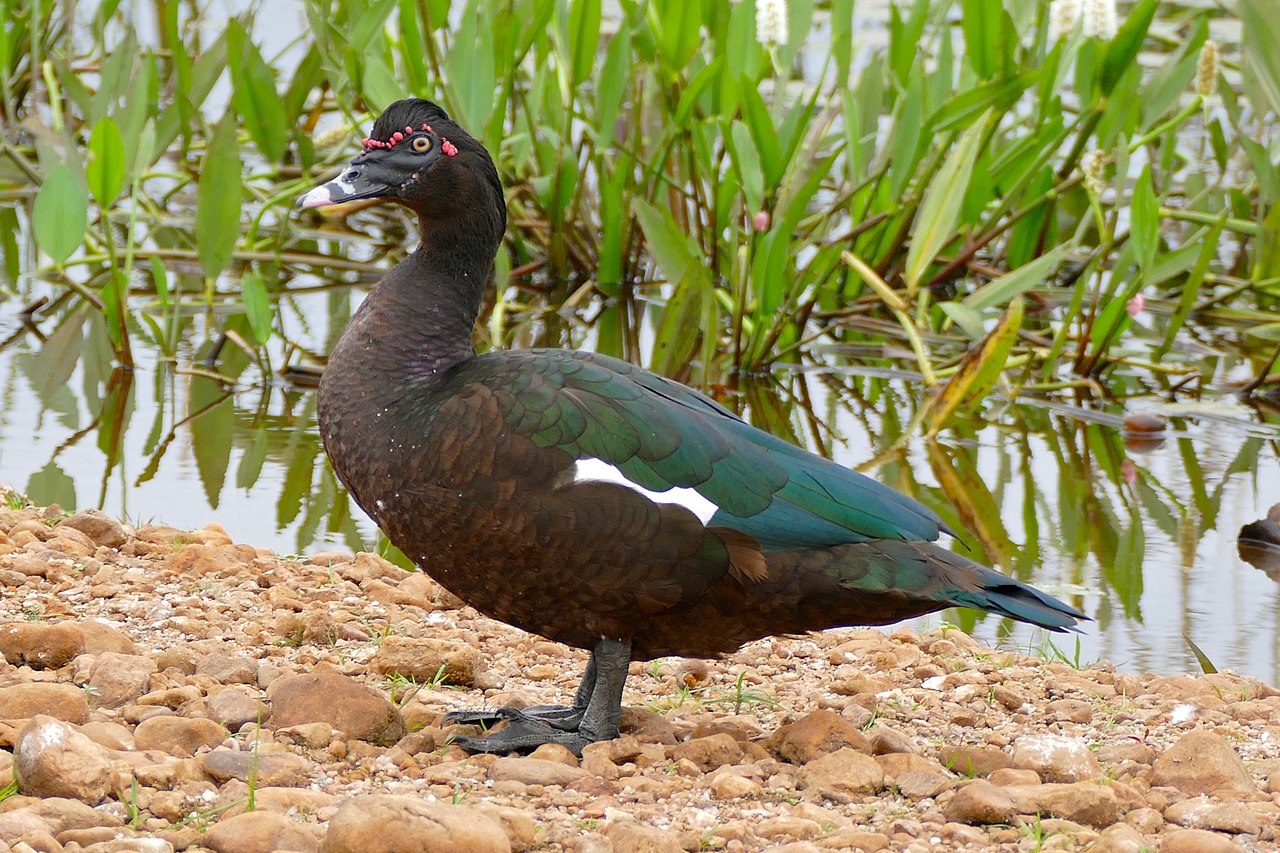
The Muscovy Duck (Cairina moschata) is a large duck native to Mexico, Central, and South America. It is characterized by its distinctive caruncles (fleshy growths) around the face, especially prominent in males. Wild populations are typically dark with white wing patches, while domesticated forms exhibit a wide range of plumages. It is a perching duck, often found in wooded wetlands.
Size & lifespan
- Length
- 66-84 cm (26-33 in)
- Wingspan
- 102-152 cm (40-60 in)
- Weight
- Males: 2.7-6.8 kg (6-15 lbs); Females: 1.4-3.6 kg (3-8 lbs)
- Lifespan
- 8-12 years in the wild, up to 20 years in captivity
- Diet
- Omnivore
Physical characteristics
- Plumage
- Wild Muscovy Ducks are predominantly glossy black with iridescent green and purple sheens, especially on the back and wings. They have large white patches on the wings, visible in flight and often when at rest. Domesticated varieties show a much wider range of colors including white, black, blue, chocolate, and pied patterns.
- Beak shape
- Broad, flattened bill, typically dark with pinkish or reddish areas, especially near the base. The bill is often partially obscured by caruncles in males.
- Eye color
- Dark brown, often surrounded by the carunculated facial skin.
- Leg color
- Short, stout legs and webbed feet, typically dark gray to black, sometimes with reddish tints.
- Distinguishing features
- The most distinctive feature is the extensive red or black carunculated (fleshy, warty) skin around the eyes and bill, particularly pronounced in adult males. They also have a crest of feathers on the nape that can be raised. The large white wing patches are a key field mark for wild birds.
- Juvenile appearance
- Juveniles resemble adult females but are duller in coloration, with less developed caruncles. Their plumage is typically a duller brown-black, and the white wing patches may be less distinct.
- Seasonal changes
- No significant seasonal plumage changes. The caruncles may become more vibrant or pronounced during the breeding season, especially in males.
- Sexual dimorphism
- Males (drakes) are significantly larger than females (hens), often twice the weight. Males have much more extensive and prominent caruncles on their faces, giving them a more 'warty' appearance. Females have smaller, less developed caruncles.
How to identify
- 1
Facial Caruncles
Look for the distinctive red or black fleshy growths around the eyes and bill. These are much more pronounced in males.
- 2
Size and Shape
Note the large, heavy-bodied duck with a long body and relatively short legs. Males are significantly larger than females.
- 3
Plumage (Wild Birds)
Observe the glossy black body with iridescent sheens and the prominent white wing patches, especially visible in flight.
- 4
Behavior
Watch for perching in trees, a characteristic behavior for this species. Also, note their quiet nature compared to other ducks.
- 5
Flight
Identify by their strong, direct flight and the conspicuous white wing patches.
Habitat & range
- Biomes
- Tropical and subtropical wetlands, forests, swamps, marshes, and agricultural areas.
- Geographic range
- Native to Mexico, Central America, and South America, ranging from the Rio Grande Valley of Texas south to northern Argentina and Uruguay. Feral populations are established in many parts of the world, including North America (Florida, Texas), Europe, and Australia.
- Elevation range
- Primarily lowlands, typically below 1,000 meters (3,300 feet), but can be found at higher elevations in some parts of its range.
- Preferred environments
- Prefers wooded swamps, forested rivers, lakes, and ponds, especially those with overhanging trees for perching and nesting. They are often found near human settlements and agricultural lands where food is readily available.
Behavior
- Activity time
- Diurnal, most active during the day, especially in the morning and late afternoon.
- Feeding habits
- Forages by dabbling in shallow water, grazing on land, and occasionally diving. Its diet is highly varied, including aquatic plants, seeds, grains, grasses, small fish, crustaceans, insects, and small reptiles. They are opportunistic feeders.
- Social behavior
- Typically found in small groups or pairs, though larger aggregations can occur at favored feeding or roosting sites. Wild populations are generally wary of humans. Domesticated and feral populations can be quite tame.
- Flight pattern
- Strong, direct flight with relatively slow wingbeats. The large white wing patches are very conspicuous in flight. They are capable of perching in trees, a characteristic of 'perching ducks'.
- Migration pattern
- Generally non-migratory (resident) throughout its native range. Some local movements may occur in response to water availability or food resources.
- Territoriality
- Males can be highly territorial, especially during the breeding season, defending nesting sites and mates. They may engage in aggressive displays and fights with other males.
Song & calls
- Song
- Muscovy Ducks are generally quiet birds. They do not quack like typical ducks. Males produce a low, hissing sound or a soft, breathy 'huff-huff' during courtship or aggression. Females make a soft, trilling or chirping sound, especially when calling their ducklings.
- Call
- Males: Hissing, breathy 'huff-huff'. Females: Soft trill or chirp. Ducklings emit typical peeping sounds.
- When they vocalize
- Vocalizations are most common during courtship, when disturbed, or when communicating with young. Otherwise, they are largely silent.
Breeding & reproduction
- Breeding season
- Varies geographically, often year-round in tropical regions, or coinciding with rainy seasons. In temperate regions, typically spring and summer.
- Nesting habits
- Nests are usually built in tree cavities, hollow logs, or dense vegetation near water. They may also use abandoned nests of other large birds. The nest is a shallow depression lined with vegetation and down feathers.
- Clutch size
- 8-15 eggs, sometimes up to 20 in exceptional cases.
- Egg description
- 8-15 eggs, typically creamy white to pale greenish-white, smooth, and oval-shaped. Size averages about 6.5 x 4.5 cm.
- Incubation period
- 35-37 days, primarily by the female.
- Fledging period
- Ducklings are precocial and leave the nest shortly after hatching. They are capable of flight at about 70-80 days old.
- Parental care
- The female alone incubates the eggs and cares for the ducklings. Males do not participate in parental care after mating.
Where to find
Wooded Wetlands
Look in swamps, forested rivers, and lakes with dense vegetation and overhanging trees in their native range.
Urban/Suburban Ponds
Feral populations are common in parks, golf courses, and residential ponds, especially in Florida and Texas.
Agricultural Areas
They can be found near farms and cultivated fields, particularly those with nearby water sources.
Field tips
- Look Up. Unlike most ducks, Muscovy Ducks frequently perch in trees, so remember to scan tree branches near water bodies.
- Listen Carefully. They are generally quiet, but listening for their soft hisses or trills can help locate them, especially in dense cover.
- Observe Facial Features. The caruncles are the most definitive identification feature, so focus on the head and face, particularly in adult birds.
- Check for White Wing Patches. In wild birds, the large white wing patches are a reliable field mark, especially when the bird is in flight or stretching its wings.
Similar species
Wood Duck
Aix sponsa
Wood Ducks are smaller, have a more elaborate crest, and males have highly iridescent, colorful plumage with distinct white facial markings. They lack the prominent caruncles of the Muscovy Duck. Wood Ducks also have a different call (a 'woo-eek' call).
Black-bellied Whistling-Duck
Dendrocygna autumnalis
Black-bellied Whistling-Ducks are smaller, have long legs, a bright red bill, and a distinct black belly. They lack caruncles and have a characteristic 'whistling' call. Their flight profile is also different, with legs trailing behind the tail.
Domestic Ducks (e.g., Mallard derivatives)
Anas platyrhynchos domesticus
Domestic ducks derived from Mallards typically have a more typical 'duck' shape, often lack caruncles (except some breeds with minor facial growths), and produce a loud 'quack'. Their plumage is highly variable but generally lacks the distinct white wing patches of wild Muscovy Ducks.
Quick facts
- Native Range:
- Mexico, Central, and South America
- Diet:
- Omnivorous (plants, seeds, insects, small vertebrates)
- Vocalization:
- Hisses (males), trills/chirps (females), no quacking
- Nesting:
- Tree cavities, hollow logs, dense vegetation
- Conservation Status:
- Least Concern
Fun facts
- The Muscovy Duck is one of the few domesticated duck species not derived from the Mallard (Anas platyrhynchos).
- Despite its name, the 'Muscovy' duck has no connection to Moscow or Russia. The origin of the name is debated, possibly from 'musk' due to a perceived musky odor, or from 'Muisca', an indigenous people of Colombia.
- They are excellent fliers and can cover long distances, which has contributed to the establishment of feral populations worldwide.
- Muscovy Ducks are known for their strong claws, which help them grip tree branches for perching.
- In some regions, feral Muscovy Ducks are considered an invasive species due to their aggressive nature and potential to outcompete native waterfowl.
Scientific classification
- Kingdom
- Animalia
- Phylum
- Chordata
- Class
- Aves
- Order
- Anseriformes
- Family
- Anatidae
- Genus
- Cairina
- Species
- Cairina moschata
Explore the Muscovy Duck
Identify birds anywhere
Free on iOS, Android, and Web. Photo & sound identification, full species database, and your personal life list.