
Spotted a bird? Identify it instantly with the Birdby app
Open the appAbout
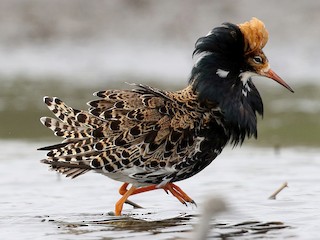
The Ruff is a medium-sized wading bird, famous for the elaborate breeding plumage of the male, which includes a large ruff of feathers and ear tufts. This species exhibits extreme sexual dimorphism during the breeding season, with males being significantly larger and more ornate than females (known as 'Reeves'). They are highly migratory, breeding in the Arctic and sub-Arctic regions of Eurasia and wintering in warmer climates, primarily Africa, but also parts of southern Asia and Australia.
Size & lifespan
- Length
- 20-32 cm (7.9-12.6 in)
- Wingspan
- 46-59 cm (18-23 in)
- Weight
- Male: 110-250 g (3.9-8.8 oz), Female: 70-170 g (2.5-6.0 oz)
- Lifespan
- Up to 10 years in the wild
- Diet
- Omnivore (primarily invertebrates, some plant material)
Physical characteristics
- Plumage
- Non-breeding plumage: Upperparts are grey-brown with darker streaking, underparts are white. Breeding male plumage is highly variable and elaborate, featuring a large ruff of feathers around the neck and ear tufts, which can be black, white, chestnut, rufous, barred, or mottled. The back and scapulars are also highly variable in color, often rufous, chestnut, or black with intricate patterns. Breeding female (Reeve) plumage is duller, typically grey-brown with some darker markings, but can show hints of rufous on the breast.
- Beak shape
- Medium-length, straight to slightly decurved, dark bill, often with a paler base in non-breeding birds.
- Eye color
- Dark brown
- Leg color
- Variable, typically yellowish, orange, or greenish-grey; can be duller in non-breeding birds.
- Distinguishing features
- The elaborate ruff and ear tufts of breeding males are unmistakable. In non-breeding plumage, the combination of medium size, relatively long neck, small head, and often yellowish legs helps distinguish it. The scaly pattern on the back of juveniles is also distinctive.
- Juvenile appearance
- Juveniles have a distinctive 'scaly' appearance on their upperparts due to dark feather centers and pale fringes. The breast and flanks are often washed with buff or rufous. Legs are typically yellowish-orange.
- Seasonal changes
- Non-breeding plumage is much plainer, with grey-brown upperparts and white underparts, lacking the elaborate ruffs and ear tufts of breeding males. Males undergo a dramatic molt into their breeding finery, which is then shed for the plainer non-breeding plumage.
- Sexual dimorphism
- Extreme during breeding season: males are significantly larger, with elaborate ruffs and ear tufts of highly variable colors. Females (Reeves) are smaller and lack these ornaments, having a more cryptic, streaky brown plumage. Males also exhibit three distinct behavioral morphs: territorial 'independents' (with large ruffs), smaller 'satellites' (with white ruffs), and 'faeders' (females that mimic males in size and behavior, but lack ruffs and are genetically female).
How to identify
- 1
Size and Shape
Medium-sized wader, stocky build, relatively long neck, small head, and an upright posture. Males are noticeably larger than females.
- 2
Breeding Male Plumage
Unmistakable with its large, erectile ruff and ear tufts, which come in an astonishing array of colors and patterns (black, white, rufous, barred, etc.). Back and scapulars also highly variable and ornate.
- 3
Non-breeding Plumage
Grey-brown upperparts with darker streaking, white underparts. Look for the relatively long neck, small head, and often yellowish or greenish-grey legs. Bill is dark, sometimes with a paler base.
- 4
Juvenile Plumage
Distinctive 'scaly' pattern on the back due to dark feather centers and pale fringes. Often a buff or rufous wash on the breast and flanks. Legs typically yellowish-orange.
- 5
Leg Color
Variable but often a key clue: yellowish, orange, or greenish-grey, especially in non-breeding birds and juveniles. This contrasts with the black legs of many other small waders.
- 6
Behavior
Watch for their characteristic foraging style, often probing in mud. During breeding, the lekking behavior of males is unique and highly distinctive.
Habitat & range
- Biomes
- Tundra, taiga, temperate grasslands, wetlands, coastal areas
- Geographic range
- Breeds across Arctic and sub-Arctic Eurasia, from Scandinavia east to Siberia. Winters primarily in sub-Saharan Africa, but also in southern Europe, the Middle East, South Asia, Southeast Asia, and Australia. Vagrants occur regularly in North America.
- Elevation range
- Typically lowlands, especially near water bodies; generally not found at high altitudes.
- Preferred environments
- Breeding: wet meadows, marshy tundra, bogs, and damp grasslands. Non-breeding/Migration: freshwater and brackish wetlands, flooded fields, sewage farms, estuaries, mudflats, and coastal lagoons.
Behavior
- Activity time
- Diurnal, though may forage at night during migration or in areas with tidal influence.
- Feeding habits
- Forages by probing in soft mud or shallow water, picking items from the surface, or gleaning from vegetation. Diet consists mainly of insects (especially larvae of flies and beetles), crustaceans, mollusks, worms, and spiders. During migration and winter, they also consume seeds and other plant material.
- Social behavior
- Highly social, especially outside the breeding season, forming large flocks, sometimes numbering thousands of individuals. During breeding, males gather at leks (communal display grounds) where they perform elaborate courtship displays to attract females. Females are solitary nesters.
- Flight pattern
- Strong, direct flight with rapid wingbeats. Often flies in compact flocks during migration. When displaying, males may perform short, fluttering flights.
- Migration pattern
- Long-distance migrant. Breeds in the Arctic and sub-Arctic of Eurasia and migrates south to wintering grounds in Africa, southern Europe, and Asia. Migration occurs in broad fronts, often with stopovers at suitable wetland habitats.
- Territoriality
- Males are highly territorial on the lek, defending small display territories. Females are territorial around their nests but not on the lek itself. Non-breeding birds are generally not territorial.
Song & calls
- Song
- Males at the lek are largely silent, but may produce soft, purring or grunting sounds during displays. There is no elaborate song.
- Call
- Typically quiet. Calls include a soft, low 'tew-it' or 'tew-tew-tew' in flight, and a short, sharp 'kek' or 'whit' when alarmed. Juveniles may emit a soft 'peep'.
- When they vocalize
- Most vocal during the breeding season, particularly at leks, though calls are generally subdued. Calls are also heard during migration, especially in flight.
Breeding & reproduction
- Breeding season
- May to July
- Nesting habits
- Nests are shallow scrapes on the ground, often concealed in dense vegetation in wet meadows or marshy areas. Lined with grass, leaves, and moss. Females are solely responsible for nest building and incubation.
- Clutch size
- 3-4 eggs
- Egg description
- Typically 4 eggs, olive-buff to greenish-brown, heavily spotted and blotched with dark brown or black, especially at the broader end. Pyriform (pear-shaped).
- Incubation period
- 20-23 days, incubated solely by the female.
- Fledging period
- 25-28 days after hatching, chicks are precocial and leave the nest shortly after hatching, but are cared for by the female until they can fly.
- Parental care
- Only the female provides parental care, incubating the eggs and raising the chicks. Males play no role in nesting or chick-rearing.
Where to find
Wetlands and Marshes
During migration and winter, look in freshwater and brackish wetlands, flooded fields, sewage farms, and marshy areas.
Coastal Mudflats and Estuaries
Can be found foraging on coastal mudflats and in estuaries, often alongside other waders.
Tundra and Bogs
On breeding grounds, they inhabit wet tundra, bogs, and damp grasslands in Arctic and sub-Arctic regions.
Field tips
- Scan Wader Flocks. Ruffs often associate with other waders. Carefully scan mixed flocks for their distinctive shape, leg color, or, if in breeding plumage, the elaborate ruff.
- Look for Upright Posture. Even in non-breeding plumage, Ruffs tend to stand more upright than many other small sandpipers, giving them a distinctive silhouette.
- Observe Leg Color. The yellowish, orange, or greenish-grey legs are a good field mark, especially when comparing with black-legged species.
- Visit Lek Sites (Breeding Season). If in breeding range, finding a lek site offers the best chance to observe the spectacular male displays. These are often in open, wet grasslands.
- Check Flooded Fields. During migration, Ruffs frequently use flooded agricultural fields, which can be excellent places to find them.
Similar species
Curlew Sandpiper
Calidris ferruginea
Ruff is larger and stockier, with a shorter, straighter bill (Curlew Sandpiper has a distinctly decurved bill). Non-breeding Ruffs have a more upright posture and often yellowish legs, while Curlew Sandpipers have black legs. Breeding Curlew Sandpipers are brick-red underneath, unlike the variable but never uniformly brick-red Ruff.
Pectoral Sandpiper
Calidris melanotos
Ruff is generally larger and has a more upright stance. Pectoral Sandpiper has a sharply demarcated streaky breast band that contrasts with a white belly, a feature less pronounced or absent in Ruff. Pectoral Sandpiper often has a more yellowish base to the bill and duller legs. Juveniles can be tricky, but Ruff juveniles have a more scaly back pattern.
Common Redshank
Tringa totanus
Redshank is larger, with bright orange-red legs and a straight, bicolored bill (red base, black tip). Ruff's legs are typically duller yellow/orange/greenish and its bill is darker. Redshank has prominent white trailing edge to the wing in flight, which Ruff lacks.
Quick facts
- Common Name:
- Ruff
- Scientific Name:
- Calidris pugnax
- Family:
- Scolopacidae
- Conservation Status:
- Least Concern
- Breeding Habitat:
- Arctic/sub-Arctic wet meadows, tundra
- Wintering Habitat:
- African wetlands, southern Europe, Asia
- Diet:
- Invertebrates, some plant material
- Key Feature:
- Elaborate male breeding plumage (ruff and ear tufts)
Fun facts
- The Ruff is one of the most sexually dimorphic birds, with males being significantly larger and having highly variable, elaborate breeding plumages.
- Male Ruffs exhibit three distinct behavioral morphs: 'independents' (territorial, with large ruffs), 'satellites' (smaller, with white ruffs, share territories with independents), and 'faeders' (genetically female but mimic males in size and behavior, lack ruffs, and are rare).
- The name 'Ruff' refers to the distinctive collar of feathers that males develop during the breeding season.
- Ruffs are famous for their lekking behavior, where males gather at communal display grounds to perform elaborate courtship rituals to attract females.
- Despite their elaborate displays, male Ruffs play no role in nesting or raising the young; all parental care is provided by the female (Reeve).
- Ruffs are strong long-distance migrants, undertaking journeys of thousands of kilometers between their Arctic breeding grounds and African wintering areas.
Scientific classification
- Kingdom
- Animalia
- Phylum
- Chordata
- Class
- Aves
- Order
- Charadriiformes
- Family
- Scolopacidae
- Genus
- Calidris
- Species
- Calidris pugnax
Explore the Ruff
Identify birds anywhere
Free on iOS, Android, and Web. Photo & sound identification, full species database, and your personal life list.