
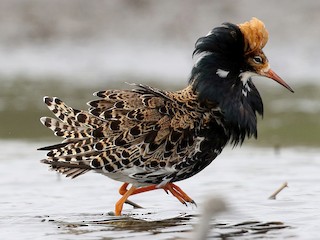
Where does the Ruff live?
Calidris pugnax
Spotted a bird? Identify it instantly with the Birdby app
Open the appThe Ruff lives in specific habitats and regions. Knowing where, and when, to look improves your chances of a successful sighting.
Biomes
Tundra, taiga, temperate grasslands, wetlands, coastal areas
Geographic range
Breeds across Arctic and sub-Arctic Eurasia, from Scandinavia east to Siberia. Winters primarily in sub-Saharan Africa, but also in southern Europe, the Middle East, South Asia, Southeast Asia, and Australia. Vagrants occur regularly in North America.
Preferred environments
Breeding: wet meadows, marshy tundra, bogs, and damp grasslands. Non-breeding/Migration: freshwater and brackish wetlands, flooded fields, sewage farms, estuaries, mudflats, and coastal lagoons.
Elevation range
Typically lowlands, especially near water bodies; generally not found at high altitudes.
Where to look
Wetlands and Marshes
During migration and winter, look in freshwater and brackish wetlands, flooded fields, sewage farms, and marshy areas.
Coastal Mudflats and Estuaries
Can be found foraging on coastal mudflats and in estuaries, often alongside other waders.
Tundra and Bogs
On breeding grounds, they inhabit wet tundra, bogs, and damp grasslands in Arctic and sub-Arctic regions.
Field tips
- Scan Wader Flocks. Ruffs often associate with other waders. Carefully scan mixed flocks for their distinctive shape, leg color, or, if in breeding plumage, the elaborate ruff.
- Look for Upright Posture. Even in non-breeding plumage, Ruffs tend to stand more upright than many other small sandpipers, giving them a distinctive silhouette.
- Observe Leg Color. The yellowish, orange, or greenish-grey legs are a good field mark, especially when comparing with black-legged species.
- Visit Lek Sites (Breeding Season). If in breeding range, finding a lek site offers the best chance to observe the spectacular male displays. These are often in open, wet grasslands.
- Check Flooded Fields. During migration, Ruffs frequently use flooded agricultural fields, which can be excellent places to find them.
Migration
Long-distance migrant. Breeds in the Arctic and sub-Arctic of Eurasia and migrates south to wintering grounds in Africa, southern Europe, and Asia. Migration occurs in broad fronts, often with stopovers at suitable wetland habitats.
Explore the Ruff
Identify birds anywhere
Free on iOS, Android, and Web. Photo & sound identification, full species database, and your personal life list.