
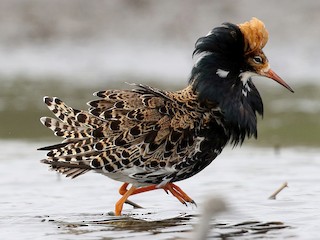
How to identify the Ruff
Calidris pugnax
Spotted a bird? Identify it instantly with the Birdby app
Open the appTo correctly identify the Ruff (Calidris pugnax), check each of these features. Birds can be tricky: habit, habitat, and call often confirm a sighting that a single photo cannot.
Size at a glance
- Length
- 20-32 cm (7.9-12.6 in)
- Wingspan
- 46-59 cm (18-23 in)
- Weight
- Male: 110-250 g (3.9-8.8 oz), Female: 70-170 g (2.5-6.0 oz)
Physical features to check
- 1
Plumage
Overall feather coloration and pattern.
Non-breeding plumage: Upperparts are grey-brown with darker streaking, underparts are white. Breeding male plumage is highly variable and elaborate, featuring a large ruff of feathers around the neck and ear tufts, which can be black, white, chestnut, rufous, barred, or mottled. The back and scapulars are also highly variable in color, often rufous, chestnut, or black with intricate patterns. Breeding female (Reeve) plumage is duller, typically grey-brown with some darker markings, but can show hints of rufous on the breast.
- 2
Beak shape
Shape and color of the bill: a key field mark.
Medium-length, straight to slightly decurved, dark bill, often with a paler base in non-breeding birds.
- 3
Eye color
Iris color and any distinctive eye markings.
Dark brown
- 4
Leg color
Leg and foot color.
Variable, typically yellowish, orange, or greenish-grey; can be duller in non-breeding birds.
- 5
Distinguishing features
Standout features that separate this species.
The elaborate ruff and ear tufts of breeding males are unmistakable. In non-breeding plumage, the combination of medium size, relatively long neck, small head, and often yellowish legs helps distinguish it. The scaly pattern on the back of juveniles is also distinctive.
- 6
Juvenile appearance
How young birds differ from adults.
Juveniles have a distinctive 'scaly' appearance on their upperparts due to dark feather centers and pale fringes. The breast and flanks are often washed with buff or rufous. Legs are typically yellowish-orange.
- 7
Seasonal changes
Plumage variation between breeding and non-breeding seasons.
Non-breeding plumage is much plainer, with grey-brown upperparts and white underparts, lacking the elaborate ruffs and ear tufts of breeding males. Males undergo a dramatic molt into their breeding finery, which is then shed for the plainer non-breeding plumage.
- 8
Sexual dimorphism
How males and females differ.
Extreme during breeding season: males are significantly larger, with elaborate ruffs and ear tufts of highly variable colors. Females (Reeves) are smaller and lack these ornaments, having a more cryptic, streaky brown plumage. Males also exhibit three distinct behavioral morphs: territorial 'independents' (with large ruffs), smaller 'satellites' (with white ruffs), and 'faeders' (females that mimic males in size and behavior, but lack ruffs and are genetically female).
Key field marks
- Size and Shape. Medium-sized wader, stocky build, relatively long neck, small head, and an upright posture. Males are noticeably larger than females.
- Breeding Male Plumage. Unmistakable with its large, erectile ruff and ear tufts, which come in an astonishing array of colors and patterns (black, white, rufous, barred, etc.). Back and scapulars also highly variable and ornate.
- Non-breeding Plumage. Grey-brown upperparts with darker streaking, white underparts. Look for the relatively long neck, small head, and often yellowish or greenish-grey legs. Bill is dark, sometimes with a paler base.
- Juvenile Plumage. Distinctive 'scaly' pattern on the back due to dark feather centers and pale fringes. Often a buff or rufous wash on the breast and flanks. Legs typically yellowish-orange.
- Leg Color. Variable but often a key clue: yellowish, orange, or greenish-grey, especially in non-breeding birds and juveniles. This contrasts with the black legs of many other small waders.
- Behavior. Watch for their characteristic foraging style, often probing in mud. During breeding, the lekking behavior of males is unique and highly distinctive.
Explore the Ruff
Identify birds anywhere
Free on iOS, Android, and Web. Photo & sound identification, full species database, and your personal life list.