
Spotted a bird? Identify it instantly with the Birdby app
Open the appAbout
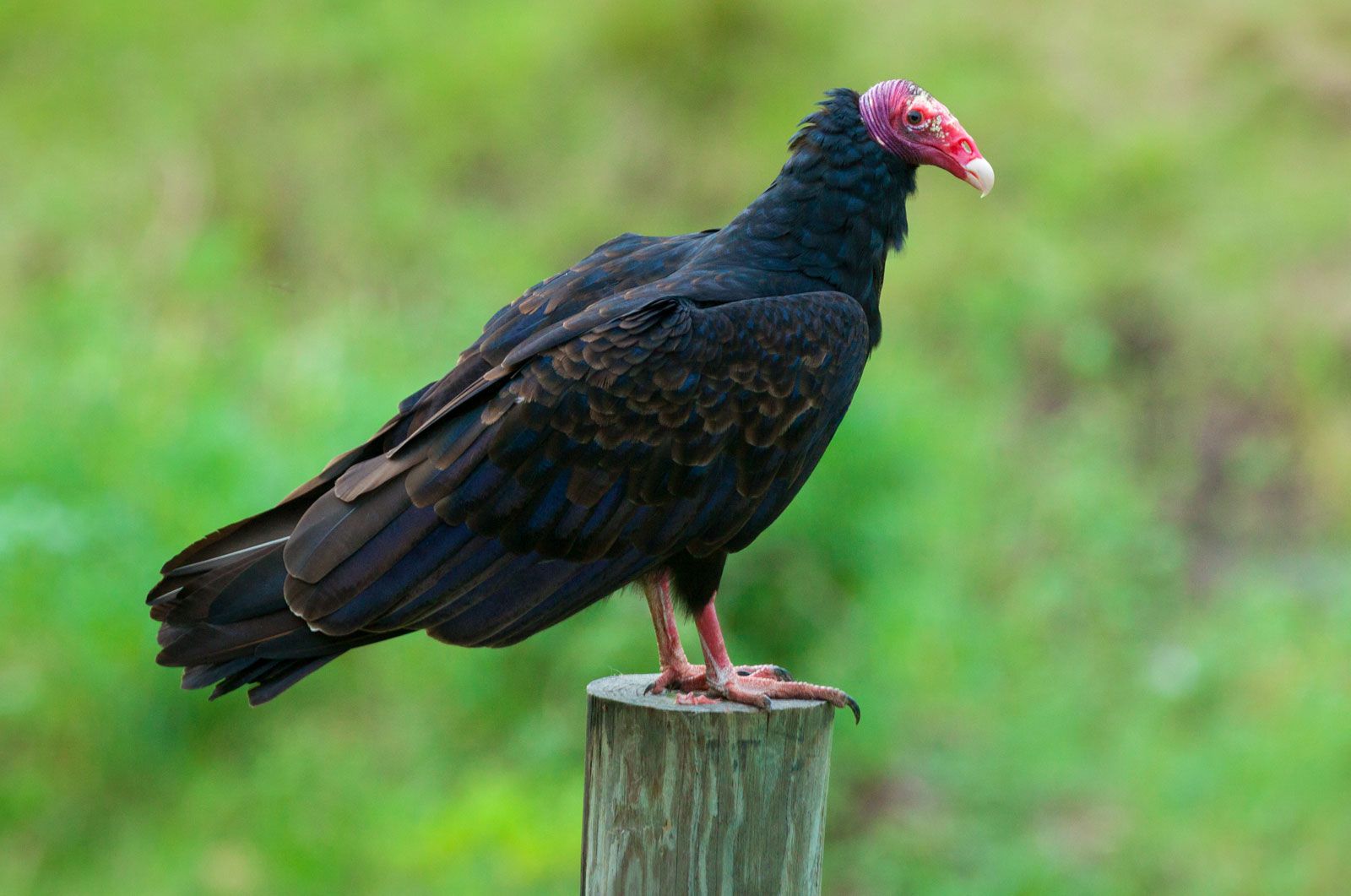
The Turkey Vulture is a large scavenger, renowned for its exceptional sense of smell, which it uses to locate carrion. It is a common and widespread species across the Americas, playing a crucial ecological role in waste removal. Its distinctive soaring flight and featherless red head make it easily recognizable.
Size & lifespan
- Length
- 62-81 cm (24-32 in)
- Wingspan
- 160-183 cm (63-72 in)
- Weight
- 0.85-2.4 kg (1.9-5.3 lbs)
- Lifespan
- Up to 16 years in the wild, over 30 years in captivity
- Diet
- Carnivore (obligate scavenger)
Physical characteristics
- Plumage
- Adults have dull blackish-brown body plumage, appearing black from a distance. The undersides of the flight feathers (remiges) are silvery-gray, creating a two-toned effect in flight. The head and neck are featherless and typically bright red in adults, though can appear duller or mottled depending on health and age. Juveniles have a grayish-black head and neck.
- Beak shape
- Hooked, ivory-colored beak, relatively weak for tearing flesh, adapted for probing.
- Eye color
- Dark brown.
- Leg color
- Pale pinkish-white to flesh-colored.
- Distinguishing features
- Featherless red head (adults), two-toned underwing pattern (silvery flight feathers contrasting with darker wing linings), and a distinctive dihedral (V-shaped) soaring flight.
- Juvenile appearance
- Juveniles have a grayish-black, downy head and neck, which gradually turns red as they mature, typically by their second year. Their plumage is generally duller than adults.
- Seasonal changes
- No significant seasonal plumage changes. The intensity of the red head color can vary with age, health, and excitement.
- Sexual dimorphism
- Minimal; males and females are similar in plumage and size, though females may be slightly larger on average.
How to identify
- 1
Flight Profile
Look for the distinctive 'V-shaped' or dihedral wing position while soaring. The bird will often appear to teeter or wobble in the air, unlike the more stable flight of other large raptors.
- 2
Underwing Pattern
Observe the underside of the wings. Turkey Vultures show a clear two-toned pattern: the flight feathers (primaries and secondaries) are silvery-gray, contrasting with the darker blackish wing linings.
- 3
Head Color (Adults)
At closer range, note the featherless, bright red head and neck of adult birds. Juveniles will have a grayish-black head.
- 4
Tail Length
Turkey Vultures have a relatively long tail that extends beyond the trailing edge of the wings in flight, giving them a more balanced appearance compared to the shorter-tailed Black Vulture.
- 5
Foraging Behavior
Watch for birds circling low over an area, often indicating they are detecting carrion by smell. They are often among the first scavengers to arrive at a carcass.
Habitat & range
- Biomes
- Forests, woodlands, grasslands, deserts, agricultural areas, open country, and suburban environments.
- Geographic range
- Widespread throughout the Americas, from southern Canada through the United States, Mexico, Central America, and most of South America to Tierra del Fuego.
- Elevation range
- Sea level up to 4,300 meters (14,000 feet) in mountainous regions.
- Preferred environments
- Prefers open areas for foraging and soaring, with nearby tall trees, cliffs, or human structures for roosting and nesting. Adaptable to a wide range of environments as long as carrion is available.
Behavior
- Activity time
- Diurnal, active during daylight hours.
- Feeding habits
- Strictly a scavenger, feeding almost exclusively on carrion. It locates food primarily by its highly developed sense of smell, detecting the odor of ethyl mercaptan, a gas produced by decaying flesh. It also uses sight, observing other vultures descending or watching for roadkill. It does not typically kill prey, though it may occasionally feed on very young, sick, or injured animals.
- Social behavior
- Often solitary while foraging, but roosts communally in large groups, sometimes numbering in the hundreds, especially during migration. They may also gather in groups at large food sources.
- Flight pattern
- Characterized by a distinctive soaring flight, holding its wings in a shallow dihedral (V-shape). It often wobbles or teeters from side to side while soaring, using thermals to gain altitude with minimal flapping. This flight style is a key identification feature.
- Migration pattern
- Northern populations are migratory, moving south for the winter. Southern populations are largely resident. Migratory birds travel in large flocks, often numbering in the thousands, utilizing thermals for energy-efficient travel.
- Territoriality
- Generally not territorial, especially around food sources or roosts. Breeding pairs defend a small area around their nest site.
Song & calls
- Song
- Turkey Vultures lack a syrinx (voice box) and therefore cannot produce true songs. They are largely silent.
- Call
- Their vocalizations are limited to hisses and grunts, particularly when disturbed, threatened, or competing for food. Hissing sounds are often heard from young birds in the nest or adults at a carcass.
- When they vocalize
- Mainly vocalize when agitated, threatened, or during interactions at a food source or nest site.
Breeding & reproduction
- Breeding season
- Varies geographically, typically March to June in North America, and earlier in more southerly regions.
- Nesting habits
- Does not build a traditional nest. Eggs are laid directly on the floor of caves, rock crevices, hollow logs, abandoned buildings, dense thickets, or under fallen trees. Nest sites are often secluded and dark.
- Clutch size
- 1-3 eggs (most commonly 2).
- Egg description
- Typically 1-3 (usually 2) eggs. Eggs are creamy white to pale buff, heavily blotched and spotted with brown, lavender, and purple, particularly at the larger end.
- Incubation period
- 30-40 days, incubated by both parents.
- Fledging period
- 70-80 days after hatching. Young are fed by regurgitation by both parents.
- Parental care
- Both parents share incubation duties and care for the young, feeding them regurgitated food until they fledge and for a period thereafter.
Where to find
Open Countryside
Look for them soaring over fields, pastures, and agricultural lands where carrion is likely to be found.
Roadsides
Often seen feeding on roadkill or perched on utility poles and trees near roads.
Thermal Updrafts
Scan the sky on warm, sunny days for soaring birds, especially around midday when thermals are strongest.
Roost Sites
At dawn and dusk, check large, dead trees, communication towers, or cliffs where they often gather in communal roosts.
Field tips
- Look Up. Turkey Vultures spend a significant amount of time soaring high in the sky. Keep an eye on the horizon and overhead, especially on clear, warm days.
- Observe Flight Style. Their characteristic teetering, V-shaped flight is a primary identification cue. If you see a large dark bird wobbling in the air, it's likely a Turkey Vulture.
- Follow Your Nose (Figuratively). While you won't smell carrion from afar, if you notice other scavengers or a strong odor, Turkey Vultures are likely nearby or will be soon.
- Check Roosts. In the early morning or late afternoon, check prominent tall structures or trees for groups of vultures warming themselves or preparing to roost.
Similar species
Black Vulture
Coragyps atratus
Black Vultures are smaller, have a shorter tail, and a black (not red) featherless head. In flight, they hold their wings flat (not in a dihedral) and have white patches only at the tips of their primary feathers, whereas Turkey Vultures have silvery-gray flight feathers along the entire trailing edge of the wing. Black Vultures also flap more frequently and erratically than Turkey Vultures.
California Condor
Gymnogyps californianus
California Condors are significantly larger, have a pinkish-orange head (adults), and large white patches on the underside of the wings near the leading edge. Their flight is more stable and less wobbly than a Turkey Vulture's. Their range is also much more restricted.
Quick facts
- Diet:
- Carrion (dead animals)
- Flight:
- Soaring with wings in a dihedral (V-shape), often teetering
- Head:
- Featherless red (adults), gray (juveniles)
- Vocalization:
- Hisses and grunts, no true song
- Ecological Role:
- Nature's clean-up crew, preventing disease spread
Fun facts
- Turkey Vultures have an exceptionally keen sense of smell, capable of detecting carrion from over a mile away, even under dense forest canopy. This is unusual for birds of prey, which typically rely on sight.
- When threatened, Turkey Vultures will often regurgitate their stomach contents. This serves two purposes: to lighten their body for easier escape and to create a foul-smelling deterrent for predators.
- They are one of the few birds that can use their urine to cool themselves. They excrete on their legs, and as the liquid evaporates, it cools the blood flowing through their legs, a process called urohidrosis.
- Despite their somewhat gruesome diet, Turkey Vultures are remarkably clean birds. Their featherless heads prevent feathers from becoming soiled with decaying flesh, and they spend considerable time preening and bathing.
- Turkey Vultures are often seen spreading their wings in the sun, a behavior called 'sunning.' This helps to warm their bodies, dry their feathers, and potentially kill bacteria or parasites.
Scientific classification
- Kingdom
- Animalia
- Phylum
- Chordata
- Class
- Aves
- Order
- Cathartiformes
- Family
- Cathartidae
- Genus
- Cathartes
- Species
- Cathartes aura
Explore the Turkey Vulture
Identify birds anywhere
Free on iOS, Android, and Web. Photo & sound identification, full species database, and your personal life list.