
Spotted a bird? Identify it instantly with the Birdby app
Open the appAbout
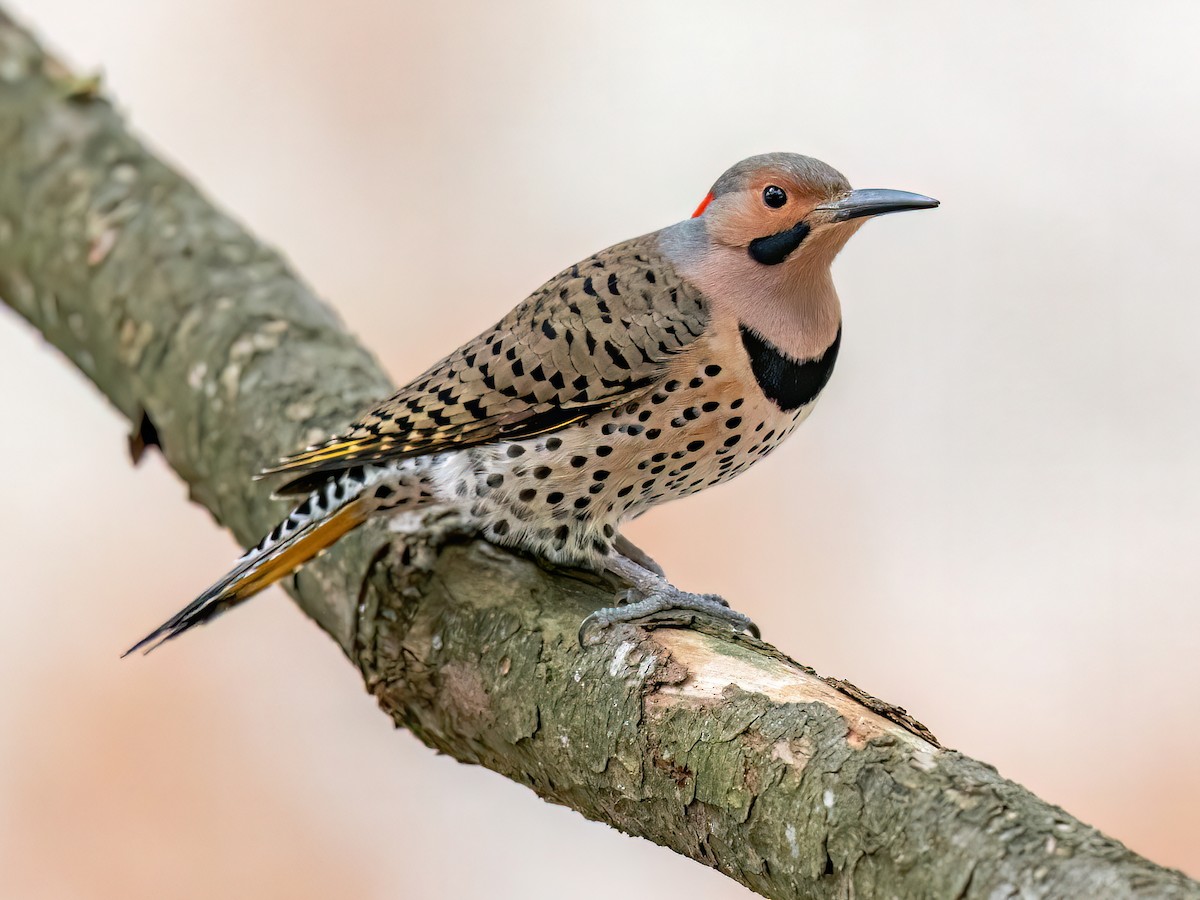
The Northern Flicker is a medium-sized woodpecker native to most of North America. Unlike most woodpeckers, it frequently forages on the ground, primarily feeding on ants and beetles. It is known for its undulating flight pattern and distinctive calls. There are two main forms, the 'Yellow-shafted' in the east and north, and the 'Red-shafted' in the west, which were formerly considered separate species but are now recognized as subspecies of Colaptes auratus.
Size & lifespan
- Length
- 31-35 cm (12-14 in)
- Wingspan
- 42-51 cm (16.5-20 in)
- Weight
- 98-165 g (3.5-5.8 oz)
- Lifespan
- Up to 9 years in the wild, with a maximum recorded lifespan of 11 years 7 months.
- Diet
- Insectivore, primarily myrmecophagous (ant-eating), but also consumes other insects, berries, and seeds.
Physical characteristics
- Plumage
- Overall brownish plumage with black barring on the back and wings, and a black crescent on the upper breast. The underparts are whitish with black spots. The rump is conspicuously white, visible in flight. The underside of the wings and tail feathers are either bright yellow (Yellow-shafted form) or salmon red (Red-shafted form).
- Beak shape
- Slightly downcurved, chisel-tipped, dark gray to black beak, typical of woodpeckers but less robust than many other species, adapted for probing soil and wood.
- Eye color
- Dark brown
- Leg color
- Grayish-black
- Distinguishing features
- White rump patch visible in flight, undulating flight, ground foraging behavior, and the distinctive color of the underwing and undertail feathers (yellow or red).
- Juvenile appearance
- Juveniles resemble adults but have duller plumage, less distinct markings, and often more extensive barring on the underparts. The malar stripe in young males may be less prominent or appear later.
- Seasonal changes
- No significant seasonal plumage changes. Plumage may appear slightly duller due to wear before molting.
- Sexual dimorphism
- Males have a malar stripe (mustache mark) that is black in Yellow-shafted forms and red in Red-shafted forms. Females lack this stripe. Otherwise, sexes are similar in plumage.
How to identify
- 1
Plumage Coloration
Look for the brownish body with black barring, black breast crescent, and spotted underparts. Crucially, note the color of the underwings and undertail: bright yellow in the east/north (Yellow-shafted) or salmon red in the west (Red-shafted).
- 2
White Rump
A prominent white patch on the rump is highly visible during its undulating flight, a key field mark.
- 3
Malar Stripe (Mustache Mark)
Males have a distinct stripe extending from the base of the bill: black in Yellow-shafted forms, red in Red-shafted forms. Females lack this stripe.
- 4
Ground Foraging
Observe its behavior. Unlike most woodpeckers, Northern Flickers spend a significant amount of time hopping on the ground, probing for ants.
- 5
Vocalizations
Listen for its loud, 'laughing' call ('wick-wick-wick') or a sustained 'kew-kew-kew' call. Also, listen for its drumming, which is often slower and more deliberate than other woodpeckers.
- 6
Flight Pattern
Its characteristic undulating flight, with periods of flapping followed by short glides, is a good identifier.
Habitat & range
- Biomes
- Forests, woodlands, open country with scattered trees, suburban areas, parks, and gardens.
- Geographic range
- Widespread across most of North America, from Alaska and Canada south through the United States and into parts of Mexico and Central America. The Yellow-shafted form occupies the eastern and northern parts of the range, while the Red-shafted form is found in the west.
- Elevation range
- Sea level up to 3,000 meters (10,000 feet) in mountainous regions.
- Preferred environments
- Prefers open woodlands, forest edges, savannas, and suburban areas with mature trees and open ground for foraging. They are less common in dense, unbroken forests.
Behavior
- Activity time
- Diurnal.
- Feeding habits
- Primarily feeds on ants, which it extracts from the ground using its long, barbed tongue. It also eats beetles, other insects, and in fall and winter, consumes berries and seeds. It often forages on the ground, hopping rather than walking, and uses its bill to probe soil and rotten wood.
- Social behavior
- Generally solitary or found in pairs during the breeding season. May form small, loose flocks during migration or in winter at abundant food sources.
- Flight pattern
- Distinctive undulating or 'bouncy' flight, characterized by several rapid wing beats followed by a short glide with wings tucked against the body, causing it to drop slightly before the next series of wing beats.
- Migration pattern
- Northern populations are migratory, moving south for the winter. Southern populations are largely resident. Migration occurs during the day, often in loose flocks.
- Territoriality
- Highly territorial during the breeding season, defending nesting and foraging areas. Males drum on resonant surfaces to announce territory and attract mates.
Song & calls
- Song
- A loud, rapid series of 'wick-wick-wick-wick' notes, often described as a 'laughing' call, or a sustained 'kew-kew-kew-kew' call.
- Call
- Common calls include a loud, single 'kyeer' or 'kleer' note, often given in flight or when alarmed. They also produce a variety of softer 'wika-wika-wika' calls.
- When they vocalize
- Most vocal during the breeding season (spring and early summer) for territorial defense and mate attraction. Calls can be heard year-round, especially when disturbed.
Breeding & reproduction
- Breeding season
- Typically April to July, varying by latitude.
- Nesting habits
- Nests in cavities excavated in dead or decaying trees, utility poles, or fence posts. They may also use existing cavities or nest boxes. Both sexes participate in excavation.
- Clutch size
- Usually 5-8 eggs, but can range from 3 to 12.
- Egg description
- 3-12 (typically 5-8) pure white, smooth, glossy eggs.
- Incubation period
- 11-14 days, primarily by the female, but male also assists.
- Fledging period
- 25-28 days after hatching. Young are fed by both parents.
- Parental care
- Both parents incubate eggs and feed the nestlings. After fledging, the young remain dependent on parents for several weeks.
Where to find
Open Woodlands
Look in areas with scattered trees, forest edges, and open canopies where they can forage on the ground.
Suburban Parks and Gardens
Common in urban and suburban environments, especially those with mature trees and lawns, as these provide foraging opportunities for ants.
Savannas and Grasslands with Trees
These habitats offer ideal conditions for ground foraging.
Dead or Decaying Trees
Check for nesting cavities or drumming activity on dead snags or utility poles.
Field tips
- Look on the ground. Unlike most woodpeckers, flickers spend a lot of time foraging on the ground. Scan lawns, open fields, and forest floors.
- Listen for calls and drumming. Their loud calls are distinctive, and their drumming, while less rapid than some woodpeckers, is a good indicator of their presence, especially in spring.
- Watch for undulating flight. Their characteristic bouncy flight pattern with a visible white rump is a strong visual cue, especially when flying between trees.
- Check tree trunks and branches. While they forage on the ground, they still roost and nest in trees, so look for them perched or clinging to vertical surfaces.
Similar species
Gilded Flicker
Colaptes chrysoides
The Gilded Flicker is found in the desert Southwest and has yellow underwing/undertail feathers like the Yellow-shafted Northern Flicker, but males have a red malar stripe (like Red-shafted) and a brown cap (Northern Flicker has a gray cap). Its habitat is also more restricted to saguaro cacti and riparian areas in deserts.
Pileated Woodpecker
Dryocopus pileatus
Much larger than the Northern Flicker (crow-sized). Has a prominent red crest and extensive black and white plumage. Its flight is also undulating but much slower and more powerful. Does not typically forage on the ground for ants.
Red-bellied Woodpecker
Melanerpes carolinus
Smaller than the Northern Flicker. Has a barred black-and-white back and a pale, faintly reddish wash on the belly (often hard to see). Males have a red crown and nape, females only a red nape. Lacks the distinct black breast crescent and white rump of the flicker.
Quick facts
- Primary Food Source:
- Ants
- Distinctive Feature:
- White rump patch in flight
- Flight Pattern:
- Undulating or 'bouncy'
- Forms/Subspecies:
- Yellow-shafted and Red-shafted
- Nesting:
- Cavity nester in dead wood
Fun facts
- Northern Flickers have an exceptionally long tongue, up to 5 inches, which they can extend far beyond their bill to extract ants from deep crevices.
- The 'Yellow-shafted' and 'Red-shafted' forms interbreed in a narrow hybrid zone in the Great Plains, producing offspring with mixed characteristics.
- They are one of the few woodpecker species that regularly forage on the ground, often seen hopping across lawns.
- Flickers often drum on metal objects like streetlights or gutters, not just trees, to attract mates and declare territory because these surfaces produce a louder, more resonant sound.
- Their scientific name, Colaptes auratus, means 'golden chisel-pecker,' referring to their bill and the golden (yellow) underwing color of the eastern form.
Scientific classification
- Kingdom
- Animalia
- Phylum
- Chordata
- Class
- Aves
- Order
- Piciformes
- Family
- Picidae
- Genus
- Colaptes
- Species
- Colaptes auratus
Explore the Northern Flicker
Identify birds anywhere
Free on iOS, Android, and Web. Photo & sound identification, full species database, and your personal life list.