
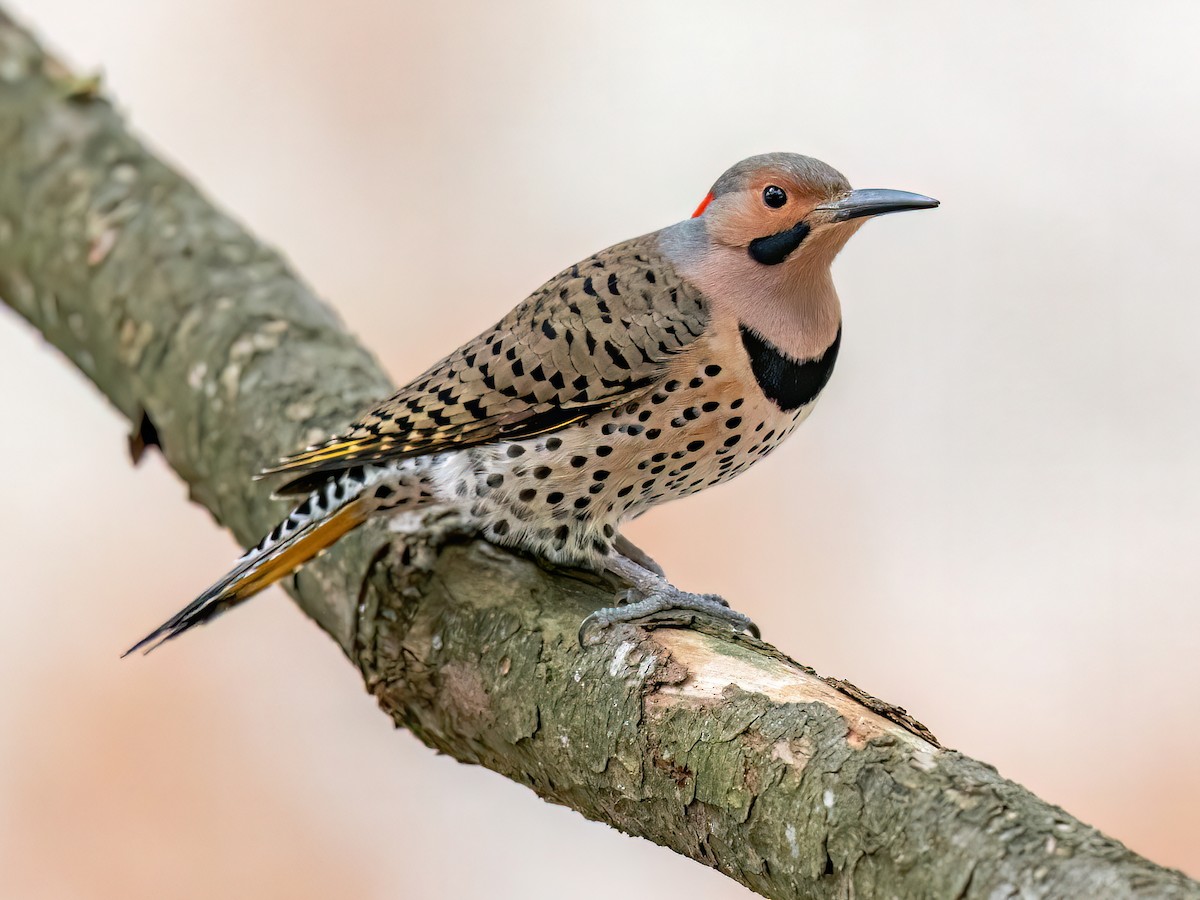
How to identify the Northern Flicker
Colaptes auratus
Spotted a bird? Identify it instantly with the Birdby app
Open the appTo correctly identify the Northern Flicker (Colaptes auratus), check each of these features. Birds can be tricky: habit, habitat, and call often confirm a sighting that a single photo cannot.
Size at a glance
- Length
- 31-35 cm (12-14 in)
- Wingspan
- 42-51 cm (16.5-20 in)
- Weight
- 98-165 g (3.5-5.8 oz)
Physical features to check
- 1
Plumage
Overall feather coloration and pattern.
Overall brownish plumage with black barring on the back and wings, and a black crescent on the upper breast. The underparts are whitish with black spots. The rump is conspicuously white, visible in flight. The underside of the wings and tail feathers are either bright yellow (Yellow-shafted form) or salmon red (Red-shafted form).
- 2
Beak shape
Shape and color of the bill: a key field mark.
Slightly downcurved, chisel-tipped, dark gray to black beak, typical of woodpeckers but less robust than many other species, adapted for probing soil and wood.
- 3
Eye color
Iris color and any distinctive eye markings.
Dark brown
- 4
Leg color
Leg and foot color.
Grayish-black
- 5
Distinguishing features
Standout features that separate this species.
White rump patch visible in flight, undulating flight, ground foraging behavior, and the distinctive color of the underwing and undertail feathers (yellow or red).
- 6
Juvenile appearance
How young birds differ from adults.
Juveniles resemble adults but have duller plumage, less distinct markings, and often more extensive barring on the underparts. The malar stripe in young males may be less prominent or appear later.
- 7
Seasonal changes
Plumage variation between breeding and non-breeding seasons.
No significant seasonal plumage changes. Plumage may appear slightly duller due to wear before molting.
- 8
Sexual dimorphism
How males and females differ.
Males have a malar stripe (mustache mark) that is black in Yellow-shafted forms and red in Red-shafted forms. Females lack this stripe. Otherwise, sexes are similar in plumage.
Key field marks
- Plumage Coloration. Look for the brownish body with black barring, black breast crescent, and spotted underparts. Crucially, note the color of the underwings and undertail: bright yellow in the east/north (Yellow-shafted) or salmon red in the west (Red-shafted).
- White Rump. A prominent white patch on the rump is highly visible during its undulating flight, a key field mark.
- Malar Stripe (Mustache Mark). Males have a distinct stripe extending from the base of the bill: black in Yellow-shafted forms, red in Red-shafted forms. Females lack this stripe.
- Ground Foraging. Observe its behavior. Unlike most woodpeckers, Northern Flickers spend a significant amount of time hopping on the ground, probing for ants.
- Vocalizations. Listen for its loud, 'laughing' call ('wick-wick-wick') or a sustained 'kew-kew-kew' call. Also, listen for its drumming, which is often slower and more deliberate than other woodpeckers.
- Flight Pattern. Its characteristic undulating flight, with periods of flapping followed by short glides, is a good identifier.
Explore the Northern Flicker
Identify birds anywhere
Free on iOS, Android, and Web. Photo & sound identification, full species database, and your personal life list.