
Spotted a bird? Identify it instantly with the Birdby app
Open the appAbout
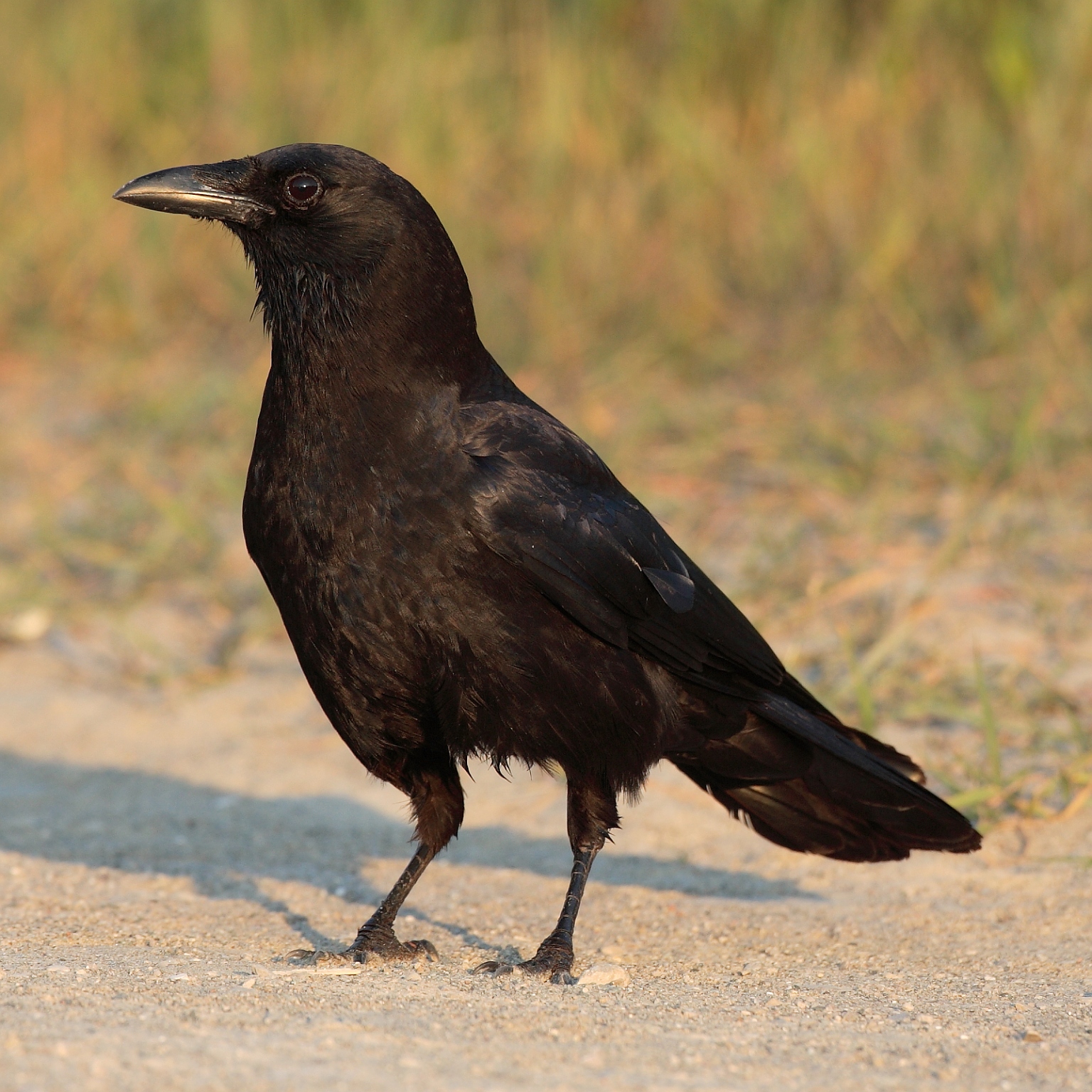
The American Crow is a large, intelligent, and highly adaptable passerine bird native to most of North America. Known for its entirely black plumage, distinctive 'caw-caw' calls, and complex social structures, it thrives in a wide range of habitats, from rural agricultural lands to urban centers. They are opportunistic omnivores and play a significant ecological role as scavengers and predators.
Size & lifespan
- Length
- 40-53 cm (16-21 in)
- Wingspan
- 85-100 cm (33-39 in)
- Weight
- 316-620 g (11.1-21.9 oz)
- Lifespan
- 7-8 years in the wild, up to 20 years or more in captivity
- Diet
- Omnivore (insects, earthworms, grains, fruits, nuts, carrion, eggs, nestlings, small vertebrates, human refuse)
Physical characteristics
- Plumage
- Entirely glossy black plumage, including feathers, beak, legs, and eyes. The feathers can show an iridescent purple or blue sheen in good light.
- Beak shape
- Stout, conical, and slightly decurved black beak.
- Eye color
- Dark brown to black
- Leg color
- Black
- Distinguishing features
- Large size, entirely black plumage, relatively long and strong legs, and a distinctive fan-shaped tail when spread in flight. The tail feathers are all roughly the same length, giving it a squared-off appearance.
- Juvenile appearance
- Juveniles resemble adults but have duller, less glossy black plumage, often with a brownish tinge, and blue eyes that gradually darken to brown. Their gape (corners of the mouth) may also be pinkish or yellowish.
- Seasonal changes
- No significant seasonal plumage changes. Plumage remains consistently black year-round.
- Sexual dimorphism
- Minimal to none. Males and females are virtually identical in plumage and size, though males may average slightly larger.
How to identify
- 1
Size and Shape
Look for a large, all-black bird with a stout body and a relatively large head. The tail is typically fan-shaped or squared-off at the end when spread in flight.
- 2
Plumage
Entirely glossy black plumage. In good light, you might see iridescent purplish or bluish sheens on the feathers.
- 3
Call
Listen for the characteristic loud, harsh 'caw-caw-caw'. This is often the most reliable identification feature, especially when distinguishing from Fish Crows or Common Ravens.
- 4
Flight Pattern
Observe its strong, direct flight with steady wingbeats. They often glide for short distances and can be seen soaring.
- 5
Behavior
Look for social behavior, such as foraging in groups, mobbing larger birds of prey, or gathering in large communal roosts. Their intelligence and adaptability are often evident in their interactions with their environment.
Habitat & range
- Biomes
- Forests (deciduous, coniferous, mixed), woodlands, open country, agricultural fields, suburban areas, urban parks, coastal areas.
- Geographic range
- Throughout most of North America, from southern Canada across the United States to northern Mexico. Absent from the extreme northern Arctic and some arid southwestern deserts.
- Elevation range
- Sea level up to approximately 3,000 meters (10,000 feet) in mountainous regions.
- Preferred environments
- Highly adaptable, preferring open woodlands, forest edges, and areas with a mix of trees for nesting and roosting, and open ground for foraging. They are particularly common in human-modified landscapes.
Behavior
- Activity time
- Diurnal, active from dawn to dusk.
- Feeding habits
- Highly opportunistic and adaptable. Forages on the ground, in trees, and in shallow water. Diet includes insects, earthworms, grubs, seeds, grains, fruits, nuts, carrion, eggs and nestlings of other birds, small mammals, amphibians, reptiles, and human refuse. They are known to cache food.
- Social behavior
- Highly social birds, often forming large family groups and communal roosts, especially outside the breeding season. They exhibit complex social behaviors, including cooperative breeding, mobbing predators, and sophisticated communication. They are known to hold 'funerals' for deceased crows.
- Flight pattern
- Strong, direct flight with steady, rhythmic wingbeats. Often glides for short distances. Can be seen soaring on thermals. In flocks, flight can appear coordinated.
- Migration pattern
- Primarily resident throughout much of its range. Northern populations may undertake short-distance, irruptive migrations south during harsh winters, forming large communal roosts of thousands of individuals.
- Territoriality
- Breeding pairs are territorial, defending their nest site and immediate foraging area. Outside the breeding season, they are less territorial and form large communal roosts.
Song & calls
- Song
- American Crows do not have a complex song in the traditional sense. Their vocalizations are primarily calls.
- Call
- The most common and recognizable call is a loud, harsh 'caw-caw-caw'. They have a wide repertoire of calls, including alarm calls (short, rapid 'caws'), assembly calls (long, drawn-out 'caws'), begging calls from juveniles, and various clicks, rattles, and gurgles used in social interactions. Calls vary in pitch, rhythm, and intensity depending on the context.
- When they vocalize
- Vocalize year-round, but particularly active and vocal during the breeding season and when communicating within flocks or mobbing predators.
Breeding & reproduction
- Breeding season
- Typically March to July, varying geographically. Peak activity in April-May.
- Nesting habits
- Monogamous pairs, often assisted by offspring from previous years (cooperative breeding). Nests are large, bulky structures made of sticks, twigs, and mud, lined with softer materials like grass, hair, and bark. Built high in trees (coniferous or deciduous), often near the trunk or in a major fork.
- Clutch size
- 3-7 eggs, usually 4-6.
- Egg description
- 3-7 eggs, typically 4-6. Eggs are pale bluish-green to olive-green, heavily marked with brown, olive, or gray spots and blotches, especially at the larger end. Average size is about 4.0 x 2.9 cm.
- Incubation period
- 18-19 days, primarily by the female.
- Fledging period
- 30-35 days after hatching. Young remain dependent on parents and helpers for several weeks to months after fledging.
- Parental care
- Both parents feed and care for the young. Often, non-breeding adults (usually offspring from previous years) act as 'helpers' at the nest, assisting with feeding and defense of the young.
Where to find
Urban and Suburban Areas
Parks, residential neighborhoods, city centers, and agricultural fields are prime locations due to abundant food sources and roosting trees.
Open Woodlands and Forest Edges
Areas where forests meet open fields provide both cover for nesting and foraging opportunities.
Agricultural Lands
Fields with crops, especially corn, and areas with livestock often attract crows for foraging.
Communal Roosts
During non-breeding seasons, look for large gatherings of crows (hundreds to thousands) at dusk, flying to established communal roost sites, often in dense stands of trees.
Field tips
- Listen for Calls. Their distinctive 'caw-caw' is often heard before the bird is seen. Learning to differentiate it from Fish Crow and Raven calls is key.
- Observe Social Behavior. Crows are highly social. Look for groups foraging, interacting, or mobbing predators like hawks and owls. This behavior can lead you to them.
- Check Roosts. In fall and winter, locate large communal roosts by observing flight paths of crows heading to a central location around sunset. These can be spectacular to witness.
- Look for Foraging. Crows frequently forage on the ground in open areas. Scan fields, lawns, and roadsides for their black forms.
Similar species
Fish Crow
Corvus ossifragus
Slightly smaller and more slender than the American Crow. The most reliable distinction is the call: Fish Crows have a more nasal, often two-syllable 'cah-ah' or 'uh-uh' call, compared to the American Crow's harsher, clearer 'caw-caw'. In flight, Fish Crows may appear to have a slightly longer primary projection. Found primarily along the Atlantic and Gulf Coasts of North America.
Common Raven
Corvus corax
Significantly larger than the American Crow (up to twice the weight). Ravens have a much heavier, shaggier bill, shaggy throat feathers (hackles), and a wedge-shaped tail in flight (American Crow's tail is fan-shaped/squared). Ravens often soar more extensively and have a deeper, guttural 'cronk' or 'gronk' call, distinct from the crow's 'caw'.
Northwestern Crow
Corvus caurinus
Very similar in appearance to the American Crow, often indistinguishable visually. Slightly smaller on average. Primarily found along the Pacific Northwest coast. The best way to distinguish is by range and call: Northwestern Crows have a slightly hoarser, wetter 'caw' and often forage on beaches.
Quick facts
- Intelligence:
- Among the most intelligent birds, capable of problem-solving, tool use, and facial recognition.
- Social Structure:
- Complex family groups, cooperative breeding, and large communal roosts.
- Dietary Flexibility:
- Highly adaptable omnivores, consuming a vast array of food items.
- Vocalization:
- Extensive repertoire of calls, not just 'caw-caw', used for various communications.
- Conservation:
- Common and widespread, thriving in human-altered landscapes.
Fun facts
- American Crows can recognize individual human faces and remember them for years, associating faces with positive or negative experiences.
- They are known to use tools, such as dropping nuts onto roads for cars to crack them open, or using sticks to extract insects.
- Crows often engage in 'anting,' where they allow ants to crawl on their feathers, possibly to remove parasites or for the formic acid's soothing properties.
- They are known to mimic sounds, including other birds, animals, and even human speech, though less frequently than parrots.
- When a crow dies, other crows often gather around the deceased bird, a behavior sometimes referred to as a 'crow funeral,' which is thought to be a way to learn about potential threats.
Scientific classification
- Kingdom
- Animalia
- Phylum
- Chordata
- Class
- Aves
- Order
- Passeriformes
- Family
- Corvidae
- Genus
- Corvus
- Species
- Corvus brachyrhynchos
Explore the American Crow
Identify birds anywhere
Free on iOS, Android, and Web. Photo & sound identification, full species database, and your personal life list.