
Spotted a bird? Identify it instantly with the Birdby app
Open the appAbout
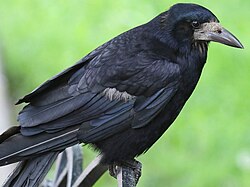
The Rook (Corvus frugilegus) is a highly social, intelligent passerine bird belonging to the crow family. It is characterized by its glossy black plumage and a distinctive bare, greyish-white patch of skin at the base of its bill in adults. Rooks are primarily found in agricultural areas, open woodlands, and urban parks across much of Eurasia, often forming large, noisy colonies known as rookeries.
Size & lifespan
- Length
- 45-47 cm
- Wingspan
- 81-99 cm
- Weight
- 250-550 g
- Lifespan
- Up to 20 years in the wild, typically 6-10 years
- Diet
- Omnivore, primarily invertebrates (especially earthworms and insect larvae), grains, seeds, fruits, and occasionally small vertebrates or carrion.
Physical characteristics
- Plumage
- Entirely glossy black plumage with a purplish-blue sheen in good light. The feathers on the head, neck, and body are dense and sleek.
- Beak shape
- Long, pointed, and slightly downcurved black bill. Adults have a distinctive bare, greyish-white patch of skin at the base of the bill, extending to the chin and throat, which is a key identification feature. Juveniles lack this bare patch.
- Eye color
- Dark brown
- Leg color
- Black
- Distinguishing features
- The most distinctive feature of an adult Rook is the bare, pale greyish-white patch of skin at the base of the bill, which contrasts sharply with the black plumage. This patch is absent in juveniles and other similar corvids. They also have shaggy 'trousers' of loose feathers around their legs.
- Juvenile appearance
- Juvenile Rooks are entirely black, lacking the bare greyish-white facial patch of adults. Their bill base is feathered, resembling a Carrion Crow. The bare patch develops during their first winter.
- Seasonal changes
- No significant seasonal plumage changes. The bare facial patch develops in juveniles during their first winter.
- Sexual dimorphism
- Males and females are outwardly similar in plumage and size, with no significant sexual dimorphism.
How to identify
- 1
Bill Base
Look for the distinctive bare, pale greyish-white patch of skin at the base of the bill in adult birds. This is the most definitive field mark.
- 2
Bill Shape
Note the relatively long, pointed, and slightly downcurved black bill, which appears more slender than that of a Carrion Crow.
- 3
Plumage
Observe the overall glossy black plumage with a purplish-blue sheen. The feathers on the legs often appear shaggy, forming 'trousers'.
- 4
Vocalization
Listen for the characteristic deep, resonant 'kaaah' or 'kraaah' call, distinct from the harsher 'caw' of a Carrion Crow.
- 5
Social Behavior
Rooks are highly gregarious, often seen in large flocks foraging in fields or nesting colonially in rookeries. Solitary Rooks are rare.
Habitat & range
- Biomes
- Temperate grasslands, agricultural lands, open woodlands, parks, urban and suburban areas.
- Geographic range
- Widespread across the Palearctic region, from Western Europe (excluding parts of Scandinavia and the Iberian Peninsula) eastward through Central Asia to eastern Siberia and northern China. Absent from North America and Africa.
- Elevation range
- Typically found in lowlands and foothills, generally below 1,000 meters, but can occur higher in some parts of its range.
- Preferred environments
- Prefers open country with scattered trees, particularly mature deciduous trees for nesting. Common in farmland, pastures, parks, large gardens, and urban fringes where food is readily available and nesting sites are present.
Behavior
- Activity time
- Diurnal. Active from dawn to dusk, with peak foraging activity in the morning and late afternoon.
- Feeding habits
- Forages primarily on the ground, often in large flocks. Uses its strong bill to probe the soil for invertebrates, especially earthworms and grubs. Also consumes seeds, grains (often from cultivated fields), fruits, nuts, and occasionally small vertebrates, eggs, or carrion. Known to cache food.
- Social behavior
- Highly gregarious, forming large flocks outside the breeding season, sometimes numbering thousands of individuals. Breeds colonially in 'rookeries', which can contain hundreds of nests. They are known for their complex social structures and cooperative behaviors.
- Flight pattern
- Strong, direct flight with steady wingbeats. Often soars and glides. Flies in large, often V-shaped or irregular formations when commuting to and from roosts or feeding grounds.
- Migration pattern
- Partially migratory. Western and southern populations are largely resident. Northern and eastern populations are migratory, moving south and west for the winter, often forming large wintering flocks. Migratory movements typically occur from September to November and February to April.
- Territoriality
- Colonial nesters, with individual pairs defending a small territory immediately around their nest within the rookery. Feeding territories are generally not defended, as they forage communally.
Song & calls
- Song
- Rooks do not have a complex song. Their vocalizations are primarily calls.
- Call
- The most characteristic call is a harsh, often drawn-out 'kaaah' or 'kraaah', which is deeper and more resonant than the call of a Carrion Crow. They also produce a variety of other calls, including softer 'caw' notes, gurgles, and clicks, especially within the rookery. Calls are often given in chorus by large flocks.
- When they vocalize
- Vocalize year-round, but particularly noisy during the breeding season within rookeries and when gathering in large roosts.
Breeding & reproduction
- Breeding season
- Typically February to May, with egg-laying usually in March-April.
- Nesting habits
- Nests colonially in large 'rookeries', often in the tops of tall deciduous trees (e.g., oaks, elms, beeches). Nests are bulky structures made of sticks, twigs, and lined with grass, moss, wool, and mud. Both sexes participate in nest building.
- Clutch size
- 3-5 eggs
- Egg description
- Typically 3-5 eggs (range 2-7). Eggs are pale blue-green or olive-green, heavily blotched and speckled with dark brown, olive, or grey markings.
- Incubation period
- 16-18 days, primarily by the female, fed by the male.
- Fledging period
- 30-35 days after hatching. Young leave the nest but remain dependent on parents for several weeks.
- Parental care
- Both parents feed and care for the young. The male brings food to the incubating female and later to the nestlings, while the female also participates in feeding the chicks.
Where to find
Agricultural Land
Extensive open fields, especially those recently ploughed or sown, are prime foraging grounds for Rooks seeking invertebrates and seeds.
Parks and Gardens
Large urban and suburban parks, as well as extensive gardens with mature trees, can host rookeries and provide foraging opportunities.
Open Woodlands
Scattered stands of tall deciduous trees within open landscapes are favored for nesting rookeries.
Roadsides and Verges
Often seen foraging along roadsides, particularly where there is disturbed ground or access to spilled grains.
Field tips
- Look for Rookeries. During the breeding season (late winter to spring), locate large clusters of stick nests high in deciduous trees. These noisy colonies are unmistakable.
- Observe Foraging Behavior. Watch for flocks of black birds probing the ground with their bills in fields. The distinctive bill shape and bare face will be apparent at closer range.
- Listen for Calls. Their deep, resonant 'kaaah' call is a good indicator of their presence, especially when large flocks are communicating.
- Check Bill Base. When observing a black corvid, always check the base of the bill. If it's pale and bare, it's an adult Rook. If it's feathered, it's likely a juvenile Rook or a Carrion Crow.
Similar species
Carrion Crow
Corvus corone
The most reliable distinction is the bare, pale greyish-white patch at the base of the Rook's bill (adults only), which is feathered black in the Carrion Crow. Rooks also have a more pointed, slender bill and shaggier 'trousers' on their legs. Their call is typically deeper and more resonant than the Carrion Crow's 'caw-caw'.
Jackdaw
Corvus monedula
Jackdaws are significantly smaller than Rooks, have distinctive pale grey eyes, and a grey nape. Their calls are a characteristic 'chack' or 'kiaw'.
Raven
Corvus corax
Ravens are much larger than Rooks, with a heavier, more robust bill and a shaggy throat 'beard'. Their flight often includes soaring, and their call is a deep, resonant 'cronk'.
Quick facts
- Social Structure:
- Highly colonial, forming large rookeries and flocks.
- Dietary Flexibility:
- Opportunistic omnivore, adapting to available food sources.
- Intelligence:
- Known for problem-solving abilities and tool use.
- Key ID Feature:
- Bare, pale greyish-white facial patch at bill base (adults).
- Nesting:
- Builds large stick nests high in trees, often in dense colonies.
Fun facts
- Rooks are one of the few bird species known to use tools in the wild, such as dropping stones into water to raise the water level to reach food.
- The collective noun for a group of Rooks is a 'parliament' or a 'building' of Rooks, reflecting their colonial nesting habits.
- Rookeries can be very long-lived, with some sites being used for hundreds of years.
- They are known to play, engaging in aerial acrobatics and even sliding down snowy roofs.
- Rooks have been observed to recognize individual human faces and react differently to people who have previously been aggressive towards them.
Scientific classification
- Kingdom
- Animalia
- Phylum
- Chordata
- Class
- Aves
- Order
- Passeriformes
- Family
- Corvidae
- Genus
- Corvus
- Species
- Corvus frugilegus
Explore the Rook
Identify birds anywhere
Free on iOS, Android, and Web. Photo & sound identification, full species database, and your personal life list.