
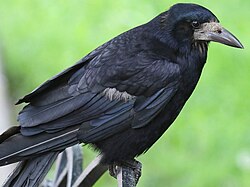
Where does the Rook live?
Corvus frugilegus
Spotted a bird? Identify it instantly with the Birdby app
Open the appThe Rook lives in specific habitats and regions. Knowing where, and when, to look improves your chances of a successful sighting.
Biomes
Temperate grasslands, agricultural lands, open woodlands, parks, urban and suburban areas.
Geographic range
Widespread across the Palearctic region, from Western Europe (excluding parts of Scandinavia and the Iberian Peninsula) eastward through Central Asia to eastern Siberia and northern China. Absent from North America and Africa.
Preferred environments
Prefers open country with scattered trees, particularly mature deciduous trees for nesting. Common in farmland, pastures, parks, large gardens, and urban fringes where food is readily available and nesting sites are present.
Elevation range
Typically found in lowlands and foothills, generally below 1,000 meters, but can occur higher in some parts of its range.
Where to look
Agricultural Land
Extensive open fields, especially those recently ploughed or sown, are prime foraging grounds for Rooks seeking invertebrates and seeds.
Parks and Gardens
Large urban and suburban parks, as well as extensive gardens with mature trees, can host rookeries and provide foraging opportunities.
Open Woodlands
Scattered stands of tall deciduous trees within open landscapes are favored for nesting rookeries.
Roadsides and Verges
Often seen foraging along roadsides, particularly where there is disturbed ground or access to spilled grains.
Field tips
- Look for Rookeries. During the breeding season (late winter to spring), locate large clusters of stick nests high in deciduous trees. These noisy colonies are unmistakable.
- Observe Foraging Behavior. Watch for flocks of black birds probing the ground with their bills in fields. The distinctive bill shape and bare face will be apparent at closer range.
- Listen for Calls. Their deep, resonant 'kaaah' call is a good indicator of their presence, especially when large flocks are communicating.
- Check Bill Base. When observing a black corvid, always check the base of the bill. If it's pale and bare, it's an adult Rook. If it's feathered, it's likely a juvenile Rook or a Carrion Crow.
Migration
Partially migratory. Western and southern populations are largely resident. Northern and eastern populations are migratory, moving south and west for the winter, often forming large wintering flocks. Migratory movements typically occur from September to November and February to April.
Explore the Rook
Identify birds anywhere
Free on iOS, Android, and Web. Photo & sound identification, full species database, and your personal life list.