
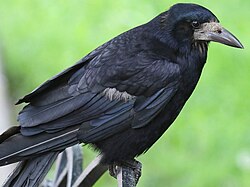
How to identify the Rook
Corvus frugilegus
Spotted a bird? Identify it instantly with the Birdby app
Open the appTo correctly identify the Rook (Corvus frugilegus), check each of these features. Birds can be tricky: habit, habitat, and call often confirm a sighting that a single photo cannot.
Size at a glance
- Length
- 45-47 cm
- Wingspan
- 81-99 cm
- Weight
- 250-550 g
Physical features to check
- 1
Plumage
Overall feather coloration and pattern.
Entirely glossy black plumage with a purplish-blue sheen in good light. The feathers on the head, neck, and body are dense and sleek.
- 2
Beak shape
Shape and color of the bill: a key field mark.
Long, pointed, and slightly downcurved black bill. Adults have a distinctive bare, greyish-white patch of skin at the base of the bill, extending to the chin and throat, which is a key identification feature. Juveniles lack this bare patch.
- 3
Eye color
Iris color and any distinctive eye markings.
Dark brown
- 4
Leg color
Leg and foot color.
Black
- 5
Distinguishing features
Standout features that separate this species.
The most distinctive feature of an adult Rook is the bare, pale greyish-white patch of skin at the base of the bill, which contrasts sharply with the black plumage. This patch is absent in juveniles and other similar corvids. They also have shaggy 'trousers' of loose feathers around their legs.
- 6
Juvenile appearance
How young birds differ from adults.
Juvenile Rooks are entirely black, lacking the bare greyish-white facial patch of adults. Their bill base is feathered, resembling a Carrion Crow. The bare patch develops during their first winter.
- 7
Seasonal changes
Plumage variation between breeding and non-breeding seasons.
No significant seasonal plumage changes. The bare facial patch develops in juveniles during their first winter.
- 8
Sexual dimorphism
How males and females differ.
Males and females are outwardly similar in plumage and size, with no significant sexual dimorphism.
Key field marks
- Bill Base. Look for the distinctive bare, pale greyish-white patch of skin at the base of the bill in adult birds. This is the most definitive field mark.
- Bill Shape. Note the relatively long, pointed, and slightly downcurved black bill, which appears more slender than that of a Carrion Crow.
- Plumage. Observe the overall glossy black plumage with a purplish-blue sheen. The feathers on the legs often appear shaggy, forming 'trousers'.
- Vocalization. Listen for the characteristic deep, resonant 'kaaah' or 'kraaah' call, distinct from the harsher 'caw' of a Carrion Crow.
- Social Behavior. Rooks are highly gregarious, often seen in large flocks foraging in fields or nesting colonially in rookeries. Solitary Rooks are rare.
Explore the Rook
Identify birds anywhere
Free on iOS, Android, and Web. Photo & sound identification, full species database, and your personal life list.