
Spotted a bird? Identify it instantly with the Birdby app
Open the appAbout
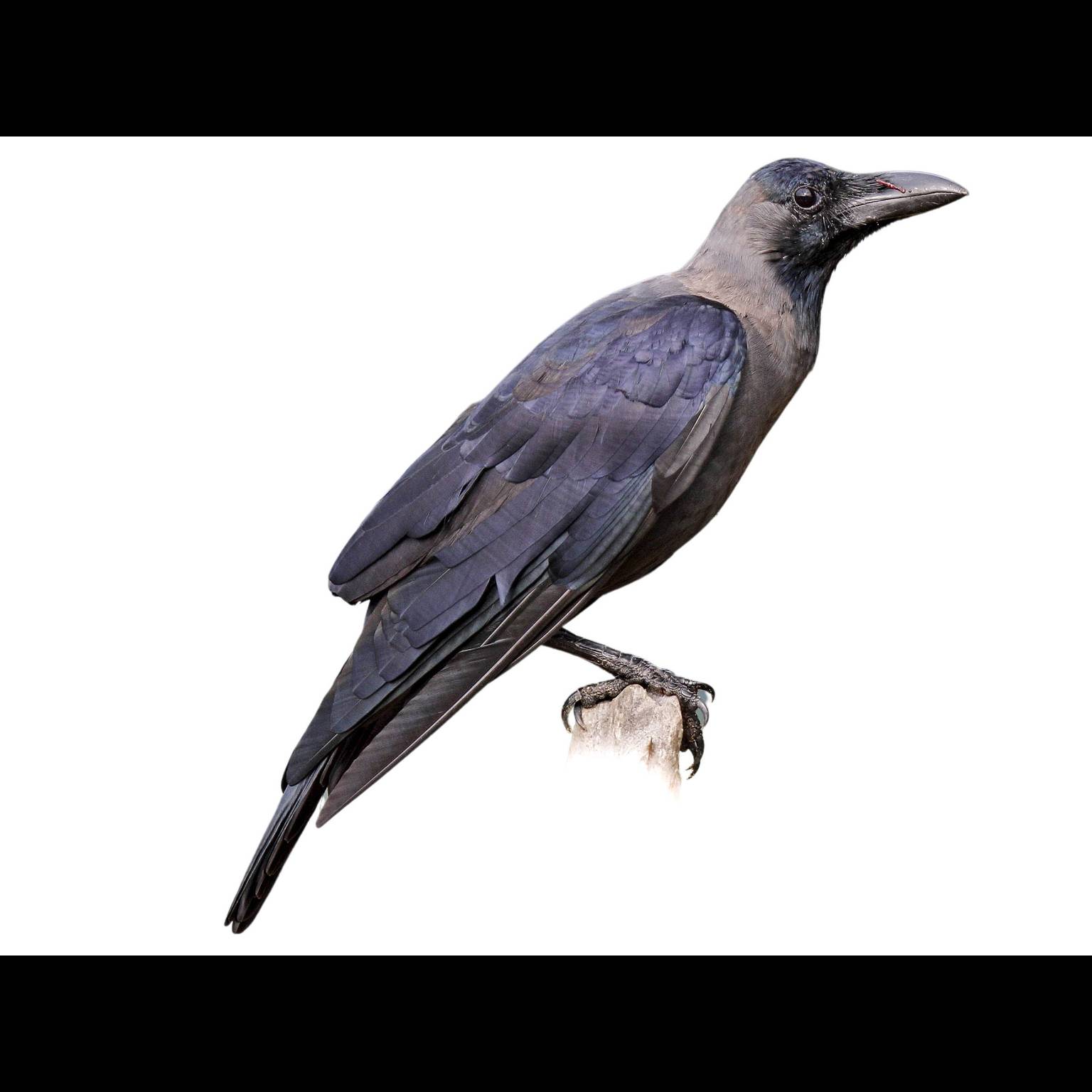
The House Crow is a medium-sized bird with glossy black plumage on its head, throat, and upper breast, contrasting with duller greyish-brown plumage on its neck, back, and underparts. It is a highly adaptable and opportunistic scavenger, predominantly found in close association with human habitation. Known for its intelligence and social behavior, it has successfully colonized various urban and suburban environments due to its omnivorous diet and reproductive success.
Size & lifespan
- Length
- 40-43 cm (15.5-17 in)
- Wingspan
- 66-79 cm (26-31 in)
- Weight
- 250-350 g (8.8-12.3 oz)
- Lifespan
- Typically 6-8 years in the wild, up to 10-15 years in captivity.
- Diet
- Omnivorous; primarily carrion, household refuse, insects, small vertebrates (lizards, rodents, nestlings), eggs, fruit, seeds, nectar. Highly opportunistic.
Physical characteristics
- Plumage
- Glossy black head, throat, and upper breast. Nape, back, and underparts are duller greyish-brown, appearing slightly mottled. Wings and tail are dark, often with a purplish-blue sheen in good light.
- Beak shape
- Stout, slightly curved, and sharply pointed. Black.
- Eye color
- Dark brown.
- Leg color
- Black.
- Distinguishing features
- The most distinctive feature is the bicolored plumage of glossy black head and throat contrasting with greyish-brown nape and body. Its relatively small size compared to other crows is also a key field mark.
- Juvenile appearance
- Juveniles resemble adults but have duller, less glossy black plumage and a less defined greyish collar. Their eyes can appear lighter brown initially.
- Seasonal changes
- No significant seasonal plumage changes.
- Sexual dimorphism
- Males and females are monomorphic, appearing identical in plumage and size.
How to identify
- 1
Plumage
Look for the diagnostic bicolor pattern: glossy black head, face, throat, and upper breast contrasting sharply with duller greyish-brown (sometimes appearing grey) on the nape, back, and underparts. Wings and tail are dark black.
- 2
Size
Notice its relatively small size for a crow; it's smaller and more slender than most other common crow species in its native and introduced range.
- 3
Calls
Listen for its characteristic 'kaa-kaa' calls, which are quicker, sharper, and less deep or guttural than the calls of larger crows such as Large-billed or Jungle Crows.
- 4
Behavior
Its strong association with human settlements, often seen scavenging in urban environments, is a key identification clue.
- 5
Flight
Observe its direct, purposeful flight with steady wing beats, often seen commuting between roosting and foraging sites.
Habitat & range
- Biomes
- Urban, suburban, agricultural, coastal areas, open woodlands.
- Geographic range
- Native to the Indian subcontinent (India, Pakistan, Nepal, Bangladesh, Sri Lanka, Maldives) and parts of Southeast Asia (Myanmar, Thailand, Malaysia, Singapore). Has established invasive populations in numerous other parts of the world, including parts of Africa (East Africa, South Africa), Middle East, Europe (Netherlands), and Australasia.
- Elevation range
- Primarily lowlands, usually up to 1500 meters (5000 feet) above sea level, but occasionally higher.
- Preferred environments
- Strongly associated with human habitation – towns, cities, villages, ports, and cultivated land. Rarely found in dense forests or remote wilderness.
Behavior
- Activity time
- Diurnal. Most active during daylight hours, especially morning and late afternoon.
- Feeding habits
- Highly opportunistic scavenger, consuming a wide variety of food items found near human activity. Forages on the ground, in trees, and around refuse dumps. Also preys on eggs and young birds, insects, and small reptiles.
- Social behavior
- Highly social, often seen in pairs or small family groups, but can form large communal roosts, sometimes numbering thousands of individuals, especially outside the breeding season. Known for mobbing predators.
- Flight pattern
- Strong, direct flight with steady wing beats. Often glides briefly. Highly agile in crowded urban environments.
- Migration pattern
- Non-migratory. Resident throughout its range, though local movements may occur in response to food availability.
- Territoriality
- Breeding pairs defend a territory around their nest, but feeding areas can be shared, especially in urban environments with abundant food sources.
Song & calls
- Song
- House Crows do not have a melodious song in the traditional sense. Their vocalizations are primarily a series of harsh calls.
- Call
- The most common call is a distinctive, repetitive 'kaa-kaa' or 'kaaa-kaaa', often given rapidly. They also produce a variety of other harsh notes, squawks, and gurgles, used for alarm, communication within the flock, or territorial display. Calls are less deep and guttural than larger crows.
- When they vocalize
- Vocal throughout the day, especially active and noisy during dawn and dusk, and when disturbed or interacting in flocks.
Breeding & reproduction
- Breeding season
- Varies geographically, but typically between March and July in India, extending earlier or later in other parts of its range. Can have multiple broods per year in optimal conditions.
- Nesting habits
- Nests are typically built in trees (often large ones in urban areas like Banyan or Peepal), but also on artificial structures such as utility poles, antennae, and buildings. The nest is a bulky cup-shaped structure made of sticks, twigs, wire, cloth, and other debris, lined with softer materials.
- Clutch size
- Usually 3-6 eggs, sometimes up to 7.
- Egg description
- Eggs are pale blue-green or greenish-white, heavily marked with brown, olive, or grey blotches and streaks. Typically ovoid.
- Incubation period
- 16-17 days, primarily by the female.
- Fledging period
- 21-28 days after hatching. Young are dependent on parents for several weeks after fledging.
- Parental care
- Both parents participate in nest building, incubation (female predominantly), and feeding the young. Young birds may remain with parents for some time after fledging.
Where to find
Urban Areas
Cities, towns, and villages with abundant human activity, food waste, and buildings for nesting and roosting.
Suburban Areas
Residential neighborhoods, parks, and gardens, especially those with mature trees.
Agricultural Landscapes
Areas near farms and cultivated fields, where they can forage for insects, seeds, and scraps.
Ports and Harbors
Coastal and port environments, as they are often transported accidentally by ships, leading to invasive populations.
Waste Disposal Sites
Landfills, refuse dumps, and open markets where food waste is readily available.
Field tips
- Mornings and Evenings. House Crows are particularly active and vocal during dawn and dusk as they move between roosting and foraging areas.
- Listen for Calls. Their distinctive 'kaa-kaa' calls are often the first sign of their presence, especially in noisy urban environments.
- Look Around Human Activity. Focus searches around garbage bins, street food vendors, markets, and any areas where food scraps might be discarded.
- Check Large Trees and Structures. Scan tall trees, utility poles, and buildings for nesting sites or communal roosts, especially outside the breeding season.
- Observe Scavenging Behavior. Watch for birds pecking at the ground, examining refuse, or chasing other smaller birds. Their opportunistic feeding habits are very characteristic.
Similar species
Large-billed Crow
Corvus macrorhynchos
The House Crow is smaller and has a distinct grey nape and underparts. The Large-billed Crow is entirely glossy black, significantly larger, and has a much heavier, more prominent bill. Their calls are also deeper and harsher.
Jungle Crow
Corvus levaillantii
The House Crow is distinguished by its bicolored plumage (grey nape and body). The Jungle Crow is entirely glossy black, larger, and has a more robust build. Its calls are also deeper and more resonant.
Hooded Crow
Corvus cornix
The Hooded Crow has similar bicolored plumage but is larger. The grey on the Hooded Crow typically covers the entire body except the black head, wings, and tail, whereas the House Crow has a distinct grey 'collar' on the nape and duller greyish-brown on the back and belly, with a black throat.
Quick facts
- Common Name:
- House Crow
- Scientific Name:
- Corvus splendens
- Family:
- Corvidae
- Native Range:
- Indian subcontinent, Southeast Asia
- Introduced Range:
- Africa, Middle East, Europe, Australasia
- Diet:
- Omnivorous Scavenger
- Habitat Preference:
- Urban and suburban areas
- Sociality:
- Highly Social
- Conservation Status:
- Least Concern
- Distinguishing Feature:
- Grey neck and body contrasting with black head and wings
Fun facts
- House Crows are considered one of the world's most invasive bird species due to their adaptability, opportunistic feeding, and rapid population growth in new environments.
- They are known for their intelligence, often observed using simple tools or dropping hard-shelled items onto hard surfaces to open them.
- In some cultures, House Crows are viewed with a mix of reverence and annoyance, often seen as clever but also as pests due to their scavenging habits.
- Despite being an invasive species in many parts of the world, they are a native and integral part of the ecosystem in the Indian subcontinent.
- House Crows are often observed mobbing larger birds of prey and even domestic cats or dogs that venture too close to their nests or young.
Scientific classification
- Kingdom
- Animalia
- Phylum
- Chordata
- Class
- Aves
- Order
- Passeriformes
- Family
- Corvidae
- Genus
- Corvus
- Species
- C. splendens
Explore the House Crow
Identify birds anywhere
Free on iOS, Android, and Web. Photo & sound identification, full species database, and your personal life list.