
Spotted a bird? Identify it instantly with the Birdby app
Open the appAbout
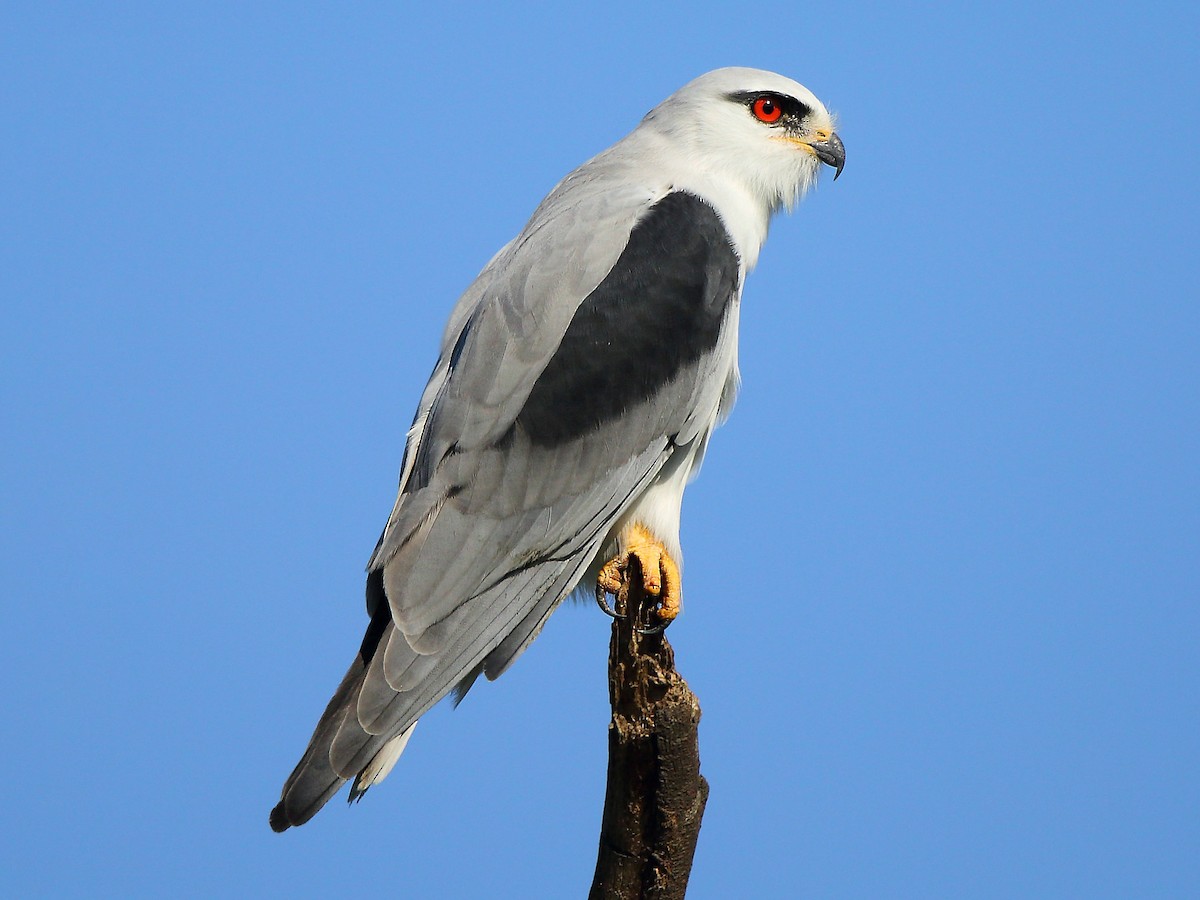
The Black-shouldered Kite is a small, elegant raptor characterized by its predominantly white plumage, black shoulders, and striking red eyes. It is renowned for its distinctive hovering flight while hunting, often seen over open grasslands and agricultural areas. This species is widespread across Africa, Asia, and parts of Europe, adapting well to human-modified landscapes.
Size & lifespan
- Length
- 30-37 cm
- Wingspan
- 75-95 cm
- Weight
- 190-340 g
- Lifespan
- 6-8 years in the wild, up to 10-12 years in captivity
- Diet
- Carnivore, primarily feeding on small mammals (especially voles and mice), but also takes large insects, small birds, and reptiles.
Physical characteristics
- Plumage
- Adults are predominantly white on the underparts and head, with pale grey upperparts. The most distinctive feature is the prominent black patch on the 'shoulders' (carpal joint) of the wings, visible both at rest and in flight. The primary feathers are black, contrasting sharply with the white underwing coverts. The tail is short and square, white with a grey tip.
- Beak shape
- Small, sharply hooked, black beak with a yellow cere.
- Eye color
- Striking ruby-red eyes, surrounded by a black patch (lores).
- Leg color
- Bright yellow legs and feet with black talons.
- Distinguishing features
- Black shoulder patches, red eyes, white underparts, pale grey upperparts, and a characteristic hovering flight.
- Juvenile appearance
- Juveniles have a brownish wash on the head and breast, with rufous-brown mottling on the upperparts and wing coverts. The black shoulder patches are less defined, and the eyes are brownish-orange, gradually turning red with age. The tail often has a dark subterminal band.
- Seasonal changes
- No significant seasonal plumage changes. Plumage remains consistent year-round for adults.
- Sexual dimorphism
- Males and females are generally similar in plumage and size, though females may be slightly larger and heavier on average.
How to identify
- 1
Plumage
Look for the striking contrast of pure white underparts and head against pale grey upperparts. The most definitive mark is the prominent black patch on the 'shoulders' (carpal joint) of the wings.
- 2
Eyes
The intense ruby-red eyes are a key identifier, especially in adults, contrasting with the black lores.
- 3
Flight Style
Observe its characteristic hovering (kiting) flight, often stationary in the air with rapid wing beats, scanning the ground. This behavior is highly diagnostic.
- 4
Perching Posture
When perched, it often sits upright on an exposed branch or power line, with its short tail and black shoulder patches clearly visible.
- 5
Juvenile Plumage
In juveniles, look for the brownish wash on the head and breast, rufous mottling on the back, and brownish-orange eyes. The black shoulder patches are still present but may be less distinct.
Habitat & range
- Biomes
- Grasslands, savannas, open woodlands, agricultural fields, semi-deserts, and cultivated areas.
- Geographic range
- Widespread across sub-Saharan Africa, parts of North Africa, the Iberian Peninsula (Spain and Portugal), and extensively across South and Southeast Asia, extending to New Guinea and Australia (where it is known as the Black-shouldered Kite or Australian Black-shouldered Kite, *Elanus axillaris*, though some consider it conspecific with *E. caeruleus*).
- Elevation range
- Typically found from sea level up to 2,000 meters, occasionally higher.
- Preferred environments
- Open country with scattered trees or bushes for perching and nesting, often near water sources. They thrive in areas with high rodent populations.
Behavior
- Activity time
- Diurnal, most active during the morning and late afternoon.
- Feeding habits
- Primarily a diurnal hunter. It employs a distinctive 'kiting' or hovering flight, often remaining stationary in the air at heights of 10-30 meters, scanning the ground for prey. Once prey is spotted, it drops silently with wings held high, often making several short, shallow dives before seizing its target with its talons. Prey is usually consumed on a perch.
- Social behavior
- Generally solitary or found in pairs. Outside the breeding season, they may form communal roosts, sometimes numbering dozens of individuals, especially in areas with abundant prey.
- Flight pattern
- Graceful and buoyant flight, characterized by deep, slow wing beats interspersed with glides. The most iconic flight pattern is its sustained hovering, often with rapid wing beats, facing into the wind.
- Migration pattern
- Mostly resident throughout its range, but some populations, particularly in the northern parts of its distribution (e.g., Iberian Peninsula), may undertake short-distance dispersive movements or irruptions in response to prey availability. African populations are largely sedentary.
- Territoriality
- Pairs defend a breeding territory, especially around the nest site. Outside the breeding season, territoriality is less pronounced.
Song & calls
- Song
- Not known for a complex song. Vocalizations are generally simple and call-like.
- Call
- Common calls include a high-pitched, whistled 'whee-whee-whee' or 'kwee-kwee-kwee', often given in alarm or during courtship. Also a harsh 'skree-ah' or 'skree-skree' when agitated or defending the nest. Young birds emit begging calls.
- When they vocalize
- Most vocal during the breeding season, especially around the nest, and when interacting with a mate or intruders. Alarm calls can be heard year-round.
Breeding & reproduction
- Breeding season
- Highly variable across its vast range, often coinciding with peak prey availability. In Africa, it can be year-round, but typically peaks after rains. In Europe, March to August. In Asia, often October to May.
- Nesting habits
- Nests are typically built in the canopy of a tree or large bush, 5-20 meters above the ground. Both sexes contribute to building a relatively small, untidy platform of sticks, lined with green leaves, grass, or hair. They may reuse nests from previous years or take over old crow or raptor nests.
- Clutch size
- 3-5 eggs, occasionally 2 or 6.
- Egg description
- Typically 3-5 eggs (range 2-6), dull white to creamy-white, heavily blotched and spotted with reddish-brown, particularly at the broader end. Eggs measure approximately 39 x 31 mm.
- Incubation period
- 25-30 days, primarily by the female, while the male provides food.
- Fledging period
- 30-35 days. Young birds remain dependent on parents for several weeks after fledging.
- Parental care
- Both parents are involved in raising the young. The female incubates and broods, while the male hunts and brings food to the nest. After hatching, both parents feed the chicks.
Where to find
Open Grasslands and Savannas
These are prime habitats where they hunt for rodents. Look for them hovering over fields.
Agricultural Areas
Cultivated lands, especially those with cereal crops or pastures, provide abundant prey. They often perch on fence posts or power lines.
Edges of Woodlands
They prefer open areas but use scattered trees or woodland edges for nesting and roosting.
Roadsides
Often seen perched on roadside poles, wires, or trees, scanning the verges for prey.
Field tips
- Look for hovering birds. Their distinctive kiting behavior is often the first clue to their presence. They can hover for extended periods, even in strong winds.
- Scan exposed perches. Check dead trees, power lines, fence posts, and tall bushes in open areas. They often sit conspicuously.
- Listen for calls. While not overly vocal, their high-pitched whistles can draw attention, especially during the breeding season.
- Observe during morning and late afternoon. These are their most active hunting periods.
- Check areas with high rodent populations. Where there are voles and mice, there are likely Black-shouldered Kites.
Similar species
Australian Black-shouldered Kite
Elanus axillaris
Historically considered a subspecies or conspecific with *E. caeruleus*. Morphologically very similar, but *E. axillaris* is generally slightly smaller, has a more extensive black patch on the underwing coverts, and is restricted to Australia. Some authorities now treat them as distinct species based on genetic and minor morphological differences.
Letter-winged Kite
Elanus scriptus
Found only in Australia. Distinguished by a prominent black 'W' or 'M' pattern on the underwing, formed by black primary and secondary coverts, which is absent in the Black-shouldered Kite. It is also nocturnal.
White-tailed Kite
Elanus leucurus
Found in the Americas. Very similar in appearance, but generally larger, with a longer, more deeply forked tail (though this can be subtle). The black shoulder patch is typically less extensive, and the underwing pattern differs slightly. Often considered a sister species or even conspecific by some older classifications.
Grey-headed Kite
Leptodon cayanensis
Found in Central and South America. While also a raptor, it has a distinctly grey head, darker upperparts, and a different flight profile. It lacks the prominent black shoulder patches and red eyes of the Black-shouldered Kite.
Quick facts
- Primary Hunting Method:
- Hovering (kiting)
- Eye Color:
- Ruby-red (adults)
- Distinctive Mark:
- Black shoulder patches
- Diet Focus:
- Small mammals (rodents)
- Conservation Status:
- Least Concern
Fun facts
- The Black-shouldered Kite is one of the few raptors that regularly hovers, a technique more commonly associated with kestrels.
- Despite its name 'kite', it is more closely related to harriers and buzzards than to other true kites (Milvinae).
- Its exceptional eyesight allows it to spot small prey from considerable heights while hovering.
- In some parts of its range, particularly in Africa, it is considered a beneficial bird by farmers due to its predation on agricultural pests like rodents.
- The species has shown a remarkable ability to adapt to human-modified landscapes, often thriving in agricultural areas.
Scientific classification
- Kingdom
- Animalia
- Phylum
- Chordata
- Class
- Aves
- Order
- Accipitriformes
- Family
- Accipitridae
- Genus
- Elanus
- Species
- Elanus caeruleus
Explore the Black-shouldered Kite
Identify birds anywhere
Free on iOS, Android, and Web. Photo & sound identification, full species database, and your personal life list.