
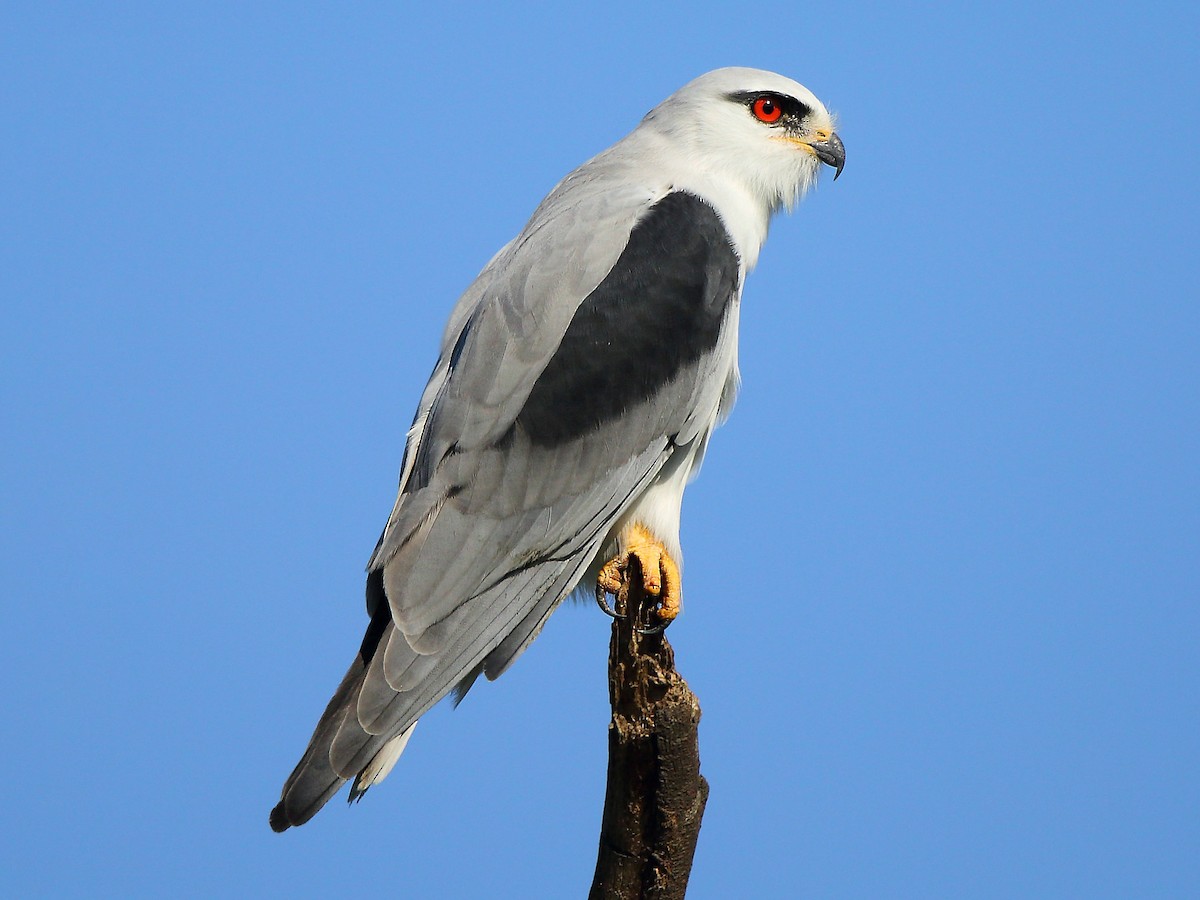
Where does the Black-shouldered Kite live?
Elanus caeruleus
Spotted a bird? Identify it instantly with the Birdby app
Open the appThe Black-shouldered Kite lives in specific habitats and regions. Knowing where, and when, to look improves your chances of a successful sighting.
Biomes
Grasslands, savannas, open woodlands, agricultural fields, semi-deserts, and cultivated areas.
Geographic range
Widespread across sub-Saharan Africa, parts of North Africa, the Iberian Peninsula (Spain and Portugal), and extensively across South and Southeast Asia, extending to New Guinea and Australia (where it is known as the Black-shouldered Kite or Australian Black-shouldered Kite, *Elanus axillaris*, though some consider it conspecific with *E. caeruleus*).
Preferred environments
Open country with scattered trees or bushes for perching and nesting, often near water sources. They thrive in areas with high rodent populations.
Elevation range
Typically found from sea level up to 2,000 meters, occasionally higher.
Where to look
Open Grasslands and Savannas
These are prime habitats where they hunt for rodents. Look for them hovering over fields.
Agricultural Areas
Cultivated lands, especially those with cereal crops or pastures, provide abundant prey. They often perch on fence posts or power lines.
Edges of Woodlands
They prefer open areas but use scattered trees or woodland edges for nesting and roosting.
Roadsides
Often seen perched on roadside poles, wires, or trees, scanning the verges for prey.
Field tips
- Look for hovering birds. Their distinctive kiting behavior is often the first clue to their presence. They can hover for extended periods, even in strong winds.
- Scan exposed perches. Check dead trees, power lines, fence posts, and tall bushes in open areas. They often sit conspicuously.
- Listen for calls. While not overly vocal, their high-pitched whistles can draw attention, especially during the breeding season.
- Observe during morning and late afternoon. These are their most active hunting periods.
- Check areas with high rodent populations. Where there are voles and mice, there are likely Black-shouldered Kites.
Migration
Mostly resident throughout its range, but some populations, particularly in the northern parts of its distribution (e.g., Iberian Peninsula), may undertake short-distance dispersive movements or irruptions in response to prey availability. African populations are largely sedentary.
Explore the Black-shouldered Kite
Identify birds anywhere
Free on iOS, Android, and Web. Photo & sound identification, full species database, and your personal life list.